
Sign In Start Free Trial
Account

Add to playlist

Create a Playlist

Modal Close icon
You need to login to use this feature.
  • Book Overview & Buying Next.js Quick Start Guide
  • Table Of Contents Toc
  • Feedback & Rating feedback
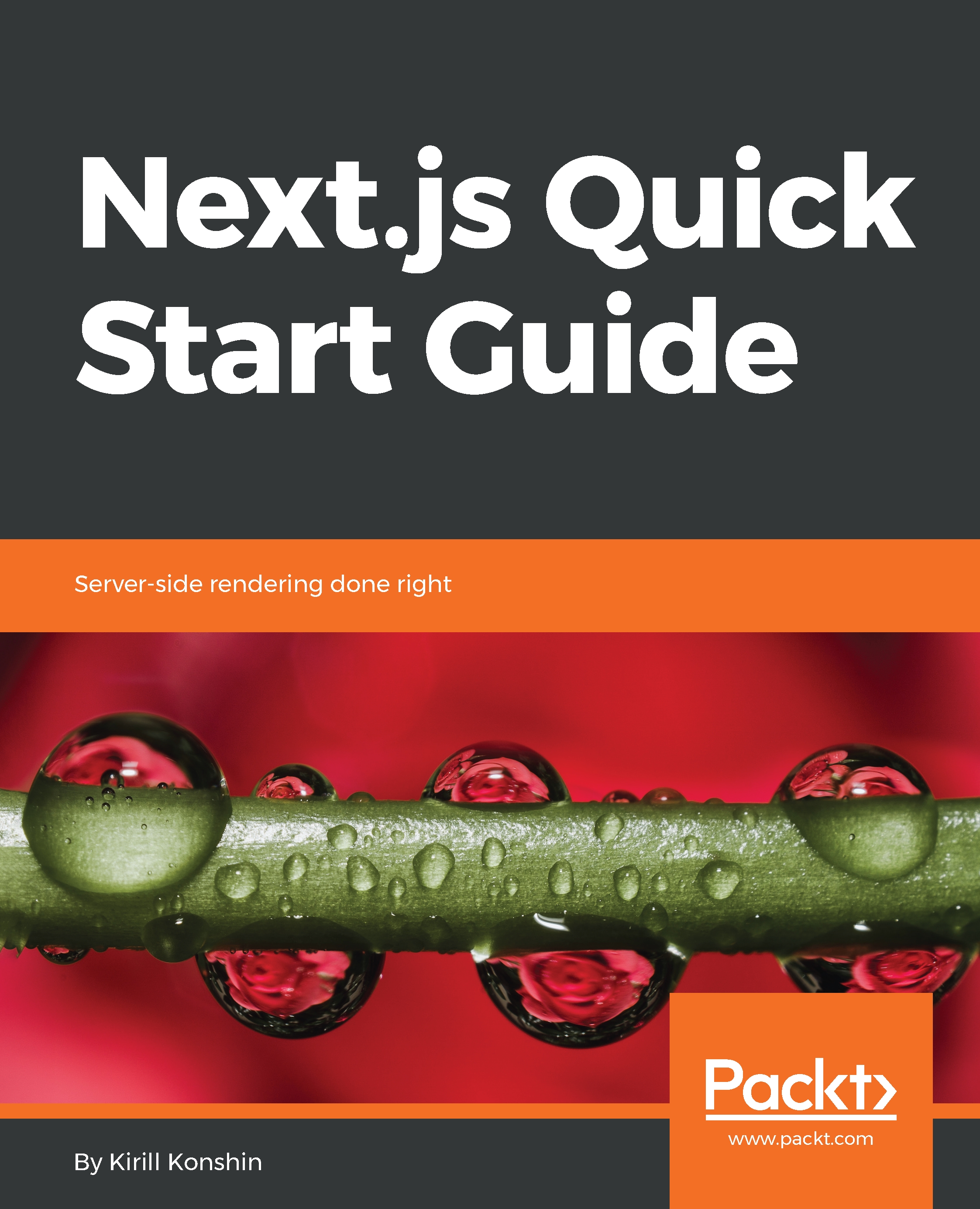
Next.js Quick Start Guide

Next.js Quick Start Guide

By : Konshin
1 (2)
close
close
Next.js Quick Start Guide

Next.js Quick Start Guide

1 (2)
By: Konshin

Overview of this book

Next.js is a powerful addition to the ever-growing and dynamic JavaScript world. Built on top of React, Webpack, and Babel, it is a minimalistic framework for server-rendered universal JavaScript applications. This book will show you the best practices for building sites using Next. js, enabling you to build SEO-friendly and superfast websites. This book will guide you from building a simple single page app to a scalable and reliable client-server infrastructure. You will explore code sharing between client and server, universal modules, and server-side rendering. The book will take you through the core Next.js concepts that everyone is talking about – hot reloading, code splitting, routing, server rendering, transpilation, CSS isolation, and more. You will learn ways of implementing them in order to create your own universal JavaScript application. You will walk through the building and deployment stages of your applications with the JSON API,customizing the confguration, error handling,data fetching, deploying to production, and authentication.
Table of Contents (9 chapters)
close
close

Installation of Next.js

First, create an empty project folder and initialize npm in it:

$ mkdir next-js-condensed
$ cd next-js-condensed
$ npm init

After that, let's install the Next.js package:

$ npm install nextjs@latest --save-dev
$ npm install react@latest react-dom@latest --save

We save Next.js to devDependencies to clearly separate dependencies for the client and for the server. Server-side dependencies will be in the devDependencies section; the client's will be in the regular section.

If you're using Git or any similar source control tool, it makes sense to add an ignore file that will remove the build artifacts folder from source control. We show an example .gitignore file here:

.DS_Store
.idea
.next
.vscode
build
coverage
node_modules
npm-debug*
out
yarn-debug*
yarn-error*

Visually different images
CONTINUE READING
83
Tech Concepts
36
Programming languages
73
Tech Tools
Icon Unlimited access to the largest independent learning library in tech of over 8,000 expert-authored tech books and videos.
Icon Innovative learning tools, including AI book assistants, code context explainers, and text-to-speech.
Icon 50+ new titles added per month and exclusive early access to books as they are being written.
Next.js Quick Start Guide
notes
bookmark Notes and Bookmarks search Search in title playlist Add to playlist download Download options font-size Font size

Change the font size

margin-width Margin width

Change margin width

day-mode Day/Sepia/Night Modes

Change background colour

Close icon Search
Country selected

Close icon Your notes and bookmarks

Confirmation

Modal Close icon
claim successful

Buy this book with your credits?

Modal Close icon
Are you sure you want to buy this book with one of your credits?
Close
YES, BUY

Submit Your Feedback

Modal Close icon
Modal Close icon
Modal Close icon