Sign In Start Free Trial
Account

Add to playlist

Create a Playlist

Modal Close icon
You need to login to use this feature.
  • Book Overview & Buying Python Microservices Development
  • Table Of Contents Toc
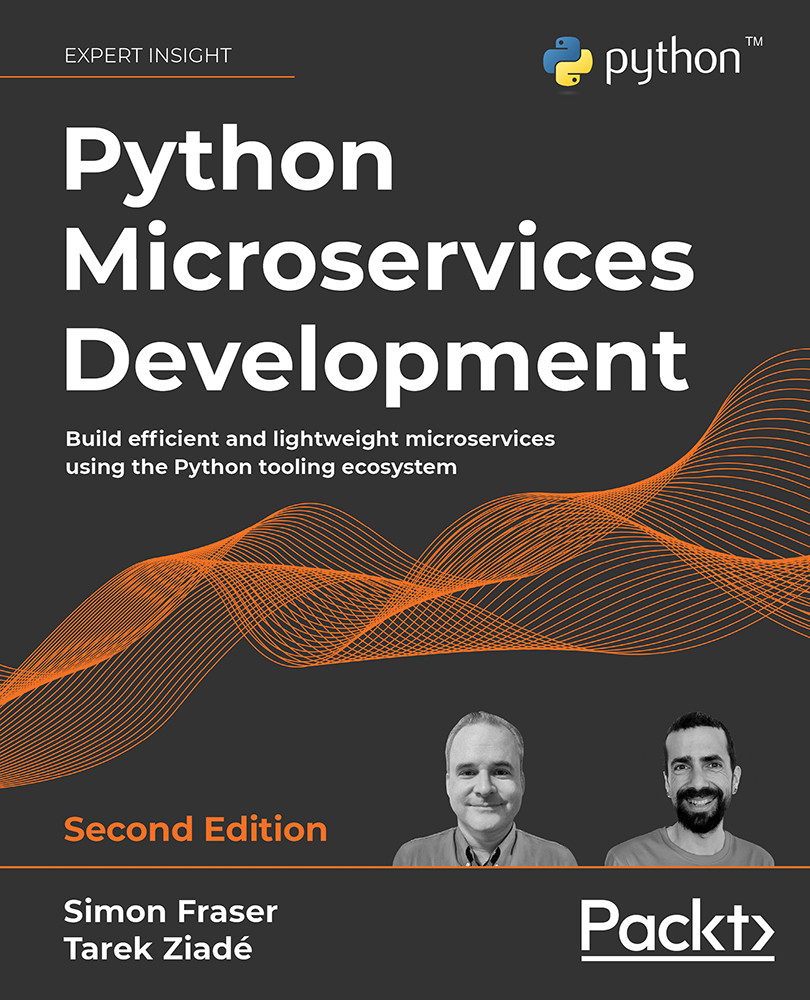
Python Microservices Development

Python Microservices Development - Second Edition

By : Simon Fraser, Tarek Ziadé
5 (3)
close
close
Python Microservices Development

Python Microservices Development

5 (3)
By: Simon Fraser, Tarek Ziadé

Overview of this book

The small scope and self-contained nature of microservices make them faster, cleaner, and more scalable than code-heavy monolithic applications. However, building microservices architecture that is efficient as well as lightweight into your applications can be challenging due to the complexity of all the interacting pieces. Python Microservices Development, Second Edition will teach you how to overcome these issues and craft applications that are built as small standard units using proven best practices and avoiding common pitfalls. Through hands-on examples, this book will help you to build efficient microservices using Quart, SQLAlchemy, and other modern Python tools In this updated edition, you will learn how to secure connections between services and how to script Nginx using Lua to build web application firewall features such as rate limiting. Python Microservices Development, Second Edition describes how to use containers and AWS to deploy your services. By the end of the book, you’ll have created a complete Python application based on microservices.
Table of Contents (14 chapters)
close
close
12
Other Books You May Enjoy
13
Index

Summary

In this chapter, we looked at how microservices can be containerized with containers, and how you can create a deployment entirely based on Docker images. Containers are a well-established technology that is widely used to run internet services. The most important thing to keep in mind is that a containerized application is ephemeral: it is designed to be destroyed and recreated on demand, and any data that is not externalized using a mount point is lost.

For provisioning and clustering your services, there is no generic solution, as the tools you use will depend on your needs. From a simple Docker Compose setup to a full Kubernetes cluster, each option provides different complexity and benefits. The best choice often depends on where you are to deploy your services, how your teams work, and how large your application needs to be in the present—there is no sense in planning for an unknowable future.

The best way to tackle this problem is to take baby...

CONTINUE READING
83
Tech Concepts
36
Programming languages
73
Tech Tools
Icon Unlimited access to the largest independent learning library in tech of over 8,000 expert-authored tech books and videos.
Icon Innovative learning tools, including AI book assistants, code context explainers, and text-to-speech.
Icon 50+ new titles added per month and exclusive early access to books as they are being written.
Python Microservices Development
notes
bookmark Notes and Bookmarks search Search in title playlist Add to playlist download Download options font-size Font size

Change the font size

margin-width Margin width

Change margin width

day-mode Day/Sepia/Night Modes

Change background colour

Close icon Search
Country selected

Close icon Your notes and bookmarks

Confirmation

Modal Close icon
claim successful

Buy this book with your credits?

Modal Close icon
Are you sure you want to buy this book with one of your credits?
Close
YES, BUY

Submit Your Feedback

Modal Close icon
Modal Close icon
Modal Close icon