Sign In Start Free Trial
Account

Add to playlist

Create a Playlist

Modal Close icon
You need to login to use this feature.
  • Book Overview & Buying Express Web Application Development
  • Table Of Contents Toc
  • Feedback & Rating feedback
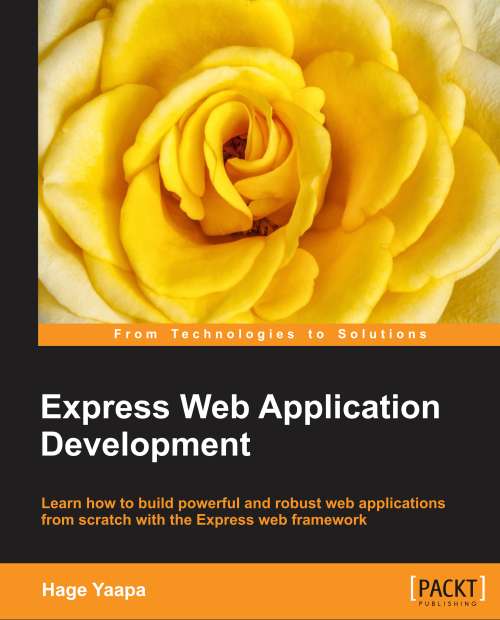
Express Web Application Development

Express Web Application Development

By : Hage Yaaapa
4.6 (11)
close
close
Express Web Application Development

Express Web Application Development

4.6 (11)
By: Hage Yaaapa

Overview of this book

Express is a minimal and flexible node.js web application framework, providing a robust set of features for building single and multi-page, and hybrid web applications. It provides a thin layer of features fundamental to any web application, without obscuring features that developers know and love in node.js. "Express Web Application Development" is a comprehensive guide for those looking to learn how to use the Express web framework for web application development. Starting with the initial setup of the Express web framework, "Express Web Application Development" helps you to understand the fundamentals of the framework. By the end of "Express Web Application Development", you will have acquired enough knowledge and skills to create production-ready Express apps. All of this is made possible by the incremental introduction of more advanced topics, starting from the very essentials. On the way to mastering Express for application development, we teach you the more advanced topics such as routes, views, middleware, forms, sessions, cookies and various other aspects of configuring an Express application. Jade; the recommended HTML template engine, and Stylus; the CSS pre-processor for Express, are covered in detail. Last, but definitely not least, Express Web Application Development also covers practices and setups that are required to make Express apps production-ready.
Table of Contents (15 chapters)
close
close
Express Web Application Development
Credits
About the Author
About the Reviewers
www.PacktPub.com
Preface
1
Index

Rules


Stylus implements a superset of various CSS rules, and includes some of its own.

@import

@import can either be used to import CSS or Stylus files. When importing CSS files, the rule works in the regular CSS context. When importing Stylus files, the contents of the included files are parsed and included in the generated CSS file.

Note

The import path is relative to the directory of the file applying the import rule.

Importing a CSS file is done just by using the regular CSS @import rule:

@import "common.css"

If the file extension is .styl or it is omitted, it is assumed to be a Style file, and the content of the included file is rendered in the generated file.

Say, this is the content of special.styl:

.special
  border: 1px solid red

And this, the content of style.styl:

@import "special"

When style.css is called, the following will be generated:

.special {
  border: 1px solid #f00;
}

To modularize Stylus imports, we can use indexed directories. In such cases, we just have to mention the name of...

Visually different images
CONTINUE READING
83
Tech Concepts
36
Programming languages
73
Tech Tools
Icon Unlimited access to the largest independent learning library in tech of over 8,000 expert-authored tech books and videos.
Icon Innovative learning tools, including AI book assistants, code context explainers, and text-to-speech.
Icon 50+ new titles added per month and exclusive early access to books as they are being written.
Express Web Application Development
notes
bookmark Notes and Bookmarks search Search in title playlist Add to playlist font-size Font size

Change the font size

margin-width Margin width

Change margin width

day-mode Day/Sepia/Night Modes

Change background colour

Close icon Search
Country selected

Close icon Your notes and bookmarks

Confirmation

Modal Close icon
claim successful

Buy this book with your credits?

Modal Close icon
Are you sure you want to buy this book with one of your credits?
Close
YES, BUY

Submit Your Feedback

Modal Close icon
Modal Close icon
Modal Close icon