
Sign In Start Free Trial
Account

Add to playlist

Create a Playlist

Modal Close icon
You need to login to use this feature.
  • Book Overview & Buying Phoenix Web Development
  • Table Of Contents Toc
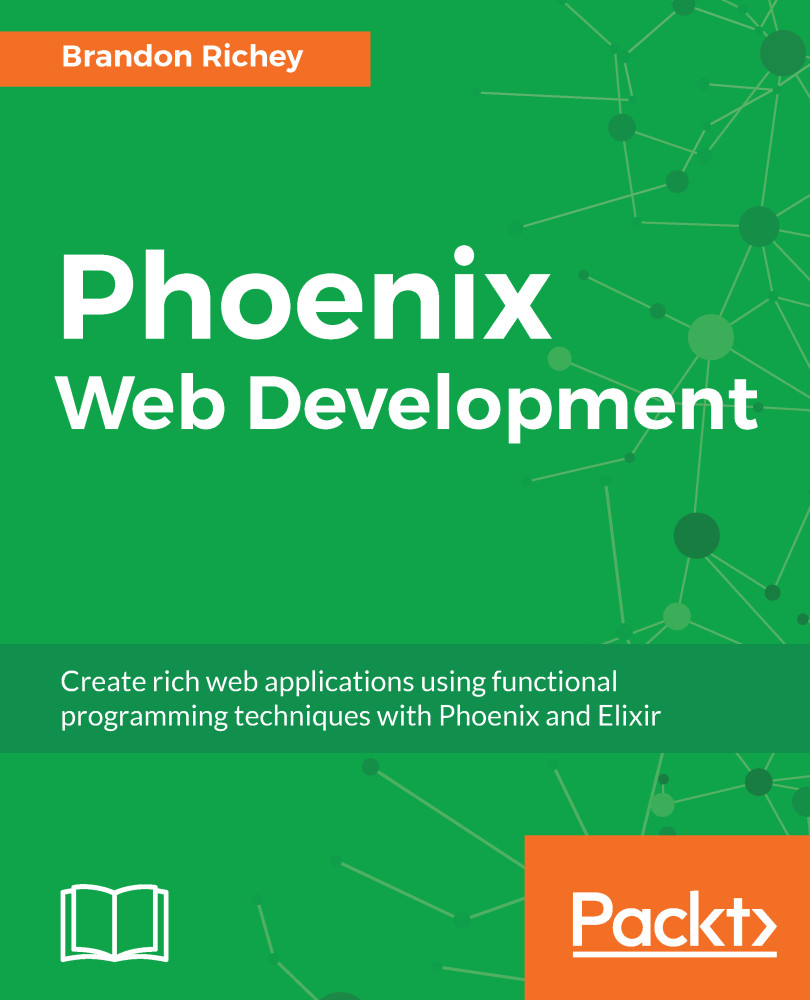
Phoenix Web Development

Phoenix Web Development

By : Brandon Richey
close
close
Phoenix Web Development

Phoenix Web Development

By: Brandon Richey

Overview of this book

Phoenix is a modern web development framework that is used to build API’s and web applications. It is built on Elixir and runs on Erlang VM which makes it much faster than other options. With Elixir and Phoenix, you build your application the right way, ready to scale and ready for the increasing demands of real-time web applications. This book covers the basics of the Phoenix web framework, showing you how to build a community voting application, and is divided into three parts. In the first part, you will be introduced to Phoenix and Elixir and understand the core terminologies that are used to describe them. You will also learn to build controller pages, store and retrieve data, add users to your app pages and protect your database. In the second section you will be able to reinforce your knowledge of architecting real time applications in phoenix and not only debug these applications but also diagnose issues in them. In the third and final section you will have the complete understanding of deploying and running the phoenix application and should be comfortable to make your first application release By the end of this book, you'll have a strong grasp of all of the core fundamentals of the Phoenix framework, and will have built a full production-ready web application from scratch.
Table of Contents (14 chapters)
close
close
4
Introducing User Accounts and Sessions

Validations, Errors, and Tying Loose Ends

In the previous chapter, we worked on how to add user accounts to our web app, as well as how to add a new Hex package to our project to help us deal with password encryption.

In this chapter, we're going to spend some time putting the rest of everything together, filling the gaps we left in the previous chapter and then building on top of our application a little more. We'll work on cleaning up the interconnectivity of the different schemas and contexts and doing a better job of making sure our tests are sufficiently cover the majority of our application.

Finally, we'll do a deep dive into the different validation methods provided to us by Ecto out of the box (validation, in this case, meaning the validation of data before it is inserted into the database). We'll also work on improving user experience by displaying...

Visually different images
CONTINUE READING
83
Tech Concepts
36
Programming languages
73
Tech Tools
Icon Unlimited access to the largest independent learning library in tech of over 8,000 expert-authored tech books and videos.
Icon Innovative learning tools, including AI book assistants, code context explainers, and text-to-speech.
Icon 50+ new titles added per month and exclusive early access to books as they are being written.
Phoenix Web Development
notes
bookmark Notes and Bookmarks search Search in title playlist Add to playlist download Download options font-size Font size

Change the font size

margin-width Margin width

Change margin width

day-mode Day/Sepia/Night Modes

Change background colour

Close icon Search
Country selected

Close icon Your notes and bookmarks

Confirmation

Modal Close icon
claim successful

Buy this book with your credits?

Modal Close icon
Are you sure you want to buy this book with one of your credits?
Close
YES, BUY

Submit Your Feedback

Modal Close icon
Modal Close icon
Modal Close icon