


In this chapter, we looked at how to use sklearn and Keras, how to import data from a UCI repository using the pandas read_csv function, and how to preprocess that data. One of the ways to handle missing data, whether in healthcare applications or not, is to remove the rows or instances that have missing attributes. We then learned how to describe the data and print out histograms so we know what we're working with, followed by doing a train/test split with model_selection from sklearn. Furthermore, we also learned how to convert one-hot encoded vectors for a categorical classification, by defining simple neural networks using Keras. We then looked at types of activation function, such as softmax, for categorical classifications with categorical_crossentropy. In contrast, when we got to our binary classification, we used a sigmoid activation function and a binary_crossentropy...
-
Book Overview & Buying
-
Table Of Contents

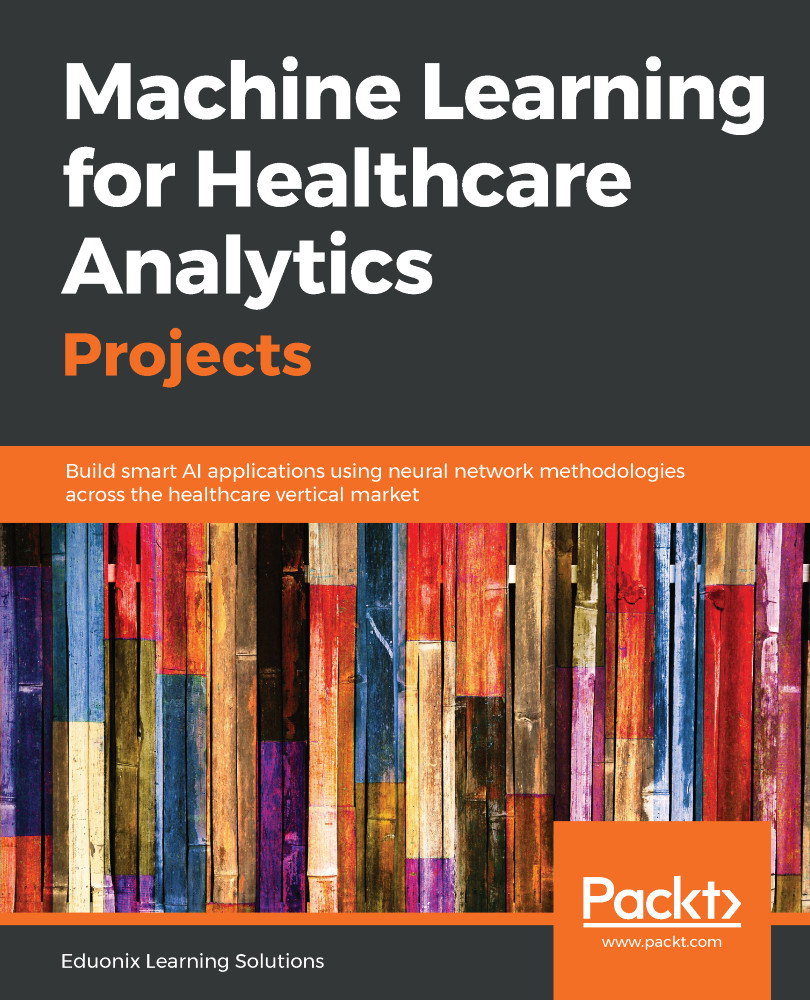
Machine Learning for Healthcare Analytics Projects


Machine Learning for Healthcare Analytics Projects
Overview of this book
Machine Learning (ML) has changed the way organizations and individuals use data to improve the efficiency of a system. ML algorithms allow strategists to deal with a variety of structured, unstructured, and semi-structured data. Machine Learning for Healthcare Analytics Projects is packed with new approaches and methodologies for creating powerful solutions for healthcare analytics.
This book will teach you how to implement key machine learning algorithms and walk you through their use cases by employing a range of libraries from the Python ecosystem. You will build five end-to-end projects to evaluate the efficiency of Artificial Intelligence (AI) applications for carrying out simple-to-complex healthcare analytics tasks. With each project, you will gain new insights, which will then help you handle healthcare data efficiently. As you make your way through the book, you will use ML to detect cancer in a set of patients using support vector machines (SVMs) and k-Nearest neighbors (KNN) models. In the final chapters, you will create a deep neural network in Keras to predict the onset of diabetes in a huge dataset of patients. You will also learn how to predict heart diseases using neural networks.
By the end of this book, you will have learned how to address long-standing challenges, provide specialized solutions for how to deal with them, and carry out a range of cognitive tasks in the healthcare domain.
Table of Contents (7 chapters)
Preface

 Free Chapter
Breast Cancer Detection
Diabetes Onset Detection
DNA Classification
Diagnosing Coronary Artery Disease

Autism Screening with Machine Learning
Another Book You May Enjoy


