


-
Book Overview & Buying
-
Table Of Contents

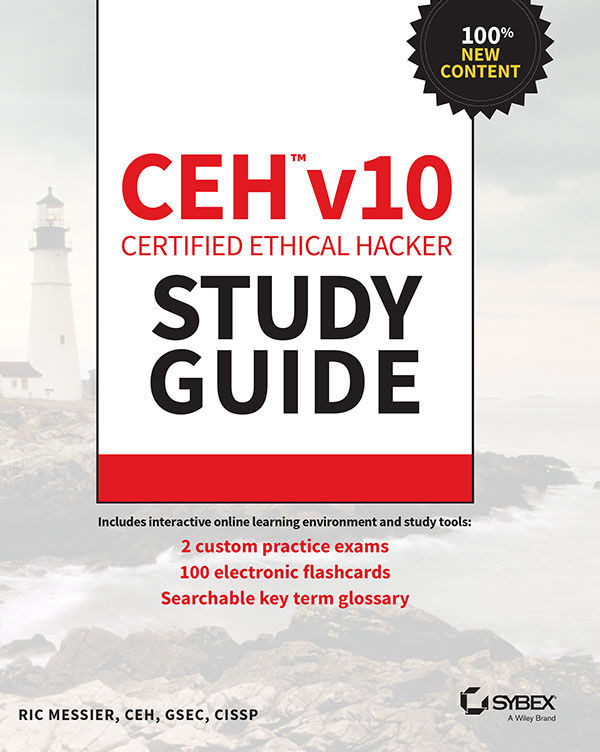
CEH v10 Certified Ethical Hacker Study Guide
By :


CEH v10 Certified Ethical Hacker Study Guide
By:
Overview of this book
As protecting information becomes a rapidly growing concern for today’s businesses, certifications in IT security have become highly desirable, even as the number of certifications has grown. Now you can set yourself apart with the Certified Ethical Hacker (CEH v10) certification. The CEH v10 Certified Ethical Hacker Study Guide offers a comprehensive overview of the CEH certification requirements using concise and easy-to-follow instructions. Chapters are organized by exam objective, with a handy section that maps each objective to its corresponding chapter, so you can keep a track of your progress. The text provides thorough coverage of all topics, along with challenging chapter review questions and Exam Essentials, a key feature that identifies critical study areas. Subjects include intrusion detection, DDoS attacks, buffer overflows, virus creation, and more.
This study guide goes beyond test prep, providing practical hands-on exercises to reinforce vital skills and real-world scenarios that put what you’ve learned into the context of actual job roles.
By the end of the book, you’ll have all the information and knowledge you need to pass this test with flying colors
Table of Contents (23 chapters)


About the Author

Introduction
Assessment Test
Answers to Assessment Test
Chapter 1 Ethical Hacking
Chapter 2 Networking Foundations

Chapter 3 Security Foundations
Chapter 4 Footprinting and Reconnaissance
Chapter 5 Scanning Networks
Chapter 6 Enumeration
Chapter 7 System Hacking
Chapter 8 Malware
Chapter 9 Sniffing
Chapter 10 Social Engineering
Chapter 11 Wireless Security
Chapter 12 Attack and Defense
Chapter 13 Cryptography
Chapter 14 Security Architecture and Design
Index
Comprehensive Online Learning Environment
End User License Agreement
Appendix Answers to Review Questions


