Sign In Start Free Trial
Account

Add to playlist

Create a Playlist

Modal Close icon
You need to login to use this feature.
  • Book Overview & Buying Getting Started with Powershell
  • Table Of Contents Toc
Getting Started with Powershell

Getting Started with Powershell

By : Michael Shepard
1 (1)
close
close
Getting Started with Powershell

Getting Started with Powershell

1 (1)
By: Michael Shepard

Overview of this book

Windows PowerShell is a task-based command-line shell and scripting language designed specifically for system administration. Built on the .NET Framework, Windows PowerShell helps IT professionals and power users control and automate the administration of the Windows operating system and applications that run on Windows. PowerShell is great for batch importing or deleting large sets of user accounts and will let you collect a massive amount of detailed system information in bulk via WMI (Windows Management Instrumentation). Getting Started with PowerShell is designed to help you get up and running with PowerShell, taking you from the basics of installation, to writing scripts and web server automation. This book, as an introduction to the central topics of PowerShell, covers finding and understanding PowerShell commands and packaging code for reusability, right through to a practical example of automating IIS. It also includes topics such as installation and setup, creating scripts, automating tasks, and using Powershell to access data stores, registry, and file systems. You will explore the PowerShell environment and discover how to use cmdlets, functions, and scripts to automate Windows systems. Along the way, you will learn to perform data manipulation and solve common problems using basic file input/output functions. By the end of this book, you will be familiar with PowerShell and be able to utilize the lessons learned from the book to automate your servers.
Table of Contents (14 chapters)
close
close
12
A. Next Steps
13
Index

Executing and calling functions


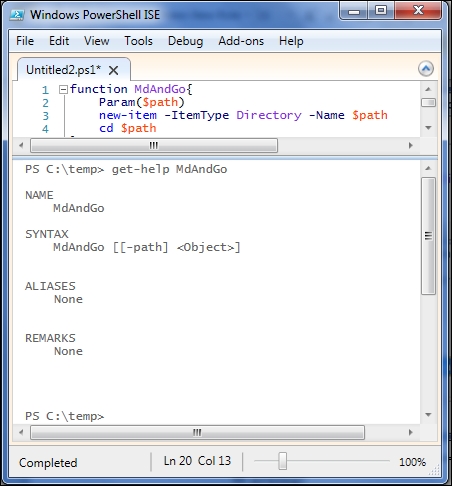
As seen in figure in the Comparing scripts and functions section, defining a function involves using the function keyword and surrounding the code you want with a scriptblock. Executing this function statement simply adds the function definition to the current PowerShell session. To subsequently call the function, you use the function name like you would a cmdlet name, and supply parameters and arguments just like you would for a cmdlet or script.

Tip

Storing the MdAndGo function in a file called MdAndGo.ps1 can be confusing because we're using the same name for the two things. You dot-source the ps1 file to load the function into the session, then you can execute this function. Dot-sourcing the file doesn't run the function. If we had written this as a script, on the other hand, we could have executed the logic of the script without dot-sourcing.

Tip

Warning!

A common mistake of new PowerShell users is to call a function using parentheses to surround the parameters...

CONTINUE READING
83
Tech Concepts
36
Programming languages
73
Tech Tools
Icon Unlimited access to the largest independent learning library in tech of over 8,000 expert-authored tech books and videos.
Icon Innovative learning tools, including AI book assistants, code context explainers, and text-to-speech.
Icon 50+ new titles added per month and exclusive early access to books as they are being written.
Getting Started with Powershell
notes
bookmark Notes and Bookmarks search Search in title playlist Add to playlist download Download options font-size Font size

Change the font size

margin-width Margin width

Change margin width

day-mode Day/Sepia/Night Modes

Change background colour

Close icon Search
Country selected

Close icon Your notes and bookmarks

Confirmation

Modal Close icon
claim successful

Buy this book with your credits?

Modal Close icon
Are you sure you want to buy this book with one of your credits?
Close
YES, BUY

Submit Your Feedback

Modal Close icon
Modal Close icon
Modal Close icon