Sign In Start Free Trial
Account

Add to playlist

Create a Playlist

Modal Close icon
You need to login to use this feature.
  • Book Overview & Buying Learning Network Programming with Java
  • Table Of Contents Toc
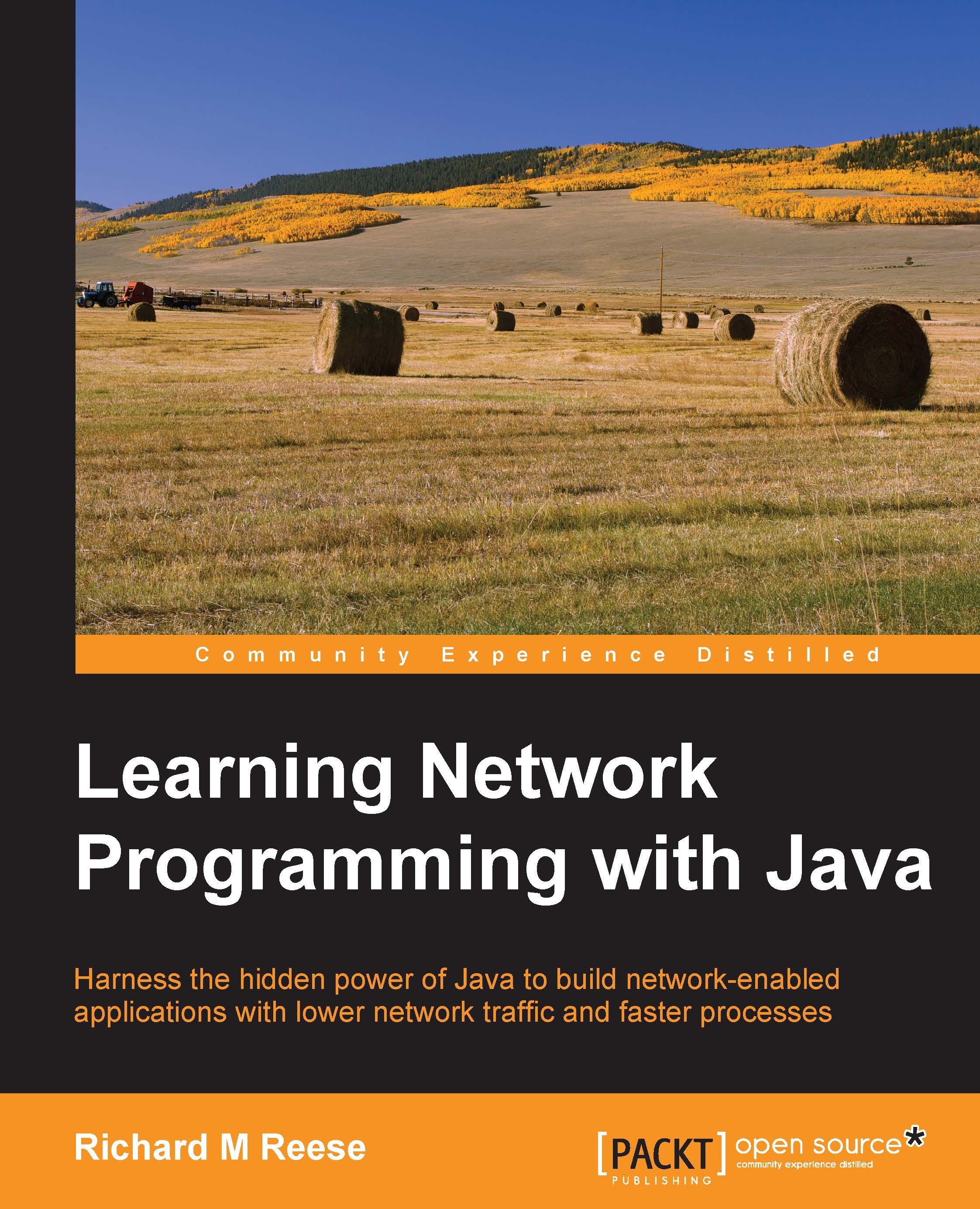
Learning Network Programming with Java

Learning Network Programming with Java

By : Richard M Reese
4.3 (4)
close
close
Learning Network Programming with Java

Learning Network Programming with Java

4.3 (4)
By: Richard M Reese

Overview of this book

Network-aware applications are becoming more prevalent and play an ever-increasing role in the world today. Connecting and using an Internet-based service is a frequent requirement for many applications. Java provides numerous classes that have evolved over the years to meet evolving network needs. These range from low-level socket and IP-based approaches to those encapsulated in software services. This book explores how Java supports networks, starting with the basics and then advancing to more complex topics. An overview of each relevant network technology is presented followed by detailed examples of how to use Java to support these technologies. We start with the basics of networking and then explore how Java supports the development of client/server and peer-to-peer applications. The NIO packages are examined as well as multitasking and how network applications can address practical issues such as security. A discussion on networking concepts will put many network issues into perspective and let you focus on the appropriate technology for the problem at hand. The examples used will provide a good starting point to develop similar capabilities for many of your network needs
Table of Contents (11 chapters)
close
close
10
Index

Security


There are many security related terms whose meaning and purpose can be daunting when they are first encountered. Most of these terms are applicable to network applications. We will start with a brief overview of many of these terms. In later sections of this chapter, we will go into more details about the ones that are relevant to our discussion.

Central to most security related issues is encryption. This is the process of converting information that needs to be protected to an encrypted form using a key or a set of keys. The receiver of the encrypted information can use a key or set of keys to decrypt the information and revert it to its original form. This technique will prevent unauthorized access to the information.

We will demonstrate the use of both symmetric and asymmetric encryption techniques. Symmetric encryption uses a single key to encrypt and decrypt messages. Asymmetric encryption uses a pair of keys. These keys are frequently stored in a file called a keystore, which...

CONTINUE READING
83
Tech Concepts
36
Programming languages
73
Tech Tools
Icon Unlimited access to the largest independent learning library in tech of over 8,000 expert-authored tech books and videos.
Icon Innovative learning tools, including AI book assistants, code context explainers, and text-to-speech.
Icon 50+ new titles added per month and exclusive early access to books as they are being written.
Learning Network Programming with Java
notes
bookmark Notes and Bookmarks search Search in title playlist Add to playlist font-size Font size

Change the font size

margin-width Margin width

Change margin width

day-mode Day/Sepia/Night Modes

Change background colour

Close icon Search
Country selected

Close icon Your notes and bookmarks

Confirmation

Modal Close icon
claim successful

Buy this book with your credits?

Modal Close icon
Are you sure you want to buy this book with one of your credits?
Close
YES, BUY

Submit Your Feedback

Modal Close icon
Modal Close icon
Modal Close icon