
Sign In Start Free Trial
Account

Add to playlist

Create a Playlist

Modal Close icon
You need to login to use this feature.
  • Book Overview & Buying Boost C++ Application Development  Cookbook
  • Table Of Contents Toc
Boost C++ Application Development  Cookbook

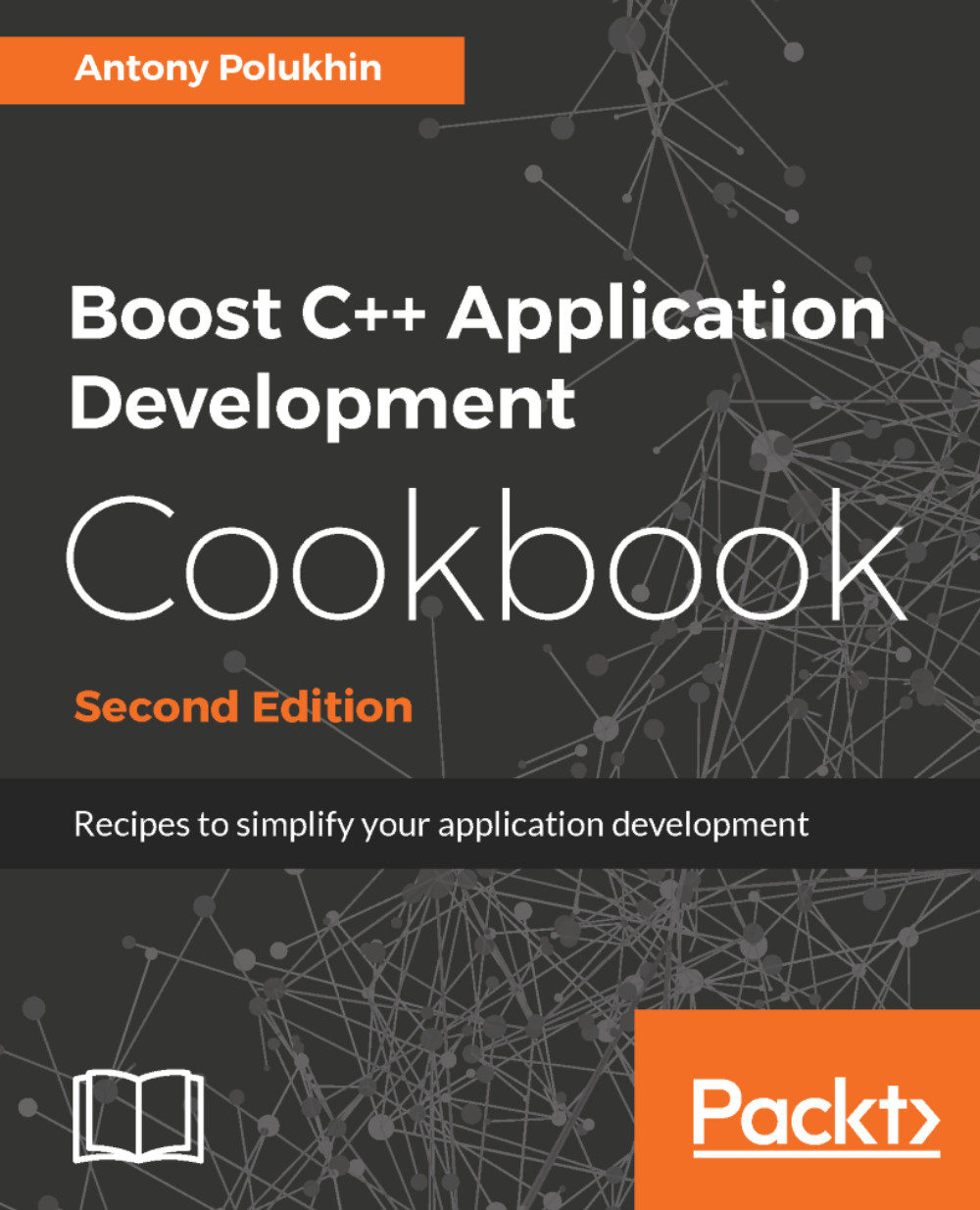
Boost C++ Application Development Cookbook - Second Edition

By : Anton Polukhin Alekseevic
4.2 (5)
close
close
Boost C++ Application Development  Cookbook

Boost C++ Application Development Cookbook

4.2 (5)
By: Anton Polukhin Alekseevic

Overview of this book

If you want to take advantage of the real power of Boost and C++ and avoid the confusion about which library to use in which situation, then this book is for you. Beginning with the basics of Boost C++, you will move on to learn how the Boost libraries simplify application development. You will learn to convert data such as string to numbers, numbers to string, numbers to numbers and more. Managing resources will become a piece of cake. You’ll see what kind of work can be done at compile time and what Boost containers can do. You will learn everything for the development of high quality fast and portable applications. Write a program once and then you can use it on Linux, Windows, MacOS, Android operating systems. From manipulating images to graphs, directories, timers, files, networking – everyone will find an interesting topic. Be sure that knowledge from this book won’t get outdated, as more and more Boost libraries become part of the C++ Standard.
Table of Contents (13 chapters)
close
close

Enabling function template usage for integral types

It's a common situation, when we have a class template that implements some functionality:

// Generic implementation.
template <class T>
class data_processor {
double process(const T& v1, const T& v2, const T& v3);
};

Now, imagine that we have two additional versions of that class, one for integral, and another for real types:

// Integral types optimized version. 
template <class T>
class data_processor_integral {
typedef int fast_int_t;
double process(fast_int_t v1, fast_int_t v2, fast_int_t v3);
};

// SSE optimized version for float types.
template <class T>
class data_processor_sse {
double process(double v1, double v2, double v3);
};

Now the question: How to make the compiler to automatically choose the correct class for a specified type?

...
CONTINUE READING
83
Tech Concepts
36
Programming languages
73
Tech Tools
Icon Unlimited access to the largest independent learning library in tech of over 8,000 expert-authored tech books and videos.
Icon Innovative learning tools, including AI book assistants, code context explainers, and text-to-speech.
Icon 50+ new titles added per month and exclusive early access to books as they are being written.
Boost C++ Application Development  Cookbook
notes
bookmark Notes and Bookmarks search Search in title playlist Add to playlist font-size Font size

Change the font size

margin-width Margin width

Change margin width

day-mode Day/Sepia/Night Modes

Change background colour

Close icon Search
Country selected

Close icon Your notes and bookmarks

Confirmation

Modal Close icon
claim successful

Buy this book with your credits?

Modal Close icon
Are you sure you want to buy this book with one of your credits?
Close
YES, BUY

Submit Your Feedback

Modal Close icon
Modal Close icon
Modal Close icon