
Sign In Start Free Trial
Account

Add to playlist

Create a Playlist

Modal Close icon
You need to login to use this feature.
  • Book Overview & Buying Continuous Integration, Delivery, and Deployment
  • Table Of Contents Toc
Continuous Integration, Delivery, and Deployment

Continuous Integration, Delivery, and Deployment

By : Rossel
4 (8)
close
close
Continuous Integration, Delivery, and Deployment

Continuous Integration, Delivery, and Deployment

4 (8)
By: Rossel

Overview of this book

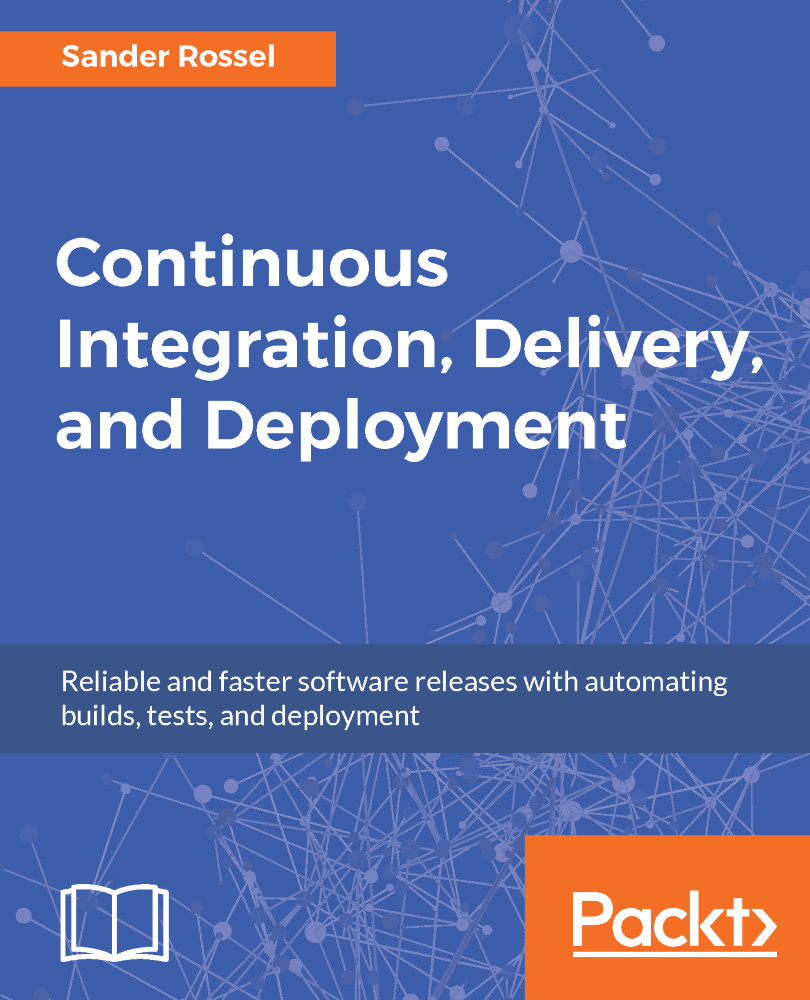
The challenge faced by many teams while implementing Continuous Deployment is that it requires the use of many tools and processes that all work together. Learning and implementing all these tools (correctly) takes a lot of time and effort, leading people to wonder whether it's really worth it. This book sets up a project to show you the different steps, processes, and tools in Continuous Deployment and the actual problems they solve. We start by introducing Continuous Integration (CI), deployment, and delivery as well as providing an overview of the tools used in CI. You'll then create a web app and see how Git can be used in a CI environment. Moving on, you'll explore unit testing using Jasmine and browser testing using Karma and Selenium for your app. You'll also find out how to automate tasks using Gulp and Jenkins. Next, you'll get acquainted with database integration for different platforms, such as MongoDB and PostgreSQL. Finally, you'll set up different Jenkins jobs to integrate with Node.js and C# projects, and Jenkins pipelines to make branching easier. By the end of the book, you'll have implemented Continuous Delivery and deployment from scratch.
Table of Contents (15 chapters)
close
close

JavaScript Deployment using SSH

The first thing we need to do is get out artifacts from our Jenkins build to where we want them fully automated. Usually, this will be some remote server, but we do not have that. However, what we will do is to pretend that our local Linux machine is some other remote Linux machine and transfer the files using SSH.

First, in our master Jenkinsfile, we will need to unpack our artifacts so that we can copy them at all. Jenkins will mention that unarchive is deprecated and replaced for most purposes by stash and unstash. As far as I know, stash and unstash are temporary for the duration of the build, while archive keeps your artifacts even when the build is complete. We need the archive because we always want to know what is currently running on production and maybe because we want to be able to manually deploy files as well. The only way to get your...

Visually different images
CONTINUE READING
83
Tech Concepts
36
Programming languages
73
Tech Tools
Icon Unlimited access to the largest independent learning library in tech of over 8,000 expert-authored tech books and videos.
Icon Innovative learning tools, including AI book assistants, code context explainers, and text-to-speech.
Icon 50+ new titles added per month and exclusive early access to books as they are being written.
Continuous Integration, Delivery, and Deployment
notes
bookmark Notes and Bookmarks search Search in title playlist Add to playlist download Download options font-size Font size

Change the font size

margin-width Margin width

Change margin width

day-mode Day/Sepia/Night Modes

Change background colour

Close icon Search
Country selected

Close icon Your notes and bookmarks

Confirmation

Modal Close icon
claim successful

Buy this book with your credits?

Modal Close icon
Are you sure you want to buy this book with one of your credits?
Close
YES, BUY

Submit Your Feedback

Modal Close icon
Modal Close icon
Modal Close icon