


-
Book Overview & Buying
-
Table Of Contents

SAFe® for DevOps Practitioners
By :


SAFe® for DevOps Practitioners
By:
Overview of this book
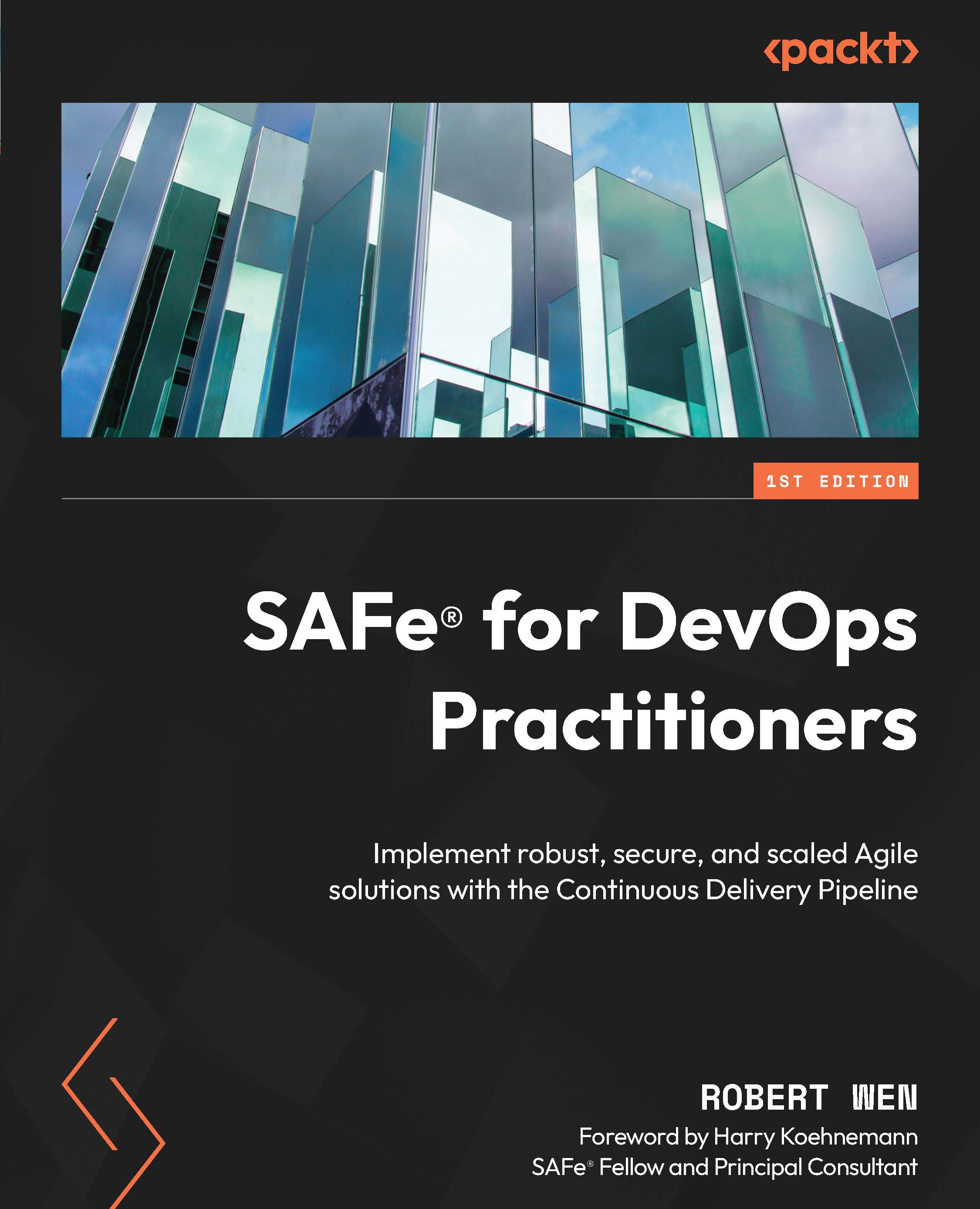
Product development and release faces overlapping challenges due to the combined pressure of delivering high-quality products in shorter time-to-market cycles, along with maintaining proper operation and ensuring security in a complex high-tech environment. This calls for new ways of overcoming these challenges from design to development, to release, and beyond. SAFe® for DevOps Practitioners helps you use a DevOps approach with the Scaled Agile Framework and details how value streams help you resolve these challenges using examples and use cases.
The book begins by explaining how the CALMR approach makes DevOps effective in resolving product development roadblocks. Next, you’ll learn to apply value stream management to establish a value stream that enables product development flow, measure its effectiveness through appropriate feedback loops, and find ways of improving it. Finally, you’ll get to grips with implementing a continuous delivery pipeline that optimizes the value stream through four phases during release on demand. This book complements the latest SAFe DevOps courses, and you’ll find it useful while studying for the SAFe DevOps Practitioner (SDP) certification.
By the end of this DevOps book, you’ll have gained a clear understanding of how to achieve continuous execution and release on demand using DevOps and SAFe.
Table of Contents (21 chapters)
Preface


Chapter 1: Introducing SAFe® and DevOps
 Free Chapter
Part 1 Approach – A Look at DevOps and SAFe® through CALMR
Chapter 2: Culture of Shared Responsibility
Chapter 3: Automation for Efficiency and Quality
Chapter 4: Leveraging Lean Flow to Keep the Work Moving
Chapter 5: Measuring the Process and Solution
Chapter 6: Recovering from Production Failures
Part 2:Implement – Moving Toward Value Streams
Chapter 7: Mapping Your Value Streams
Chapter 8: Measuring Value Stream Performance
Chapter 9: Moving to the Future with Continuous Learning
Part 3:Optimize – Enabling a Continuous Delivery Pipeline
Chapter 10: Continuous Exploration and Finding New Features

Chapter 11: Continuous Integration of Solution Development
Chapter 12: Continuous Deployment to Production
Chapter 13: Releasing on Demand to Realize Value
Chapter 14: Avoiding Pitfalls and Diving into the Future
Assessment Answers
Index


