Sign In Start Free Trial
Account

Add to playlist

Create a Playlist

Modal Close icon
You need to login to use this feature.
  • Book Overview & Buying Linux Kernel Programming
  • Table Of Contents Toc
Linux Kernel Programming

Linux Kernel Programming - Second Edition

By : Kaiwan N. Billimoria
4.9 (34)
close
close
Linux Kernel Programming

Linux Kernel Programming

4.9 (34)
By: Kaiwan N. Billimoria

Overview of this book

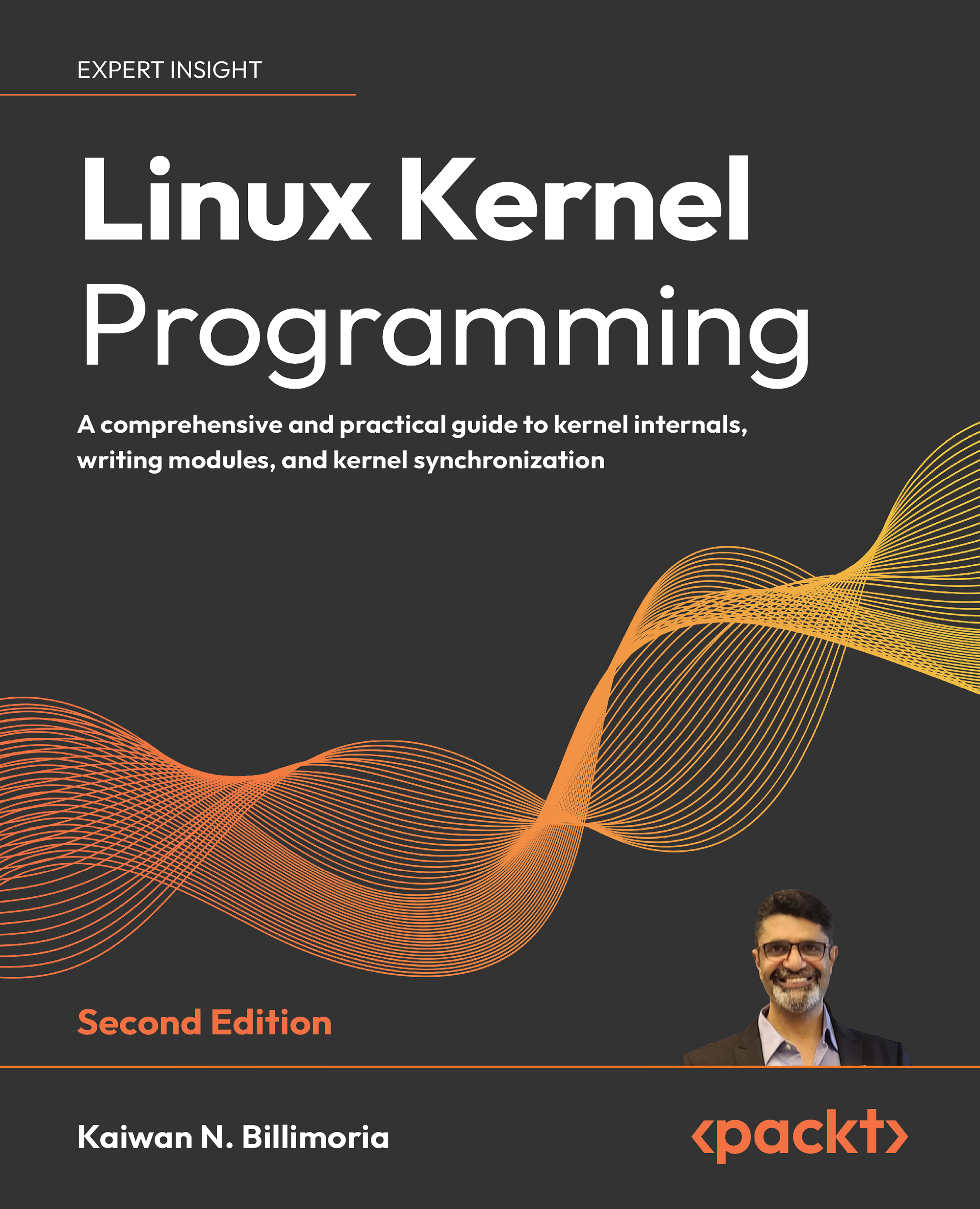
The 2nd Edition of Linux Kernel Programming is an updated, comprehensive guide for those new to Linux kernel development. Built around the latest 6.1 Long-Term Support (LTS) Linux kernel, which is maintained until December 2026, this edition explores its key features and enhancements. Additionally, with the Civil Infrastructure Project extending support for the 6.1 Super LTS (SLTS) kernel until August 2033, this book will remain relevant for years to come. You'll begin this exciting journey by learning how to build the kernel from source. Step by step, you will then learn how to write your first kernel module by leveraging the kernel's powerful Loadable Kernel Module (LKM) framework. With this foundation, you will delve into key kernel internals topics including Linux kernel architecture, memory management, and CPU (task) scheduling. You'll finish with understanding the deep issues of concurrency, and gain insight into how they can be addressed with various synchronization/locking technologies (for example, mutexes, spinlocks, atomic/refcount operators, rw-spinlocks and even lock-free technologies such as per-CPU and RCU). By the end of this book, you'll build a strong understanding of the fundamentals to writing the Linux kernel and kernel module code that can straight away be used in real-world projects and products.
Table of Contents (17 chapters)
close
close
15
Other Books You May Enjoy
16
Index

Building the 6.x Linux Kernel from Source – Part 1

Building the Linux kernel from source code is an interesting way to begin your kernel development journey! Be assured, the journey’s a long and arduous one, but that’s the fun of it, right? The topic of kernel building itself is large enough to merit being divided into two chapters, this one and the next.

Recall what we have learned till now in the extended first chapter that has been published online (http://www.packtpub.com/sites/default/files/downloads/9781803232225_Online_Chapter.pdf): primarily, how to set the workspace for Linux kernel programming. You have also been introduced to user and kernel documentation sources and several useful projects that go hand-in-hand with kernel/driver development. By now, I assume you’ve completed the chapter that has been published online, and thus the setup of the workspace environment; if not, please do so before proceeding forward.

The primary purpose of this chapter and the next is to describe in detail how exactly you can build a modern Linux kernel from scratch using source code. In this chapter, you will first learn about the required basics: the kernel version nomenclature, development workflow, and the different types of source trees. Then, we’ll get hands-on: you’ll learn how to download a stable vanilla Linux kernel source tree onto a guest Linux Virtual Machine (VM). By “vanilla kernel,” we mean the plain and regular default kernel source code released by the Linux kernel community on its repository, https://www.kernel.org. After that, you will learn a little bit about the layout of the kernel source code – getting, in effect, a 10,000-foot view of the kernel code base. The actual kernel build recipe then follows.

Before proceeding, a key piece of information: any modern Linux system, be it a supercomputer or a tiny, embedded device, has three required components:

  • A bootloader
  • An Operating System (OS) kernel
  • A root filesystem

It additionally has two optional components:

  • If the processor family is ARM or PPC (32- or 64-bit), a Device Tree Blob (DTB) image file
  • An initramfs (or initrd) image file

In these two chapters, we concern ourselves only with the building of the OS (Linux) kernel from source code. We do not delve into the root filesystem details. In the next chapter, we will learn how to minimally configure the x86-specific GNU GRUB bootloader.

The complete kernel build process – for x86[_64] at least – requires a total of six or seven steps. Besides the required preliminaries, we cover the first three here and the remaining in the next chapter.

In this chapter, we will cover the following topics:

  • Preliminaries for the kernel build
  • Steps to build the kernel from source
  • Step 1 – Obtaining a Linux kernel source tree
  • Step 2 – Extracting the kernel source tree
  • Step 3 – Configuring the Linux kernel
  • Customizing the kernel menu, Kconfig, and adding our own menu item

You may wonder: what about building the Linux kernel for another CPU architecture (like ARM 32 or 64 bit)? We do precisely this as well in the following chapter!

CONTINUE READING
83
Tech Concepts
36
Programming languages
73
Tech Tools
Icon Unlimited access to the largest independent learning library in tech of over 8,000 expert-authored tech books and videos.
Icon Innovative learning tools, including AI book assistants, code context explainers, and text-to-speech.
Icon 50+ new titles added per month and exclusive early access to books as they are being written.
Linux Kernel Programming
notes
bookmark Notes and Bookmarks search Search in title playlist Add to playlist download Download options font-size Font size

Change the font size

margin-width Margin width

Change margin width

day-mode Day/Sepia/Night Modes

Change background colour

Close icon Search
Country selected

Close icon Your notes and bookmarks

Confirmation

Modal Close icon
claim successful

Buy this book with your credits?

Modal Close icon
Are you sure you want to buy this book with one of your credits?
Close
YES, BUY

Submit Your Feedback

Modal Close icon
Modal Close icon
Modal Close icon