


-
Book Overview & Buying
-
Table Of Contents

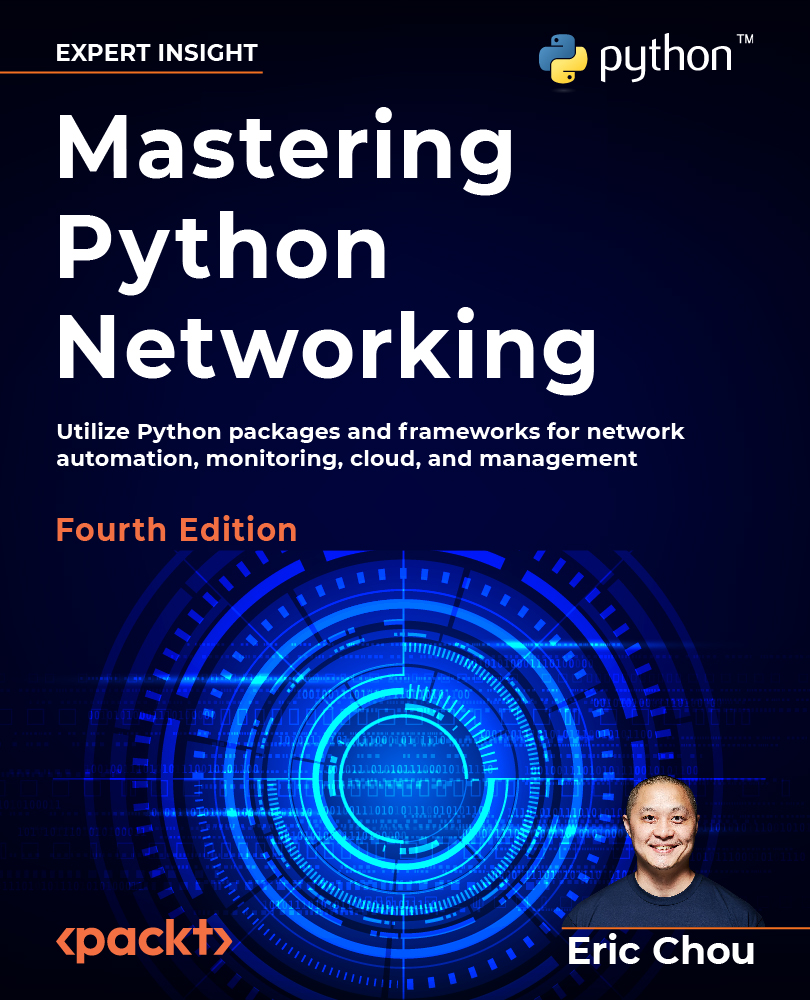
Mastering Python Networking - Fourth Edition
By :


Mastering Python Networking
By:
Overview of this book
Networks in your infrastructure set the foundation for deploying, maintaining, and servicing applications. Python is the ideal language for network engineers to explore tools that were previously available to systems engineers and application developers. Mastering Python Networking, Fourth edition, guides you on a Python-driven journey from traditional network engineering to modern network development.
This new edition incorporates the latest Python features and DevOps frameworks. In addition to new chapters on introducing Docker containers and Python 3 Async IO for network engineers, each chapter is updated with the latest libraries and working examples to ensure compatibility and clarity of the concepts.
Starting with a basic overview of Python, the book teaches you how it can interact with both legacy and API-enabled network devices. You will learn to leverage high-level Python packages and frameworks to perform network automation tasks, monitoring, management, and enhanced network security, followed by AWS and Azure cloud networking. You will use Git for code management, GitLab for continuous integration, and Python-based testing tools to verify your network.
By the end of this book, you'll be a confident network developer capable of automating modern infrastructure using Python, DevOps practices, and cloud technologies.
Table of Contents (19 chapters)
Preface


Review of TCP/IP Protocol Suite and Python
 Free Chapter
Low-Level Network Device Interactions
APIs and Intent-Driven Networking
The Python Automation Framework – Ansible
Docker Containers for Network Engineers
Network Security with Python
Network Monitoring with Python – Part 1

Network Monitoring with Python – Part 2
Building Network Web Services with Python
Introduction to Async IO
AWS Cloud Networking
Azure Cloud Networking
Network Data Analysis with Elastic Stack
Working with Git
Continuous Integration with GitLab
Test-Driven Development for Networks
Other Books You May Enjoy
Index


