Sign In Start Free Trial
Account

Add to playlist

Create a Playlist

Modal Close icon
You need to login to use this feature.
  • Book Overview & Buying AWS for Solutions Architects
  • Table Of Contents Toc
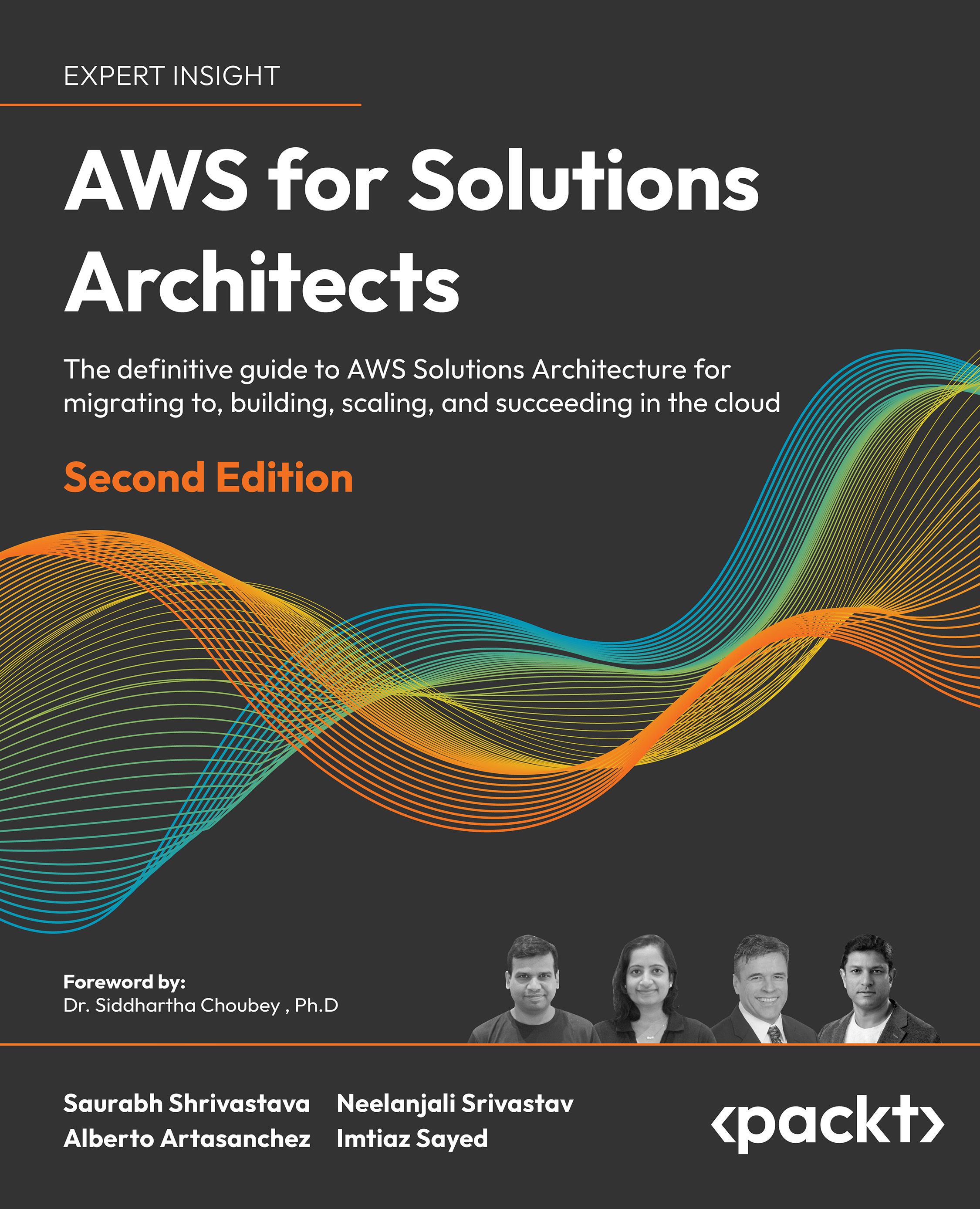
AWS for Solutions Architects

AWS for Solutions Architects - Second Edition

By : Saurabh Shrivastava, Neelanjali Srivastav, Alberto Artasanchez, Imtiaz Sayed
4.3 (62)
close
close
AWS for Solutions Architects

AWS for Solutions Architects

4.3 (62)
By: Saurabh Shrivastava, Neelanjali Srivastav, Alberto Artasanchez, Imtiaz Sayed

Overview of this book

The second edition of AWS for Solutions Architects provides a practical guide to designing cloud solutions that align with industry best practices. This updated edition covers the AWS Well-Architected Framework, core design principles, and cloud-native patterns to help you build secure, high-performance, and cost-effective architectures. Gain a deep understanding of AWS networking, hybrid cloud connectivity, and edge deployments. Explore big data processing with EMR, Glue, Kinesis, and MSK, enabling you to extract valuable insights from data efficiently. New chapters introduce CloudOps, machine learning, IoT, and blockchain, equipping you with the knowledge to develop modern cloud solutions. Learn how to optimize AWS storage, implement containerization strategies, and design scalable data lakes. Whether working on simple configurations or complex enterprise architectures, this guide provides the expertise needed to solve real-world cloud challenges and build reliable, high-performing AWS solutions.
Table of Contents (19 chapters)
close
close
17
Other Books You May Enjoy
18
Index

Learning tips and tricks for obtaining AWS certifications

Now that we have learned about the various certifications offered by AWS, let’s learn about some of the strategies we can use to get these certifications with the least amount of work possible, and what we can expect as we prepare for these certifications.

Focus on one cloud provider

Some enterprises are trying to adopt a cloud-agnostic or multi-cloud strategy. The idea behind this strategy is not to depend on only one cloud provider. In theory, this seems like a good idea, and some companies such as Databricks, Snowflake, and Cloudera offer their wares to be run using the most popular cloud providers.

However, this agnosticism comes with some difficult choices. One way to implement this strategy is to choose the least common denominator, for example, only using compute instances so that workloads can be deployed on various cloud platforms. Implementing this approach means that you cannot use the more advanced services offered by cloud providers. For example, using AWS Lambda in a cloud-agnostic fashion is quite tricky.

Another way that a multi-cloud strategy can be implemented is by using more advanced services, but this means that your staff will have to know how to use these services for all the cloud providers you decide to use. You will be a jack of all trades and a master of none, to use the common refrain.

Similarly, it isn’t easy to be a cloud expert across vendors individually. It is recommended to pick one cloud provider and try to become an expert on that one stack. AWS, Azure, and GCP, to name the most popular options, offer an immense amount of services that continuously change and get enhanced, and they keep adding more services. Keeping up with one of these providers is not an easy task. Keeping up with all three, in my opinion, is close to impossible. Pick one and dominate it.

Focus on the Associate-level certifications

As we mentioned before, there’s quite a bit of overlap between the Associate-level certifications. In addition, the jump in difficulty between the Associate-level certificates and the Professional-level ones is quite steep.

It’s highly recommended to sit for at least two, if not all three, of the Associate-level certifications before attempting the Professional-level certifications. Not only will this method prepare you for the Professional certifications but having multiple Associate certifications will also make you stand out against others that only have one Associate-level certificate.

Get experience wherever you can

AWS recommends having one year of experience before taking the Associate-level certifications and two years of experience before sitting for the Professional-level certifications. This may seem like a catch-22 situation. How can you get experience if you are not certified? However, it’s a recommendation and not a mandatory requirement. This means that you can gain experience in training and study for the exam. You can do your project using an AWS Free Tier account with a pretty decent number of services available in the first year, and you can gain good hands-on experience.

CONTINUE READING
83
Tech Concepts
36
Programming languages
73
Tech Tools
Icon Unlimited access to the largest independent learning library in tech of over 8,000 expert-authored tech books and videos.
Icon Innovative learning tools, including AI book assistants, code context explainers, and text-to-speech.
Icon 50+ new titles added per month and exclusive early access to books as they are being written.
AWS for Solutions Architects
notes
bookmark Notes and Bookmarks search Search in title playlist Add to playlist font-size Font size

Change the font size

margin-width Margin width

Change margin width

day-mode Day/Sepia/Night Modes

Change background colour

Close icon Search
Country selected

Close icon Your notes and bookmarks

Confirmation

Modal Close icon
claim successful

Buy this book with your credits?

Modal Close icon
Are you sure you want to buy this book with one of your credits?
Close
YES, BUY

Submit Your Feedback

Modal Close icon
Modal Close icon
Modal Close icon