Sign In Start Free Trial
Account

Add to playlist

Create a Playlist

Modal Close icon
You need to login to use this feature.
  • Book Overview & Buying OpenCV Computer Vision Application Programming Cookbook Second Edition
  • Table Of Contents Toc
  • Feedback & Rating feedback
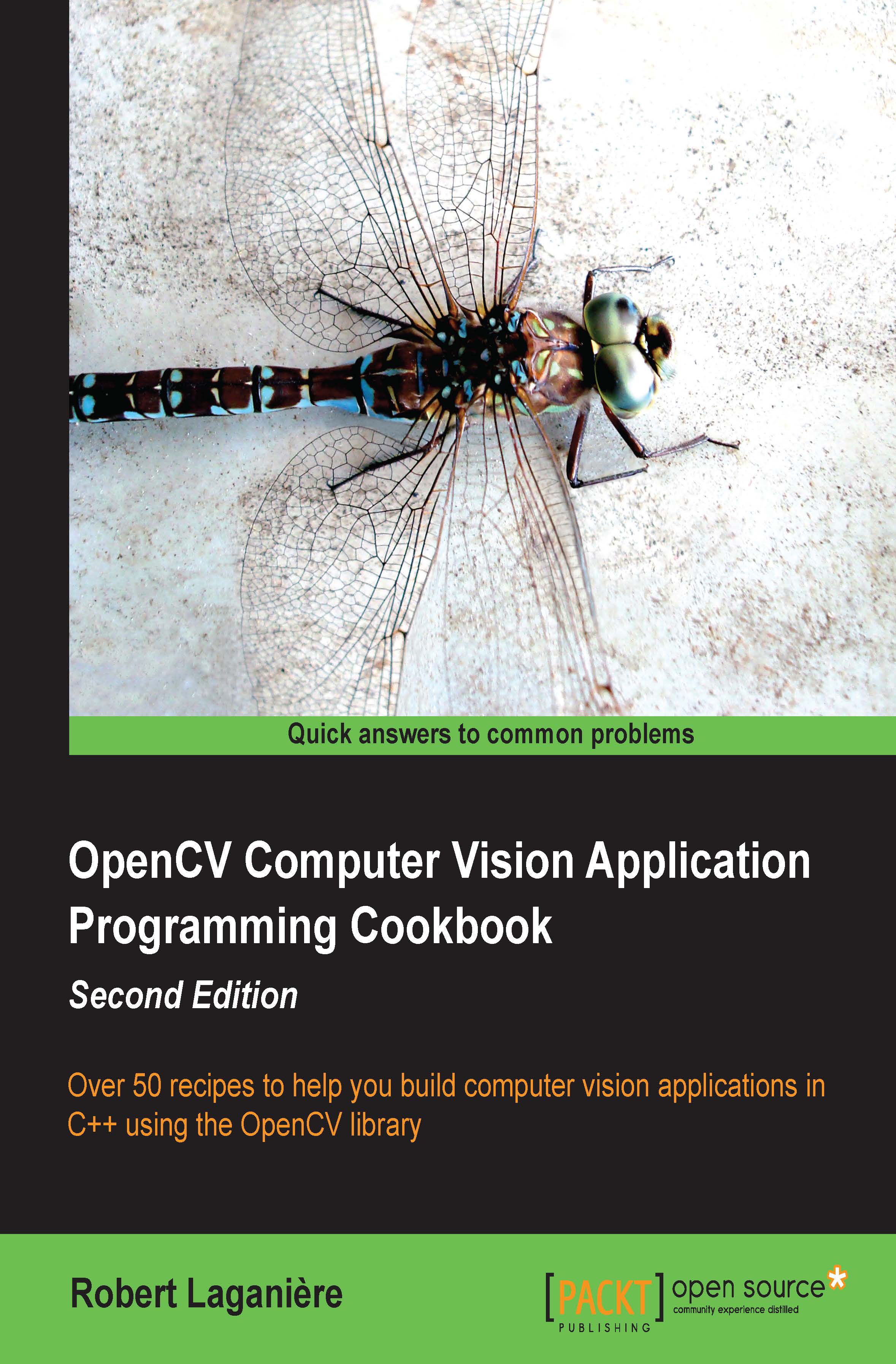
OpenCV Computer Vision Application Programming Cookbook Second Edition

OpenCV Computer Vision Application Programming Cookbook Second Edition

By : Robert Laganiere
3.7 (3)
close
close
OpenCV Computer Vision Application Programming Cookbook Second Edition

OpenCV Computer Vision Application Programming Cookbook Second Edition

3.7 (3)
By: Robert Laganiere

Overview of this book

OpenCV 3 Computer Vision Application Programming Cookbook is appropriate for novice C++ programmers who want to learn how to use the OpenCV library to build computer vision applications. It is also suitable for professional software developers wishing to be introduced to the concepts of computer vision programming. It can also be used as a companion book in a university-level computer vision courses. It constitutes an excellent reference for graduate students and researchers in image processing and computer vision.
Table of Contents (13 chapters)
close
close
12
Index

Segmenting images using watersheds


The watershed transformation is a popular image processing algorithm that is used to quickly segment an image into homogenous regions. It relies on the idea that when the image is seen as a topological relief, the homogeneous regions correspond to relatively flat basins delimited by steep edges. As a result of its simplicity, the original version of this algorithm tends to over-segment the image, which produces multiple small regions. This is why OpenCV proposes a variant of this algorithm that uses a set of predefined markers that guide the definition of the image segments.

How to do it...

The watershed segmentation is obtained through the use of the cv::watershed function. The input for this function is a 32-bit signed integer-marker image in which each nonzero pixel represents a label. The idea is to mark some pixels of the image that are known to belong to a given region. From this initial labeling, the watershed algorithm will determine the regions to...

Visually different images
CONTINUE READING
83
Tech Concepts
36
Programming languages
73
Tech Tools
Icon Unlimited access to the largest independent learning library in tech of over 8,000 expert-authored tech books and videos.
Icon Innovative learning tools, including AI book assistants, code context explainers, and text-to-speech.
Icon 50+ new titles added per month and exclusive early access to books as they are being written.
OpenCV Computer Vision Application Programming Cookbook Second Edition
notes
bookmark Notes and Bookmarks search Search in title playlist Add to playlist download Download options font-size Font size

Change the font size

margin-width Margin width

Change margin width

day-mode Day/Sepia/Night Modes

Change background colour

Close icon Search
Country selected

Close icon Your notes and bookmarks

Confirmation

Modal Close icon
claim successful

Buy this book with your credits?

Modal Close icon
Are you sure you want to buy this book with one of your credits?
Close
YES, BUY

Submit Your Feedback

Modal Close icon
Modal Close icon
Modal Close icon