Sign In Start Free Trial
Account

Add to playlist

Create a Playlist

Modal Close icon
You need to login to use this feature.
  • Book Overview & Buying Python Data Visualization Cookbook
  • Table Of Contents Toc
Python Data Visualization Cookbook

Python Data Visualization Cookbook

By : Igor Milovanovic
4 (9)
close
close
Python Data Visualization Cookbook

Python Data Visualization Cookbook

4 (9)
By: Igor Milovanovic

Overview of this book

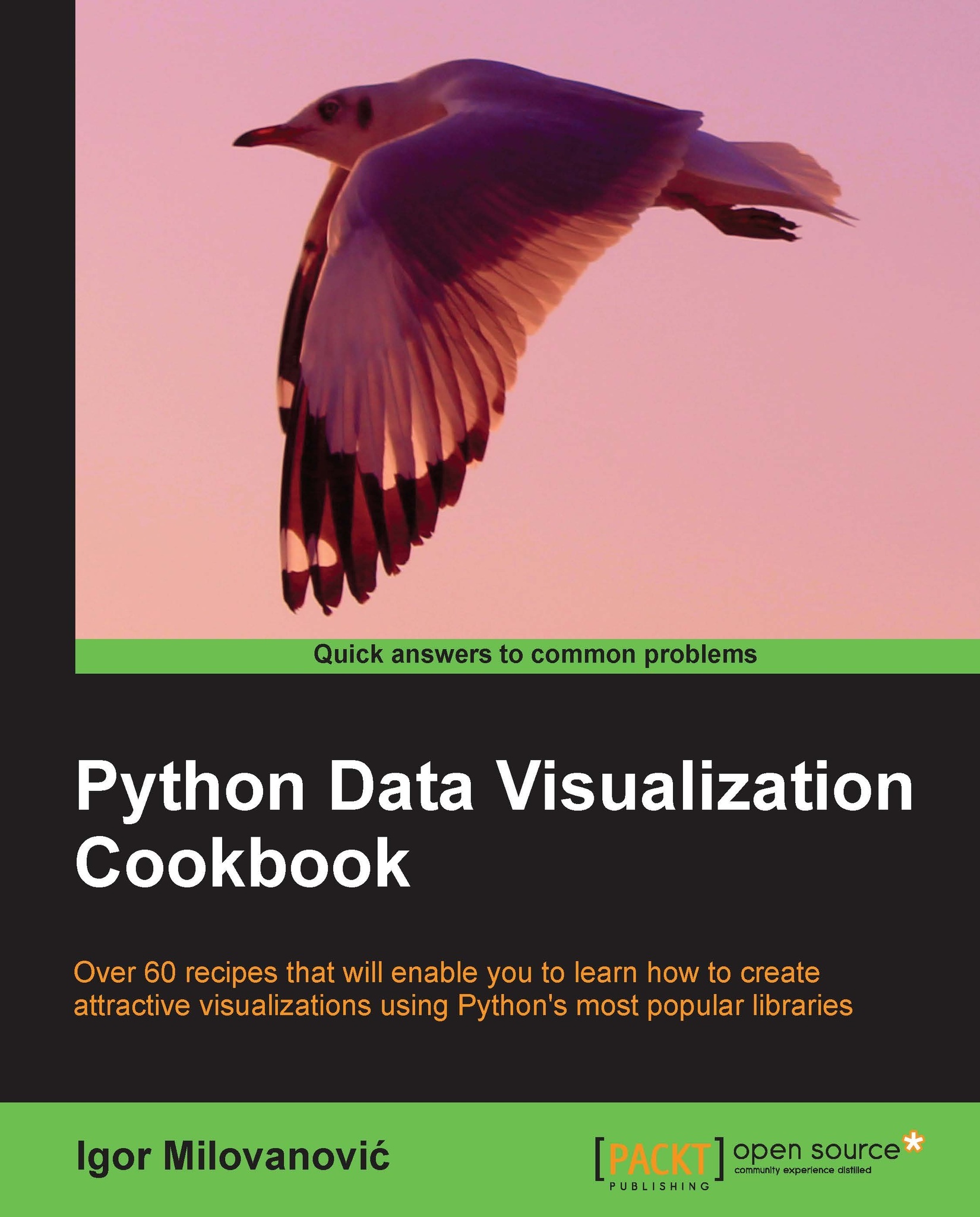
Today, data visualization is a hot topic as a direct result of the vast amount of data created every second. Transforming that data into information is a complex task for data visualization professionals, who, at the same time, try to understand the data and objectively transfer that understanding to others. This book is a set of practical recipes that strive to help the reader get a firm grasp of the area of data visualization using Python and its popular visualization and data libraries. Python Data Visualization Cookbook will progress the reader from the point of installing and setting up a Python environment for data manipulation and visualization all the way to 3D animations using Python libraries. Readers will benefit from over 60 precise and reproducible recipes that guide the reader towards a better understanding of data concepts and the building blocks for subsequent and sometimes more advanced concepts. Python Data Visualization Cookbook starts by showing you how to set up matplotlib and the related libraries that are required for most parts of the book, before moving on to discuss some of the lesser-used diagrams and charts such as Gantt Charts or Sankey diagrams. During the book, we go from simple plots and charts to more advanced ones, thoroughly explaining why we used them and how not to use them. As we go through the book, we will also discuss 3D diagrams. We will peep into animations just to show you what it takes to go into that area. Maps are irreplaceable for displaying geo-spatial data, so we also show you how to build them. In the last chapter, we show you how to incorporate matplotlib into different environments, such as a writing system, LaTeX, or how to create Gantt charts using Python. This book will help those who already know how to program in Python to explore a new field – one of data visualization. As this book is all about recipes that explain how to do something, code samples are abundant, and they are followed by visual diagrams and charts to help you understand the logic and compare your own results with what is explained in the book.
Table of Contents (15 chapters)
close
close
Python Data Visualization Cookbook
Credits
About the Author
About the Reviewers
www.PacktPub.com
Preface
1
Index

Installing Python Imaging Library (PIL) for image processing


Python Imaging Library (PIL) enables image processing using Python, has an extensive file format support, and is powerful enough for image processing.

Some popular features of PIL are fast access to data, point operations, filtering, image resizing, rotation, and arbitrary affine transforms. For example, the histogram method allows us to get statistics about the images.

PIL can also be used for other purposes, such as batch processing, image archiving, creating thumbnails, conversion between image formats, and printing images.

PIL reads a large number of formats, while write support is (intentionally) restricted to the most commonly used interchange and presentation formats.

How to do it...

The easiest and most recommended way is to use your platform's package managers. For Debian/Ubuntu use the following commands:

$ sudo apt-get build-dep python-imaging
$ sudo pip install http://effbot.org/downloads/Imaging-1.1.7.tar.gz

How it works...

This way we are satisfying all build dependencies using apt-get system but also installing the latest stable release of PIL. Some older versions of Ubuntu usually don't provide the latest releases.

On RedHat/SciLinux:

# yum install python-imaging
# yum install freetype-devel
# pip install PIL

There's more...

There is a good online handbook, specifically, for PIL. You can read it at http://www.pythonware.com/library/pil/handbook/index.htm, or download the PDF version from http://www.pythonware.com/media/data/pil-handbook.pdf.

There is also a PIL fork, Pillow, whose main aim is to fix installation issues. Pillow can be found at http://pypi.python.org/pypi/Pillow and it is easy to install.

On Windows, PIL can also be installed using a binary installation file. Install PIL in your Python site-packages by executing .exe from http://www.pythonware.com/products/pil/.

Now, if you want PIL used in virtual environment, manually copy the PIL.pth file and the PIL directory at C:\Python27\Lib\site-packages to your virtualenv site-packages directory.

CONTINUE READING
83
Tech Concepts
36
Programming languages
73
Tech Tools
Icon Unlimited access to the largest independent learning library in tech of over 8,000 expert-authored tech books and videos.
Icon Innovative learning tools, including AI book assistants, code context explainers, and text-to-speech.
Icon 50+ new titles added per month and exclusive early access to books as they are being written.
Python Data Visualization Cookbook
notes
bookmark Notes and Bookmarks search Search in title playlist Add to playlist font-size Font size

Change the font size

margin-width Margin width

Change margin width

day-mode Day/Sepia/Night Modes

Change background colour

Close icon Search
Country selected

Close icon Your notes and bookmarks

Confirmation

Modal Close icon
claim successful

Buy this book with your credits?

Modal Close icon
Are you sure you want to buy this book with one of your credits?
Close
YES, BUY

Submit Your Feedback

Modal Close icon
Modal Close icon
Modal Close icon