Sign In Start Free Trial
Account

Add to playlist

Create a Playlist

Modal Close icon
You need to login to use this feature.
  • Book Overview & Buying F# for Quantitative Finance
  • Table Of Contents Toc
F# for Quantitative Finance

F# for Quantitative Finance

By : Johan Astborg
3.8 (5)
close
close
F# for Quantitative Finance

F# for Quantitative Finance

3.8 (5)
By: Johan Astborg

Overview of this book

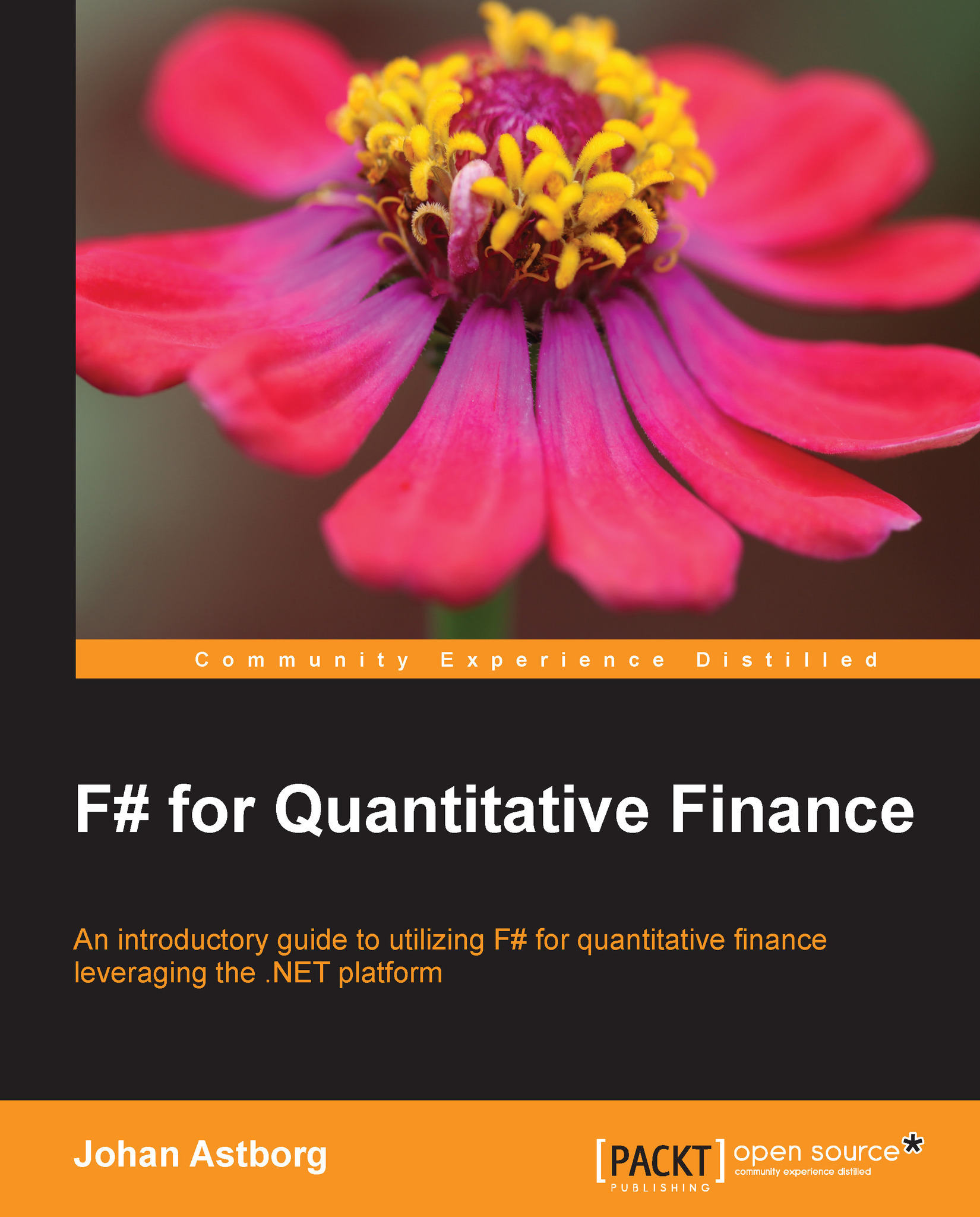
F# is a functional programming language that allows you to write simple code for complex problems. Currently, it is most commonly used in the financial sector. Quantitative finance makes heavy use of mathematics to model various parts of finance in the real world. If you are interested in using F# for your day-to-day work or research in quantitative finance, this book is a must-have.This book will cover everything you need to know about using functional programming for quantitative finance. Using a functional programming language will enable you to concentrate more on the problem itself rather than implementation details. Tutorials and snippets are summarized into an automated trading system throughout the book.This book will introduce you to F#, using Visual Studio, and provide examples with functional programming and finance combined. The book also covers topics such as downloading, visualizing and calculating statistics from data. F# is a first class programming language for the financial domain.
Table of Contents (17 chapters)
close
close
F# for Quantitative Finance
Credits
About the Author
About the Reviewers
www.PacktPub.com
Preface
1
Index

Chapter 2. Learning More About F#

This chapter is a more detailed one about the F# language itself. The tutorial approach will continue with demonstrations using Visual Studio, together with detailed aspects of the language relevant to building the final trading system throughout the later part of the book. Most of the language building blocks will be covered with explanations and examples. This chapter is quite large, but it is essential to understand the content provided here to be able to follow along throughout the book.

In this chapter, you will learn:

  • Structuring a program into modules and namespaces

  • More about data structures and types

  • Recursive functions and their role in functional programming

  • Pattern matching

  • Combining functional and object-oriented ideas

  • The imperative part of F#

  • The parallel and asynchronous programming model in F#

Tip

Download the F# 3.0 Language Specification from Microsoft Research and use it side-by-side as you go along this chapter and the rest of the book. The specification...

CONTINUE READING
83
Tech Concepts
36
Programming languages
73
Tech Tools
Icon Unlimited access to the largest independent learning library in tech of over 8,000 expert-authored tech books and videos.
Icon Innovative learning tools, including AI book assistants, code context explainers, and text-to-speech.
Icon 50+ new titles added per month and exclusive early access to books as they are being written.
F# for Quantitative Finance
notes
bookmark Notes and Bookmarks search Search in title playlist Add to playlist font-size Font size

Change the font size

margin-width Margin width

Change margin width

day-mode Day/Sepia/Night Modes

Change background colour

Close icon Search
Country selected

Close icon Your notes and bookmarks

Confirmation

Modal Close icon
claim successful

Buy this book with your credits?

Modal Close icon
Are you sure you want to buy this book with one of your credits?
Close
YES, BUY

Submit Your Feedback

Modal Close icon
Modal Close icon
Modal Close icon