
Sign In Start Free Trial
Account

Add to playlist

Create a Playlist

Modal Close icon
You need to login to use this feature.
  • Book Overview & Buying Mastering Java for Data Science
  • Table Of Contents Toc
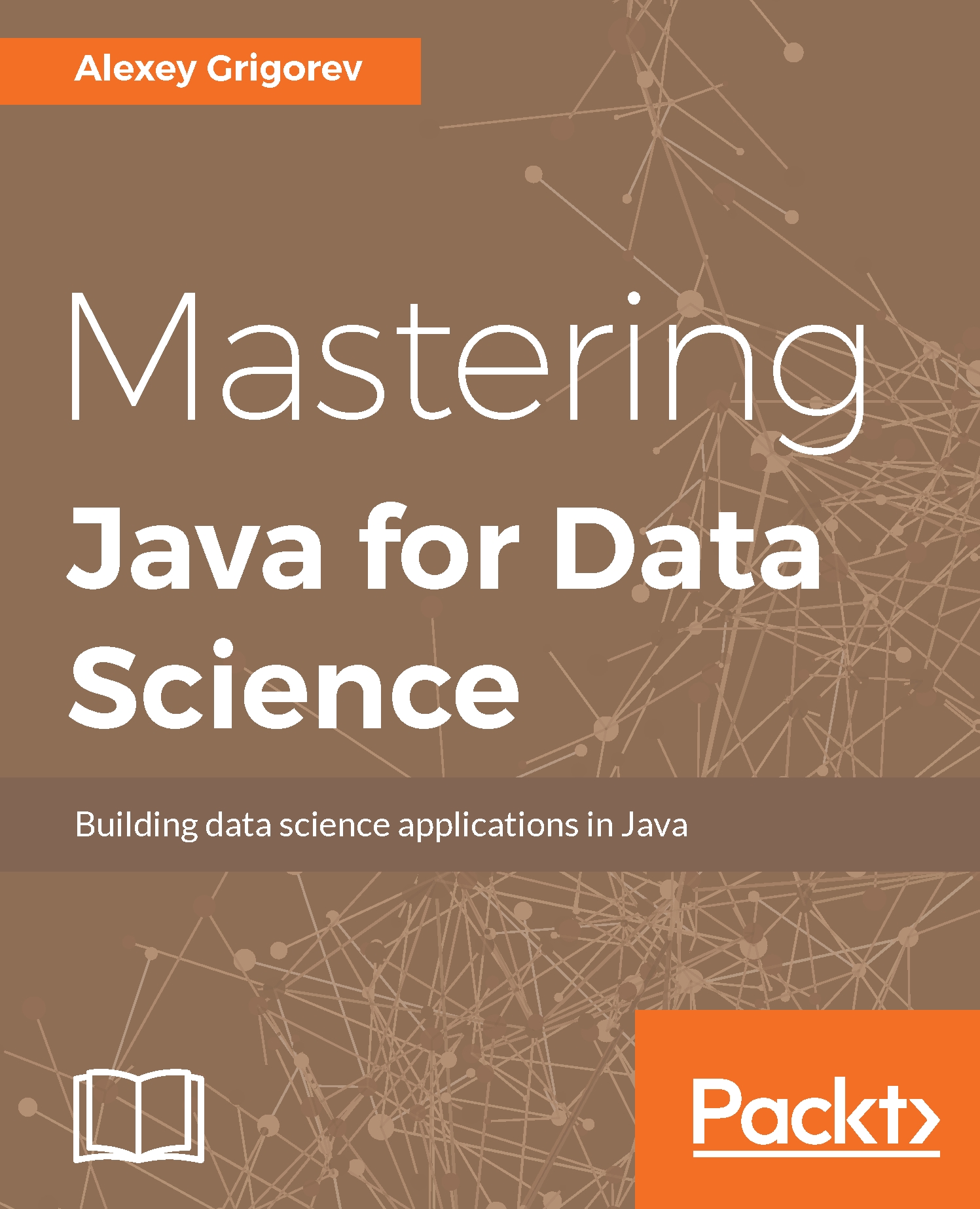
Mastering Java for Data Science

Mastering Java for Data Science

By : Alexey Grigorev
5 (1)
close
close
Mastering Java for Data Science

Mastering Java for Data Science

5 (1)
By: Alexey Grigorev

Overview of this book

Java is the most popular programming language, according to the TIOBE index, and it is a typical choice for running production systems in many companies, both in the startup world and among large enterprises. Not surprisingly, it is also a common choice for creating data science applications: it is fast and has a great set of data processing tools, both built-in and external. What is more, choosing Java for data science allows you to easily integrate solutions with existing software, and bring data science into production with less effort. This book will teach you how to create data science applications with Java. First, we will revise the most important things when starting a data science application, and then brush up the basics of Java and machine learning before diving into more advanced topics. We start by going over the existing libraries for data processing and libraries with machine learning algorithms. After that, we cover topics such as classification and regression, dimensionality reduction and clustering, information retrieval and natural language processing, and deep learning and big data. Finally, we finish the book by talking about the ways to deploy the model and evaluate it in production settings.
Table of Contents (11 chapters)
close
close

Exploratory data analysis in Java

Exploratory Data Analysis is about taking a dataset and extracting the most important information from it, in such a way that it is possible to get an idea of what the data looks like. This includes two main parts: summarization and visualization.

The summarization step is very helpful for understanding data. For numerical variables, in this step we calculate the most important sample statistics: 

  • The extremes (the minimal and the maximal values)
  • The mean value, or the sample average
  • The standard deviation, which describes the spread of the data

Often we consider other statistics, such as the median and the quartiles (25% and 75%).

As we have already seen in the previous chapter, Java offers a great set of tools for data preparation. The same set of tools can be used for EDA, and especially for creating summaries.

...
Visually different images
CONTINUE READING
83
Tech Concepts
36
Programming languages
73
Tech Tools
Icon Unlimited access to the largest independent learning library in tech of over 8,000 expert-authored tech books and videos.
Icon Innovative learning tools, including AI book assistants, code context explainers, and text-to-speech.
Icon 50+ new titles added per month and exclusive early access to books as they are being written.
Mastering Java for Data Science
notes
bookmark Notes and Bookmarks search Search in title playlist Add to playlist download Download options font-size Font size

Change the font size

margin-width Margin width

Change margin width

day-mode Day/Sepia/Night Modes

Change background colour

Close icon Search
Country selected

Close icon Your notes and bookmarks

Confirmation

Modal Close icon
claim successful

Buy this book with your credits?

Modal Close icon
Are you sure you want to buy this book with one of your credits?
Close
YES, BUY

Submit Your Feedback

Modal Close icon
Modal Close icon
Modal Close icon