Sign In Start Free Trial
Account

Add to playlist

Create a Playlist

Modal Close icon
You need to login to use this feature.
  • Book Overview & Buying Mastering Python Scientific Computing
  • Table Of Contents Toc
Mastering Python Scientific Computing

Mastering Python Scientific Computing

By : Hemant Kumar Mehta
4 (6)
close
close
Mastering Python Scientific Computing

Mastering Python Scientific Computing

4 (6)
By: Hemant Kumar Mehta

Overview of this book

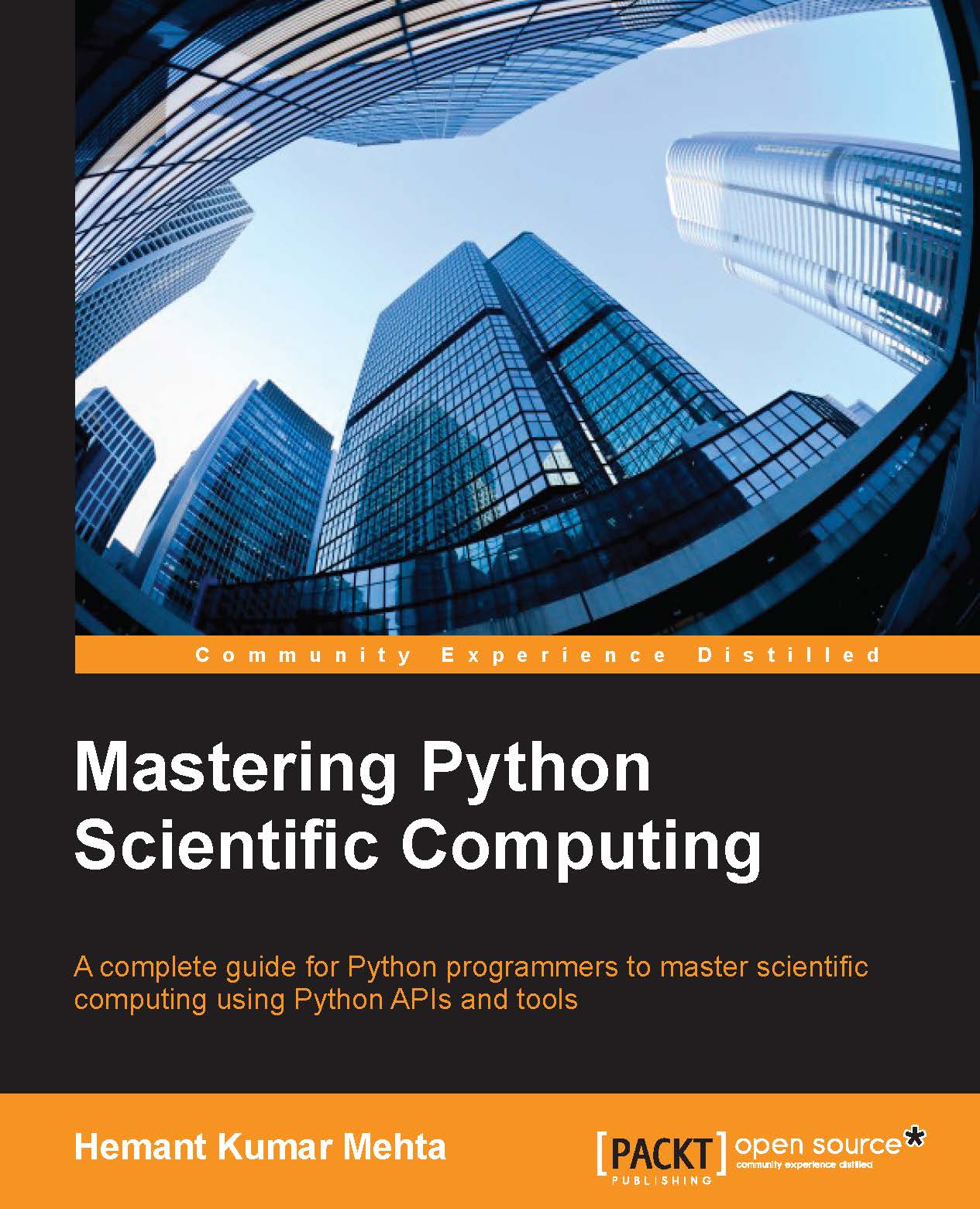
In today's world, along with theoretical and experimental work, scientific computing has become an important part of scientific disciplines. Numerical calculations, simulations and computer modeling in this day and age form the vast majority of both experimental and theoretical papers. In the scientific method, replication and reproducibility are two important contributing factors. A complete and concrete scientific result should be reproducible and replicable. Python is suitable for scientific computing. A large community of users, plenty of help and documentation, a large collection of scientific libraries and environments, great performance, and good support makes Python a great choice for scientific computing. At present Python is among the top choices for developing scientific workflow and the book targets existing Python developers to master this domain using Python. The main things to learn in the book are the concept of scientific workflow, managing scientific workflow data and performing computation on this data using Python. The book discusses NumPy, SciPy, SymPy, matplotlib, Pandas and IPython with several example programs.
Table of Contents (12 chapters)
close
close
11
Index

A strategy for solving complex problems

A simple strategy to find a solution for a complex computational problem is to first identify the difficult areas in the solution. Now, one by one, start replacing these small difficult parts with their solutions that will lead to the same solution or to a solution within the problem-specific permissible limit. In other words, the best idea is to reduce a large, complex problem to a set of smaller problems. Each of them may be complex or simple. Now each of the complex subproblems may be replaced with a similar and simple problem, and in this way, we ultimately get a simpler problem to solve. The basic idea is to combine the divide-and-conquer technique with the change of smaller complex problems with similar simple problems.

We should take care of two important points when adopting this idea. The first is that we need to search for a similar problem or a problem that has a solution from the same class. The second is that just after the replacement of one problem with another, we need to determine whether the ultimate solution is preserved within the tolerance limit, if not completely preserved. Some examples may be as follows:

  • Changing infinite-dimensional spaces in the problem to finite-dimensional spaces for simplicity
  • Change infinite processes with finite processes, such as replacing integrals or infinite series with finite summations or a derivative of finite differences
  • If feasible, then algebraic equations can be used to replace differential equations
  • Try replacing nonlinear problems with linear problems as linear problems are very simple to solve
  • If feasible, complicated functions can be changed to multiple simple functions to achieve simplicity
CONTINUE READING
83
Tech Concepts
36
Programming languages
73
Tech Tools
Icon Unlimited access to the largest independent learning library in tech of over 8,000 expert-authored tech books and videos.
Icon Innovative learning tools, including AI book assistants, code context explainers, and text-to-speech.
Icon 50+ new titles added per month and exclusive early access to books as they are being written.
Mastering Python Scientific Computing
notes
bookmark Notes and Bookmarks search Search in title playlist Add to playlist font-size Font size

Change the font size

margin-width Margin width

Change margin width

day-mode Day/Sepia/Night Modes

Change background colour

Close icon Search
Country selected

Close icon Your notes and bookmarks

Confirmation

Modal Close icon
claim successful

Buy this book with your credits?

Modal Close icon
Are you sure you want to buy this book with one of your credits?
Close
YES, BUY

Submit Your Feedback

Modal Close icon
Modal Close icon
Modal Close icon