Sign In Start Free Trial
Account

Add to playlist

Create a Playlist

Modal Close icon
You need to login to use this feature.
  • Book Overview & Buying Mastering Text Mining with R
  • Table Of Contents Toc
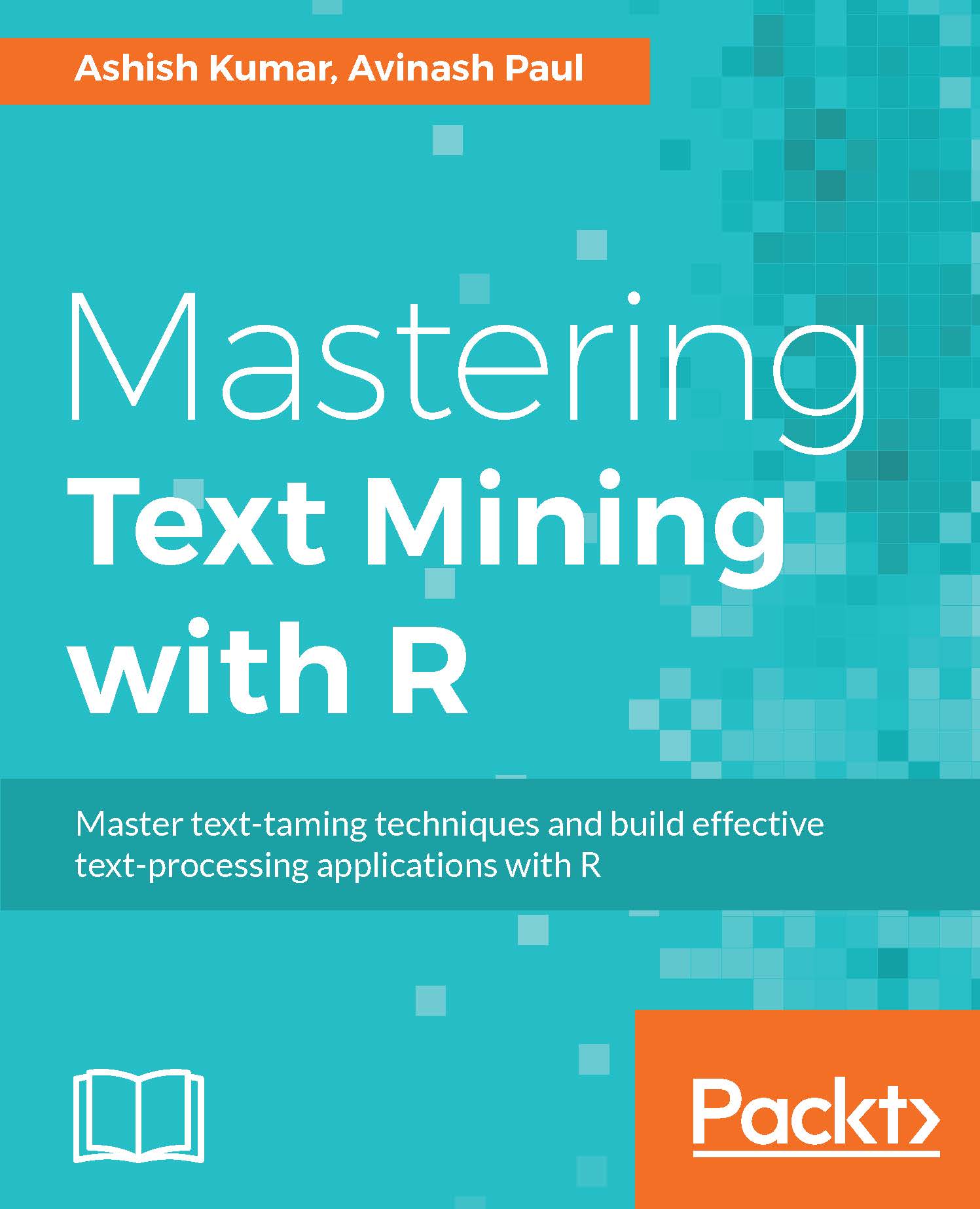
Mastering Text Mining with R

Mastering Text Mining with R

By : KUMAR ASHISH
2.4 (11)
close
close
Mastering Text Mining with R

Mastering Text Mining with R

2.4 (11)
By: KUMAR ASHISH

Overview of this book

Text Mining (or text data mining or text analytics) is the process of extracting useful and high-quality information from text by devising patterns and trends. R provides an extensive ecosystem to mine text through its many frameworks and packages. Starting with basic information about the statistics concepts used in text mining, this book will teach you how to access, cleanse, and process text using the R language and will equip you with the tools and the associated knowledge about different tagging, chunking, and entailment approaches and their usage in natural language processing. Moving on, this book will teach you different dimensionality reduction techniques and their implementation in R. Next, we will cover pattern recognition in text data utilizing classification mechanisms, perform entity recognition, and develop an ontology learning framework. By the end of the book, you will develop a practical application from the concepts learned, and will understand how text mining can be leveraged to analyze the massively available data on social media.
Table of Contents (9 chapters)
close
close

Normalizing texts

Normalization in text basically refers to standardization or canonicalization of tokens, which we derived from documents in the previous step. The simplest scenario possible could be the case where query tokens are an exact match to the list of tokens in document, however there can be cases when that is not true. The intent of normalization is to have the query and index terms in the same form. For instance, if you query U.K., you might also be expecting U.K.

Token normalization can be performed either by implicitly creating equivalence classes or by maintaining the relations between unnormalized tokens. There might be cases where we find superficial differences in character sequences of tokens, in such cases query and index term matching becomes difficult. Consider the words anti-disciplinary and anti-disciplinary. If both these words get mapped into one term named after one of the members of the set for example anti-disciplinary, text retrieval would become so efficient...

CONTINUE READING
83
Tech Concepts
36
Programming languages
73
Tech Tools
Icon Unlimited access to the largest independent learning library in tech of over 8,000 expert-authored tech books and videos.
Icon Innovative learning tools, including AI book assistants, code context explainers, and text-to-speech.
Icon 50+ new titles added per month and exclusive early access to books as they are being written.
Mastering Text Mining with R
notes
bookmark Notes and Bookmarks search Search in title playlist Add to playlist download Download options font-size Font size

Change the font size

margin-width Margin width

Change margin width

day-mode Day/Sepia/Night Modes

Change background colour

Close icon Search
Country selected

Close icon Your notes and bookmarks

Confirmation

Modal Close icon
claim successful

Buy this book with your credits?

Modal Close icon
Are you sure you want to buy this book with one of your credits?
Close
YES, BUY

Submit Your Feedback

Modal Close icon
Modal Close icon
Modal Close icon