Sign In Start Free Trial
Account

Add to playlist

Create a Playlist

Modal Close icon
You need to login to use this feature.
  • Book Overview & Buying Mastering Python for Data Science
  • Table Of Contents Toc
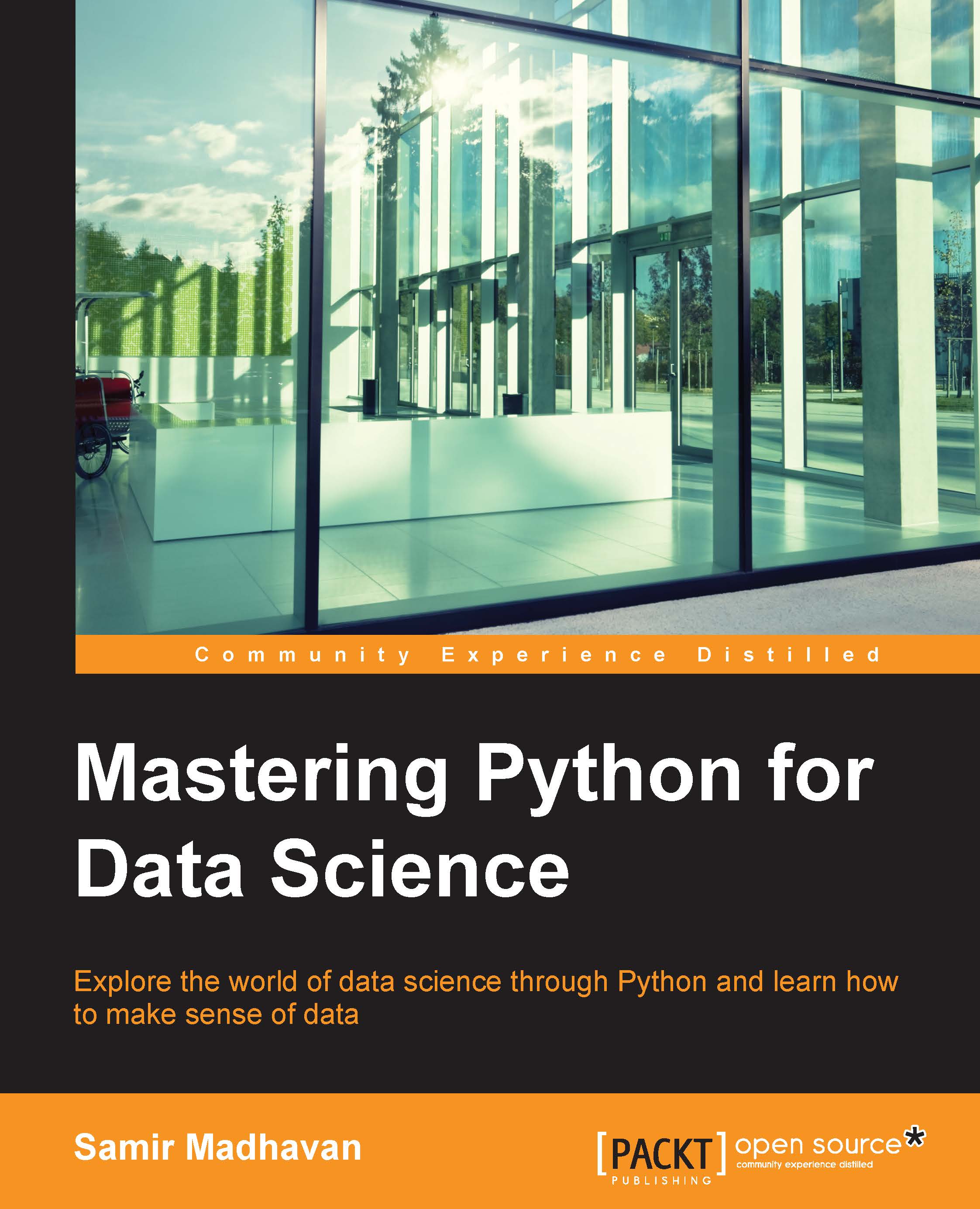
Mastering Python for Data Science

Mastering Python for Data Science

By : Samir Madhavan
3.6 (10)
close
close
Mastering Python for Data Science

Mastering Python for Data Science

3.6 (10)
By: Samir Madhavan

Overview of this book

Data science is a relatively new knowledge domain which is used by various organizations to make data driven decisions. Data scientists have to wear various hats to work with data and to derive value from it. The Python programming language, beyond having conquered the scientific community in the last decade, is now an indispensable tool for the data science practitioner and a must-know tool for every aspiring data scientist. Using Python will offer you a fast, reliable, cross-platform, and mature environment for data analysis, machine learning, and algorithmic problem solving. This comprehensive guide helps you move beyond the hype and transcend the theory by providing you with a hands-on, advanced study of data science. Beginning with the essentials of Python in data science, you will learn to manage data and perform linear algebra in Python. You will move on to deriving inferences from the analysis by performing inferential statistics, and mining data to reveal hidden patterns and trends. You will use the matplot library to create high-end visualizations in Python and uncover the fundamentals of machine learning. Next, you will apply the linear regression technique and also learn to apply the logistic regression technique to your applications, before creating recommendation engines with various collaborative filtering algorithms and improving your predictions by applying the ensemble methods. Finally, you will perform K-means clustering, along with an analysis of unstructured data with different text mining techniques and leveraging the power of Python in big data analytics.
Table of Contents (14 chapters)
close
close
7
7. Estimating the Likelihood of Events
13
Index

Chapter 1. Getting Started with Raw Data

In the world of data science, raw data comes in many forms and sizes. There is a lot of information that can be extracted from this raw data. To give an example, Amazon collects click stream data that records each and every click of the user on the website. This data can be utilized to understand if a user is a price-sensitive customer or prefer more popularly rated products. You must have noticed recommended products in Amazon; they are derived using such data.

The first step towards such an analysis would be to parse raw data. The parsing of the data involves the following steps:

  • Extracting data from the source: Data can come in many forms, such as Excel, CSV, JSON, databases, and so on. Python makes it very easy to read data from these sources with the help of some useful packages, which will be covered in this chapter.
  • Cleaning the data: Once a sanity check has been done, one needs to clean the data appropriately so that it can be utilized for analysis. You may have a dataset about students of a class and details about their height, weight, and marks. There may also be certain rows with the height or weight missing. Depending on the analysis being performed, these rows with missing values can either be ignored or replaced with the average height or weight.

In this chapter we will cover the following topics:

  • Exploring arrays with NumPy
  • Handling data with pandas
  • Reading and writing data from various formats
  • Handling missing data
  • Manipulating data
Visually different images
CONTINUE READING
83
Tech Concepts
36
Programming languages
73
Tech Tools
Icon Unlimited access to the largest independent learning library in tech of over 8,000 expert-authored tech books and videos.
Icon Innovative learning tools, including AI book assistants, code context explainers, and text-to-speech.
Icon 50+ new titles added per month and exclusive early access to books as they are being written.
Mastering Python for Data Science
notes
bookmark Notes and Bookmarks search Search in title playlist Add to playlist font-size Font size

Change the font size

margin-width Margin width

Change margin width

day-mode Day/Sepia/Night Modes

Change background colour

Close icon Search
Country selected

Close icon Your notes and bookmarks

Confirmation

Modal Close icon
claim successful

Buy this book with your credits?

Modal Close icon
Are you sure you want to buy this book with one of your credits?
Close
YES, BUY

Submit Your Feedback

Modal Close icon
Modal Close icon
Modal Close icon