Sign In Start Free Trial
Account

Add to playlist

Create a Playlist

Modal Close icon
You need to login to use this feature.
  • Book Overview & Buying Python Data Visualization Cookbook (Second Edition)
  • Table Of Contents Toc
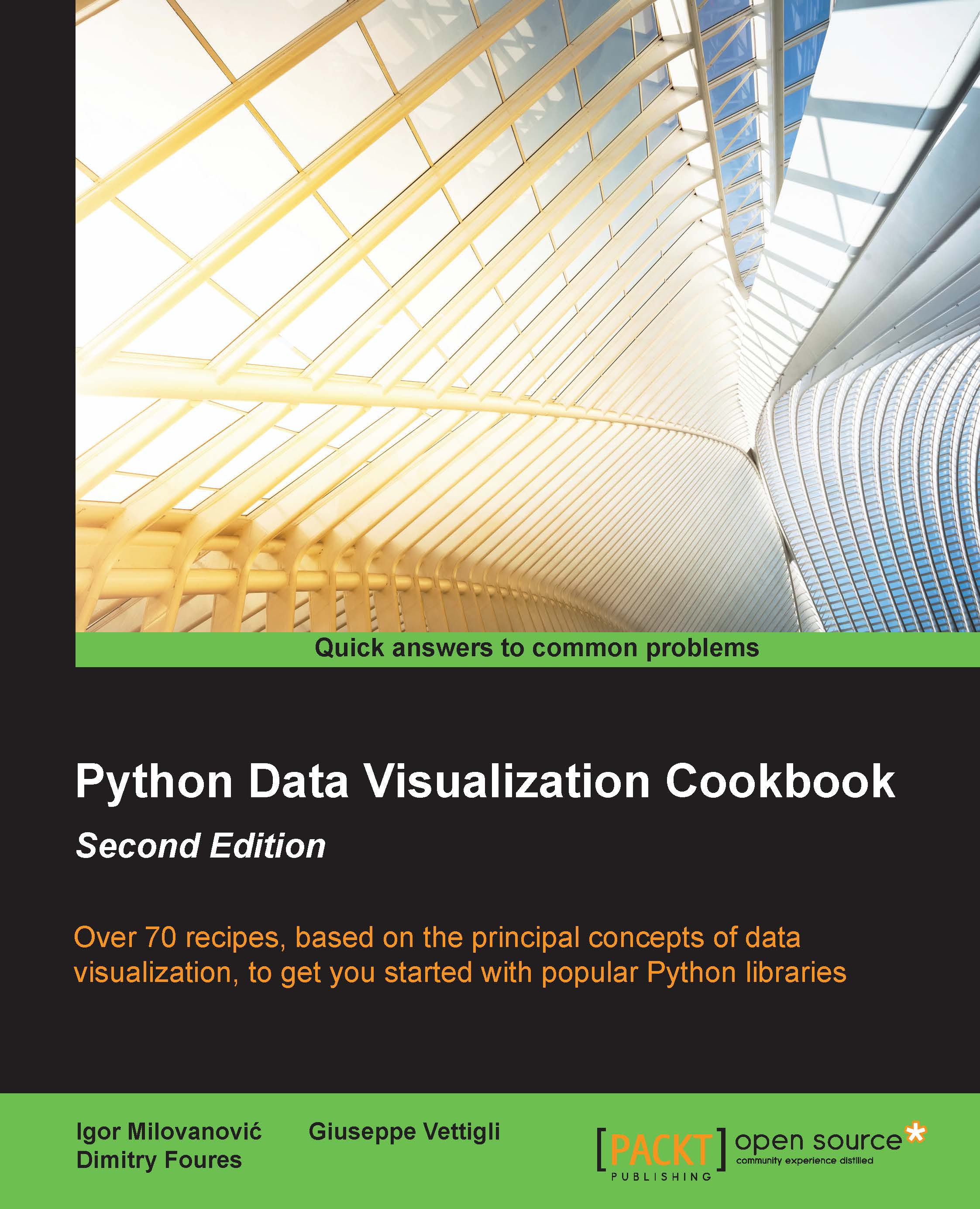
Python Data Visualization Cookbook (Second Edition)

Python Data Visualization Cookbook (Second Edition)

By : Igor Milovanovic, Foures, Giuseppe Vettigli
4 (6)
close
close
Python Data Visualization Cookbook (Second Edition)

Python Data Visualization Cookbook (Second Edition)

4 (6)
By: Igor Milovanovic, Foures, Giuseppe Vettigli

Overview of this book

Python Data Visualization Cookbook will progress the reader from the point of installing and setting up a Python environment for data manipulation and visualization all the way to 3D animations using Python libraries. Readers will benefit from over 60 precise and reproducible recipes that will guide the reader towards a better understanding of data concepts and the building blocks for subsequent and sometimes more advanced concepts. Python Data Visualization Cookbook starts by showing how to set up matplotlib and the related libraries that are required for most parts of the book, before moving on to discuss some of the lesser-used diagrams and charts such as Gantt Charts or Sankey diagrams. Initially it uses simple plots and charts to more advanced ones, to make it easy to understand for readers. As the readers will go through the book, they will get to know about the 3D diagrams and animations. Maps are irreplaceable for displaying geo-spatial data, so this book will also show how to build them. In the last chapter, it includes explanation on how to incorporate matplotlib into different environments, such as a writing system, LaTeX, or how to create Gantt charts using Python.
Table of Contents (11 chapters)
close
close
10
Index

Drawing streamlines of vector flow


Stream plots are used to visualize flow in vector fields. Examples from science and nature include fields of magnetic and gravitational forces or movement of liquid materials.

Vector field can be visualized in such a way, where we assign a line and one or more arrows to every point. The intensity can be represented by the line length, and direction by arrow pointing in particular direction.

Usually, the intensity of the force is visualized with the length of a particular streamline, but density can also be used for the same purpose.

Getting ready

To visualize vector fields, we will use matplotlib's matplotlib.pyplot.streamplot function. This function creates plots from streamlines of a flow uniformly filling the domain. The velocities field is interpolated and streamlines are integrated. The original source for this function is to visualize wind patterns or liquid flow, hence we don't need strict vector lines but uniform representation of the vector field.

Most...

CONTINUE READING
83
Tech Concepts
36
Programming languages
73
Tech Tools
Icon Unlimited access to the largest independent learning library in tech of over 8,000 expert-authored tech books and videos.
Icon Innovative learning tools, including AI book assistants, code context explainers, and text-to-speech.
Icon 50+ new titles added per month and exclusive early access to books as they are being written.
Python Data Visualization Cookbook (Second Edition)
notes
bookmark Notes and Bookmarks search Search in title playlist Add to playlist font-size Font size

Change the font size

margin-width Margin width

Change margin width

day-mode Day/Sepia/Night Modes

Change background colour

Close icon Search
Country selected

Close icon Your notes and bookmarks

Confirmation

Modal Close icon
claim successful

Buy this book with your credits?

Modal Close icon
Are you sure you want to buy this book with one of your credits?
Close
YES, BUY

Submit Your Feedback

Modal Close icon
Modal Close icon
Modal Close icon