Sign In Start Free Trial
Account

Add to playlist

Create a Playlist

Modal Close icon
You need to login to use this feature.
  • Book Overview & Buying Learning OpenCV 3 Computer Vision with Python (Update)
  • Table Of Contents Toc
Learning OpenCV 3 Computer Vision with Python (Update)

Learning OpenCV 3 Computer Vision with Python (Update)

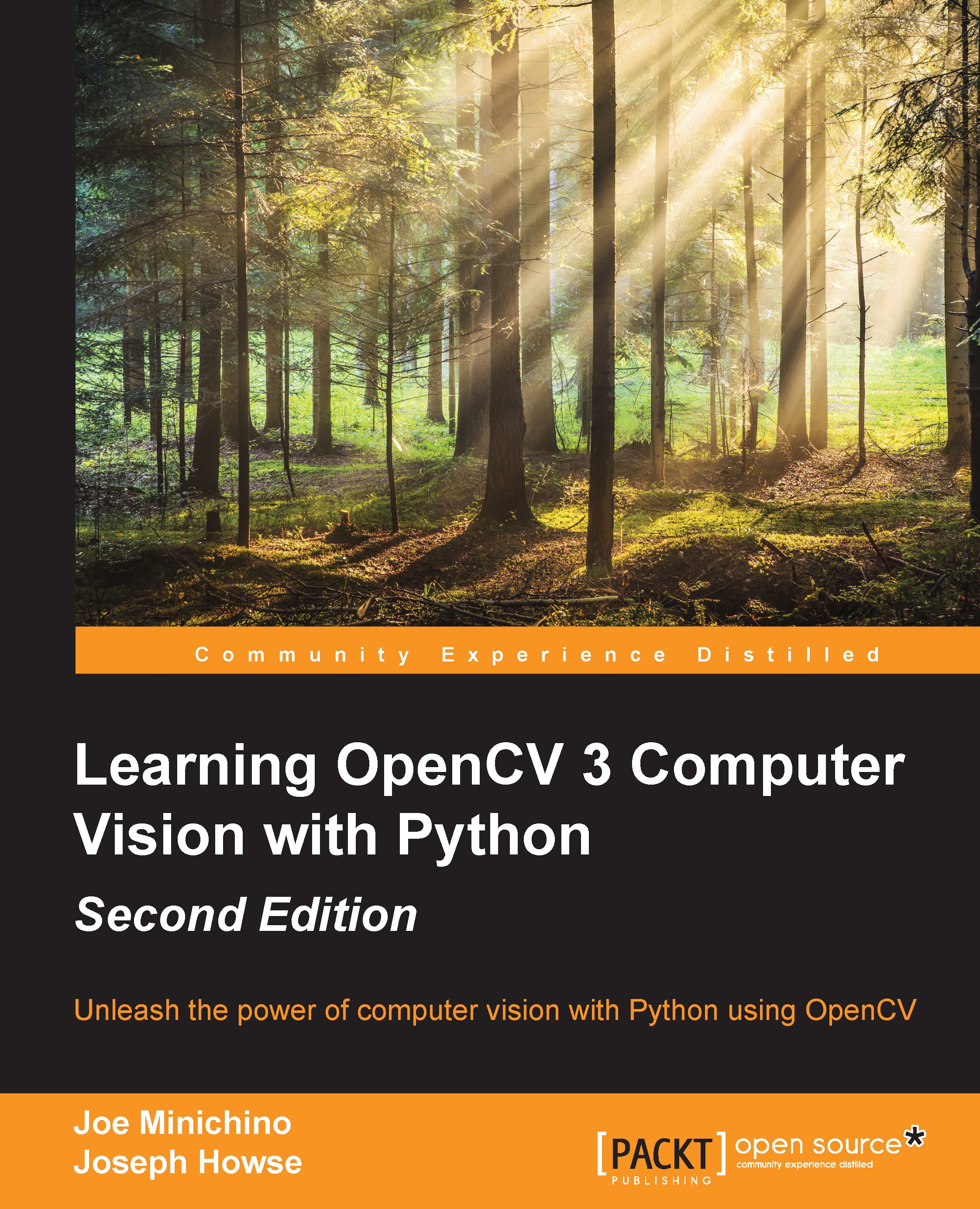
By : Joe Minichino, Joseph Howse
2.1 (7)
close
close
Learning OpenCV 3 Computer Vision with Python (Update)

Learning OpenCV 3 Computer Vision with Python (Update)

2.1 (7)
By: Joe Minichino, Joseph Howse

Overview of this book

OpenCV 3 is a state-of-the-art computer vision library that allows a great variety of image and video processing operations. Some of the more spectacular and futuristic features such as face recognition or object tracking are easily achievable with OpenCV 3. Learning the basic concepts behind computer vision algorithms, models, and OpenCV's API will enable the development of all sorts of real-world applications, including security and surveillance. Starting with basic image processing operations, the book will take you through to advanced computer vision concepts. Computer vision is a rapidly evolving science whose applications in the real world are exploding, so this book will appeal to computer vision novices as well as experts of the subject wanting to learn the brand new OpenCV 3.0.0. You will build a theoretical foundation of image processing and video analysis, and progress to the concepts of classification through machine learning, acquiring the technical know-how that will allow you to create and use object detectors and classifiers, and even track objects in movies or video camera feeds. Finally, the journey will end in the world of artificial neural networks, along with the development of a hand-written digits recognition application.
Table of Contents (11 chapters)
close
close
6
6. Retrieving Images and Searching Using Image Descriptors
10
Index

The Kalman filter


The Kalman filter is an algorithm mainly (but not only) developed by Rudolf Kalman in the late 1950s, and has found practical application in many fields, particularly navigation systems for all sorts of vehicles from nuclear submarines to aircrafts.

The Kalman filter operates recursively on streams of noisy input data (which in computer vision is normally a video feed) to produce a statistically optimal estimate of the underlying system state (the position inside the video).

Let's take a quick example to conceptualize the Kalman filter and translate the preceding (purposely broad and generic) definition into plainer English. Think of a small red ball on a table, and imagine you have a camera pointing at the scene. You identify the ball as the subject to be tracked, and flick it with your fingers. The ball will start rolling on the table, following the laws of motion we're familiar with.

If the ball is rolling at a speed of 1 meter per second (1 m/s) in a particular direction...

CONTINUE READING
83
Tech Concepts
36
Programming languages
73
Tech Tools
Icon Unlimited access to the largest independent learning library in tech of over 8,000 expert-authored tech books and videos.
Icon Innovative learning tools, including AI book assistants, code context explainers, and text-to-speech.
Icon 50+ new titles added per month and exclusive early access to books as they are being written.
Learning OpenCV 3 Computer Vision with Python (Update)
notes
bookmark Notes and Bookmarks search Search in title playlist Add to playlist font-size Font size

Change the font size

margin-width Margin width

Change margin width

day-mode Day/Sepia/Night Modes

Change background colour

Close icon Search
Country selected

Close icon Your notes and bookmarks

Confirmation

Modal Close icon
claim successful

Buy this book with your credits?

Modal Close icon
Are you sure you want to buy this book with one of your credits?
Close
YES, BUY

Submit Your Feedback

Modal Close icon
Modal Close icon
Modal Close icon