Sign In Start Free Trial
Account

Add to playlist

Create a Playlist

Modal Close icon
You need to login to use this feature.
  • Book Overview & Buying Getting Started with Python Data Analysis
  • Table Of Contents Toc
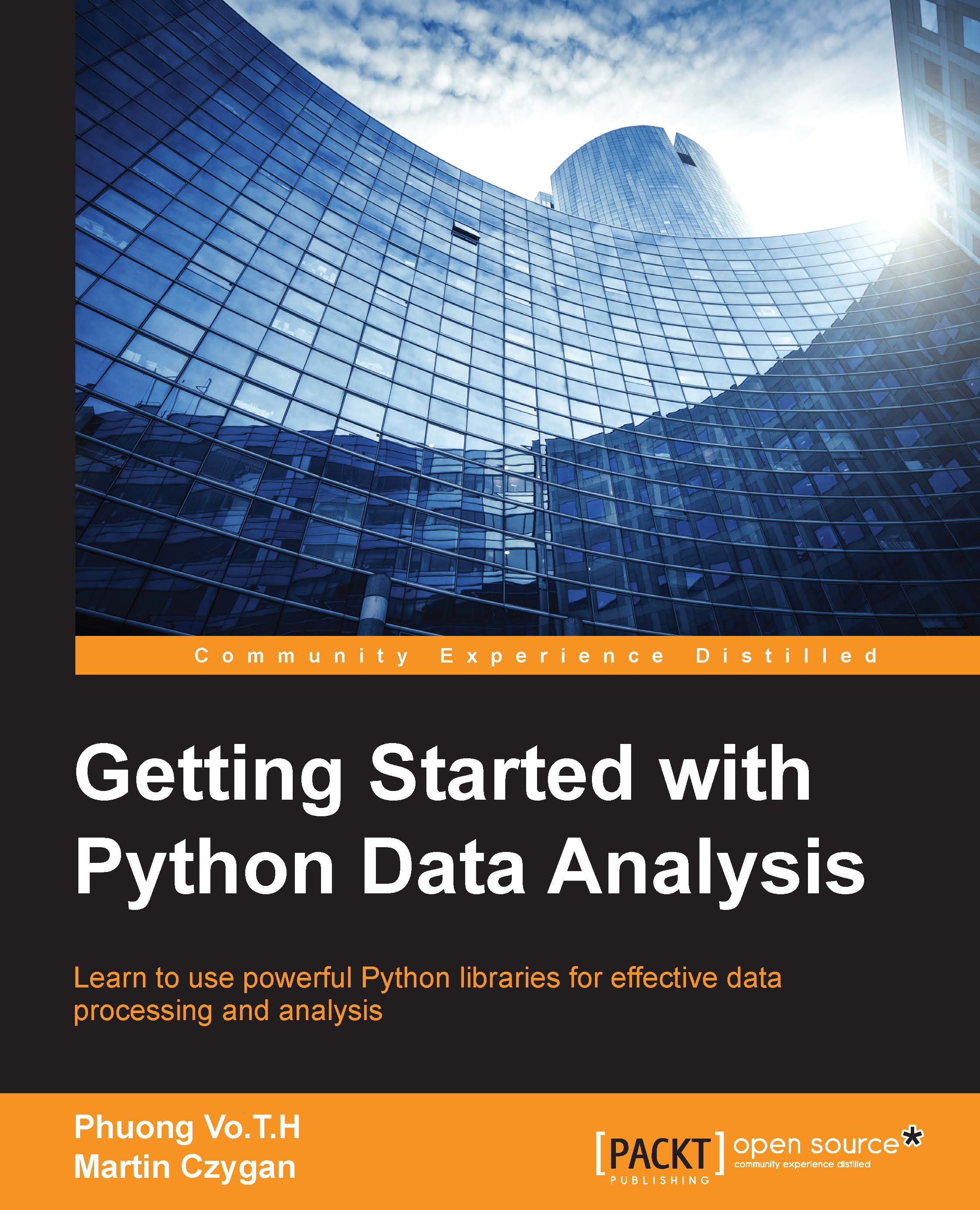
Getting Started with Python Data Analysis

Getting Started with Python Data Analysis

By : Vo.T.H, Czygan
5 (1)
close
close
Getting Started with Python Data Analysis

Getting Started with Python Data Analysis

5 (1)
By: Vo.T.H, Czygan

Overview of this book

Data analysis is the process of applying logical and analytical reasoning to study each component of data. Python is a multi-domain, high-level, programming language. It’s often used as a scripting language because of its forgiving syntax and operability with a wide variety of different eco-systems. Python has powerful standard libraries or toolkits such as Pylearn2 and Hebel, which offers a fast, reliable, cross-platform environment for data analysis. With this book, we will get you started with Python data analysis and show you what its advantages are. The book starts by introducing the principles of data analysis and supported libraries, along with NumPy basics for statistic and data processing. Next it provides an overview of the Pandas package and uses its powerful features to solve data processing problems. Moving on, the book takes you through a brief overview of the Matplotlib API and some common plotting functions for DataFrame such as plot. Next, it will teach you to manipulate the time and data structure, and load and store data in a file or database using Python packages. The book will also teach you how to apply powerful packages in Python to process raw data into pure and helpful data using examples. Finally, the book gives you a brief overview of machine learning algorithms, that is, applying data analysis results to make decisions or build helpful products, such as recommendations and predictions using scikit-learn.
Table of Contents (10 chapters)
close
close
9
Index

The essential basic functionality

Pandas supports many essential functionalities that are useful to manipulate Pandas data structures. In this book, we will focus on the most important features regarding exploration and analysis.

Reindexing and altering labels

Reindex is a critical method in the Pandas data structures. It confirms whether the new or modified data satisfies a given set of labels along a particular axis of Pandas object.

First, let's view a reindex example on a Series object:

>>> s2.reindex([0, 2, 'b', 3])
0    0.6913
2    0.8627
b    NaN
3    0.7286
dtype: float64

When reindexed labels do not exist in the data object, a default value of NaN will be automatically assigned to the position; this holds true for the DataFrame case as well:

>>> df1.reindex(index=[0, 2, 'b', 3],
        columns=['Density', 'Year', 'Median_Age','C'])
   Density  Year  Median_Age        C
0      244  2000        24.2  ...
Visually different images
CONTINUE READING
83
Tech Concepts
36
Programming languages
73
Tech Tools
Icon Unlimited access to the largest independent learning library in tech of over 8,000 expert-authored tech books and videos.
Icon Innovative learning tools, including AI book assistants, code context explainers, and text-to-speech.
Icon 50+ new titles added per month and exclusive early access to books as they are being written.
Getting Started with Python Data Analysis
notes
bookmark Notes and Bookmarks search Search in title playlist Add to playlist font-size Font size

Change the font size

margin-width Margin width

Change margin width

day-mode Day/Sepia/Night Modes

Change background colour

Close icon Search
Country selected

Close icon Your notes and bookmarks

Confirmation

Modal Close icon
claim successful

Buy this book with your credits?

Modal Close icon
Are you sure you want to buy this book with one of your credits?
Close
YES, BUY

Submit Your Feedback

Modal Close icon
Modal Close icon
Modal Close icon