Sign In Start Free Trial
Account

Add to playlist

Create a Playlist

Modal Close icon
You need to login to use this feature.
  • Book Overview & Buying R Data Science Essentials
  • Table Of Contents Toc
R Data Science Essentials

R Data Science Essentials

By : Raja B. Koushik, Sharan Kumar Ravindran
3 (3)
close
close
R Data Science Essentials

R Data Science Essentials

3 (3)
By: Raja B. Koushik, Sharan Kumar Ravindran

Overview of this book

With organizations increasingly embedding data science across their enterprise and with management becoming more data-driven it is an urgent requirement for analysts and managers to understand the key concept of data science. The data science concepts discussed in this book will help you make key decisions and solve the complex problems you will inevitably face in this new world. R Data Science Essentials will introduce you to various important concepts in the field of data science using R. We start by reading data from multiple sources, then move on to processing the data, extracting hidden patterns, building predictive and forecasting models, building a recommendation engine, and communicating to the user through stunning visualizations and dashboards. By the end of this book, you will have an understanding of some very important techniques in data science, be able to implement them using R, understand and interpret the outcomes, and know how they helps businesses make a decision.
Table of Contents (10 chapters)
close
close
9
Index

Generating filtering rules

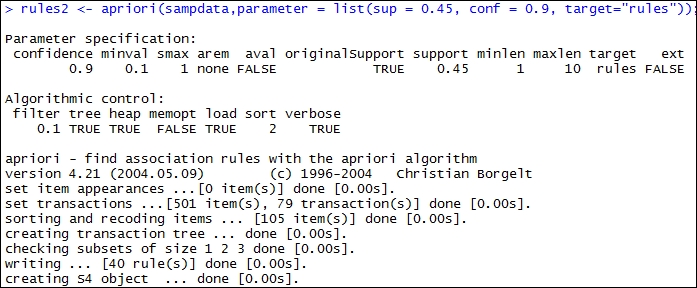
These rules are generated using the apriori function of the arules package. Let's generate the rules for the other dataset this time:

rules2<- apriori(sampdata,parameter = list(sup = 0.45, conf = 0.9, target="rules"));

The following is the output of the preceding command:

Generating filtering rules

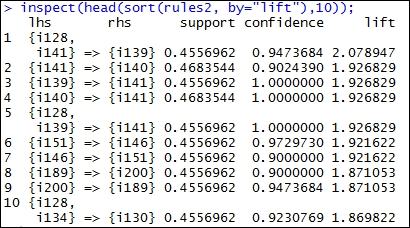
We set the threshold for support as 0.45 and the threshold for confidence as 0.9. From the preceding output, we can see that there are about 40 rules generated. We can print them in descending order of their lift ratio using the following code:

inspect(head(sort(rules2, by="lift"),10))

The output is as follows:

Generating filtering rules

From the output, it is clear that whenever the i128 and i141 items co-occur, it is most likely that the i139 item will occur. Additionally, as the lift value is more than two, it further reiterates that the combination is most likely to occur. We can also get the top rules based on the combination of support, confidence, and lift using the quality function:

head...
CONTINUE READING
83
Tech Concepts
36
Programming languages
73
Tech Tools
Icon Unlimited access to the largest independent learning library in tech of over 8,000 expert-authored tech books and videos.
Icon Innovative learning tools, including AI book assistants, code context explainers, and text-to-speech.
Icon 50+ new titles added per month and exclusive early access to books as they are being written.
R Data Science Essentials
notes
bookmark Notes and Bookmarks search Search in title playlist Add to playlist font-size Font size

Change the font size

margin-width Margin width

Change margin width

day-mode Day/Sepia/Night Modes

Change background colour

Close icon Search
Country selected

Close icon Your notes and bookmarks

Confirmation

Modal Close icon
claim successful

Buy this book with your credits?

Modal Close icon
Are you sure you want to buy this book with one of your credits?
Close
YES, BUY

Submit Your Feedback

Modal Close icon
Modal Close icon
Modal Close icon