Sign In Start Free Trial
Account

Add to playlist

Create a Playlist

Modal Close icon
You need to login to use this feature.
  • Book Overview & Buying Mastering Java Machine Learning
  • Table Of Contents Toc
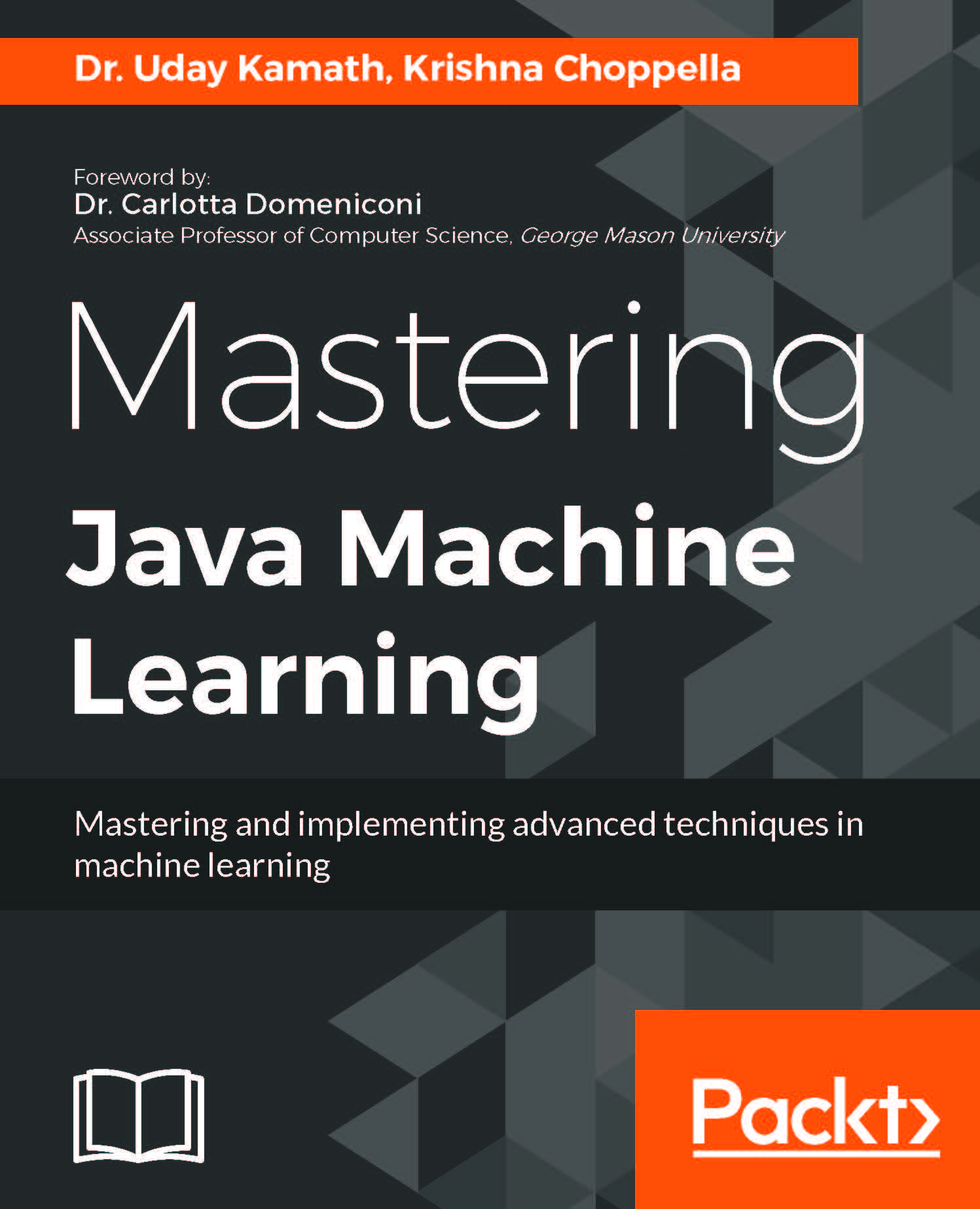
Mastering Java Machine Learning

Mastering Java Machine Learning

By : Kamath, Krishna Choppella
3.4 (9)
close
close
Mastering Java Machine Learning

Mastering Java Machine Learning

3.4 (9)
By: Kamath, Krishna Choppella

Overview of this book

Java is one of the main languages used by practicing data scientists; much of the Hadoop ecosystem is Java-based, and it is certainly the language that most production systems in Data Science are written in. If you know Java, Mastering Machine Learning with Java is your next step on the path to becoming an advanced practitioner in Data Science. This book aims to introduce you to an array of advanced techniques in machine learning, including classification, clustering, anomaly detection, stream learning, active learning, semi-supervised learning, probabilistic graph modeling, text mining, deep learning, and big data batch and stream machine learning. Accompanying each chapter are illustrative examples and real-world case studies that show how to apply the newly learned techniques using sound methodologies and the best Java-based tools available today. On completing this book, you will have an understanding of the tools and techniques for building powerful machine learning models to solve data science problems in just about any domain.
Table of Contents (13 chapters)
close
close
10
A. Linear Algebra
12
Index

Feature analysis and dimensionality reduction


Among the first tools to master are the different feature analysis and dimensionality reduction techniques. As in supervised learning, the need for reducing dimensionality arises from numerous reasons similar to those discussed earlier for feature selection and reduction.

A smaller number of discriminating dimensions makes visualization of data and clusters much easier. In many applications, unsupervised dimensionality reduction techniques are used for compression, which can then be used for transmission or storage of data. This is particularly useful when the larger data has an overhead. Moreover, applying dimensionality reduction techniques can improve the scalability in terms of memory and computation speeds of many algorithms.

Notation

We will use similar notation to what was used in the chapter on supervised learning. The examples are in d dimensions and are represented as vector:

x = (x1,x2,…xd )T

The entire dataset containing n examples can...

CONTINUE READING
83
Tech Concepts
36
Programming languages
73
Tech Tools
Icon Unlimited access to the largest independent learning library in tech of over 8,000 expert-authored tech books and videos.
Icon Innovative learning tools, including AI book assistants, code context explainers, and text-to-speech.
Icon 50+ new titles added per month and exclusive early access to books as they are being written.
Mastering Java Machine Learning
notes
bookmark Notes and Bookmarks search Search in title playlist Add to playlist download Download options font-size Font size

Change the font size

margin-width Margin width

Change margin width

day-mode Day/Sepia/Night Modes

Change background colour

Close icon Search
Country selected

Close icon Your notes and bookmarks

Confirmation

Modal Close icon
claim successful

Buy this book with your credits?

Modal Close icon
Are you sure you want to buy this book with one of your credits?
Close
YES, BUY

Submit Your Feedback

Modal Close icon
Modal Close icon
Modal Close icon