Sign In Start Free Trial
Account

Add to playlist

Create a Playlist

Modal Close icon
You need to login to use this feature.
  • Book Overview & Buying Mastering Spark for Data Science
  • Table Of Contents Toc
  • Feedback & Rating feedback
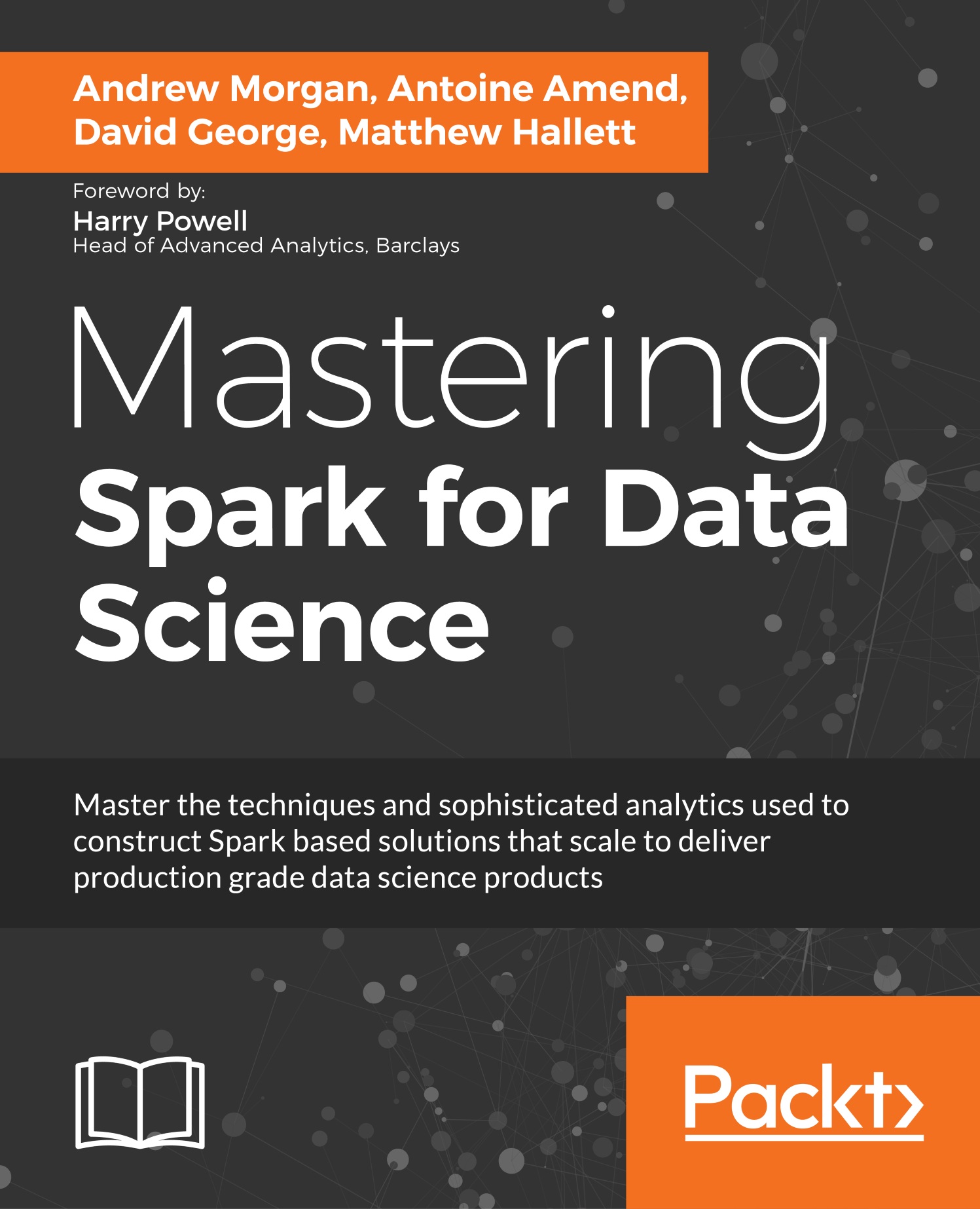
Mastering Spark for Data Science

Mastering Spark for Data Science

By : Bifet, Morgan, Amend, Hallett, George
4 (2)
close
close
Mastering Spark for Data Science

Mastering Spark for Data Science

4 (2)
By: Bifet, Morgan, Amend, Hallett, George

Overview of this book

Data science seeks to transform the world using data, and this is typically achieved through disrupting and changing real processes in real industries. In order to operate at this level you need to build data science solutions of substance –solutions that solve real problems. Spark has emerged as the big data platform of choice for data scientists due to its speed, scalability, and easy-to-use APIs. This book deep dives into using Spark to deliver production-grade data science solutions. This process is demonstrated by exploring the construction of a sophisticated global news analysis service that uses Spark to generate continuous geopolitical and current affairs insights.You will learn all about the core Spark APIs and take a comprehensive tour of advanced libraries, including Spark SQL, Spark Streaming, MLlib, and more. You will be introduced to advanced techniques and methods that will help you to construct commercial-grade data products. Focusing on a sequence of tutorials that deliver a working news intelligence service, you will learn about advanced Spark architectures, how to work with geographic data in Spark, and how to tune Spark algorithms so they scale linearly.
Table of Contents (15 chapters)
close
close

The TrendCalculus algorithm

In this section we will explain the detail of the TrendCalculus implementation, using the Brent oil price data set seen in Chapter 5, Spark for Geographic Analysis, as an example use case.

Trend windows

In order to measure any type of change, we must first quantify it in some way. For trends, we are going to define this in the following manner:

  • Overall positive change (usually expressed as a value increase)

Higher highs and higher lows => +1

  • Overall negative change (usually expressed as a value decrease)

Lower highs and lower lows => -1

We must therefore translate our data into a time series of trend direction, being either +1 or -1. By splitting our data into a series of windows, size n, we can calculate the dated highs and lows for each of them:

Trend windows

Since this type of windowing is a common practice in data science, it is reasonable to think there must be an implementation in Spark; if you have read Chapter 5, Spark for Geographic Analysis you will have seen them...

Visually different images
CONTINUE READING
83
Tech Concepts
36
Programming languages
73
Tech Tools
Icon Unlimited access to the largest independent learning library in tech of over 8,000 expert-authored tech books and videos.
Icon Innovative learning tools, including AI book assistants, code context explainers, and text-to-speech.
Icon 50+ new titles added per month and exclusive early access to books as they are being written.
Mastering Spark for Data Science
notes
bookmark Notes and Bookmarks search Search in title playlist Add to playlist download Download options font-size Font size

Change the font size

margin-width Margin width

Change margin width

day-mode Day/Sepia/Night Modes

Change background colour

Close icon Search
Country selected

Close icon Your notes and bookmarks

Confirmation

Modal Close icon
claim successful

Buy this book with your credits?

Modal Close icon
Are you sure you want to buy this book with one of your credits?
Close
YES, BUY

Submit Your Feedback

Modal Close icon
Modal Close icon
Modal Close icon