Sign In Start Free Trial
Account

Add to playlist

Create a Playlist

Modal Close icon
You need to login to use this feature.
  • Book Overview & Buying Principles of Data Science
  • Table Of Contents Toc
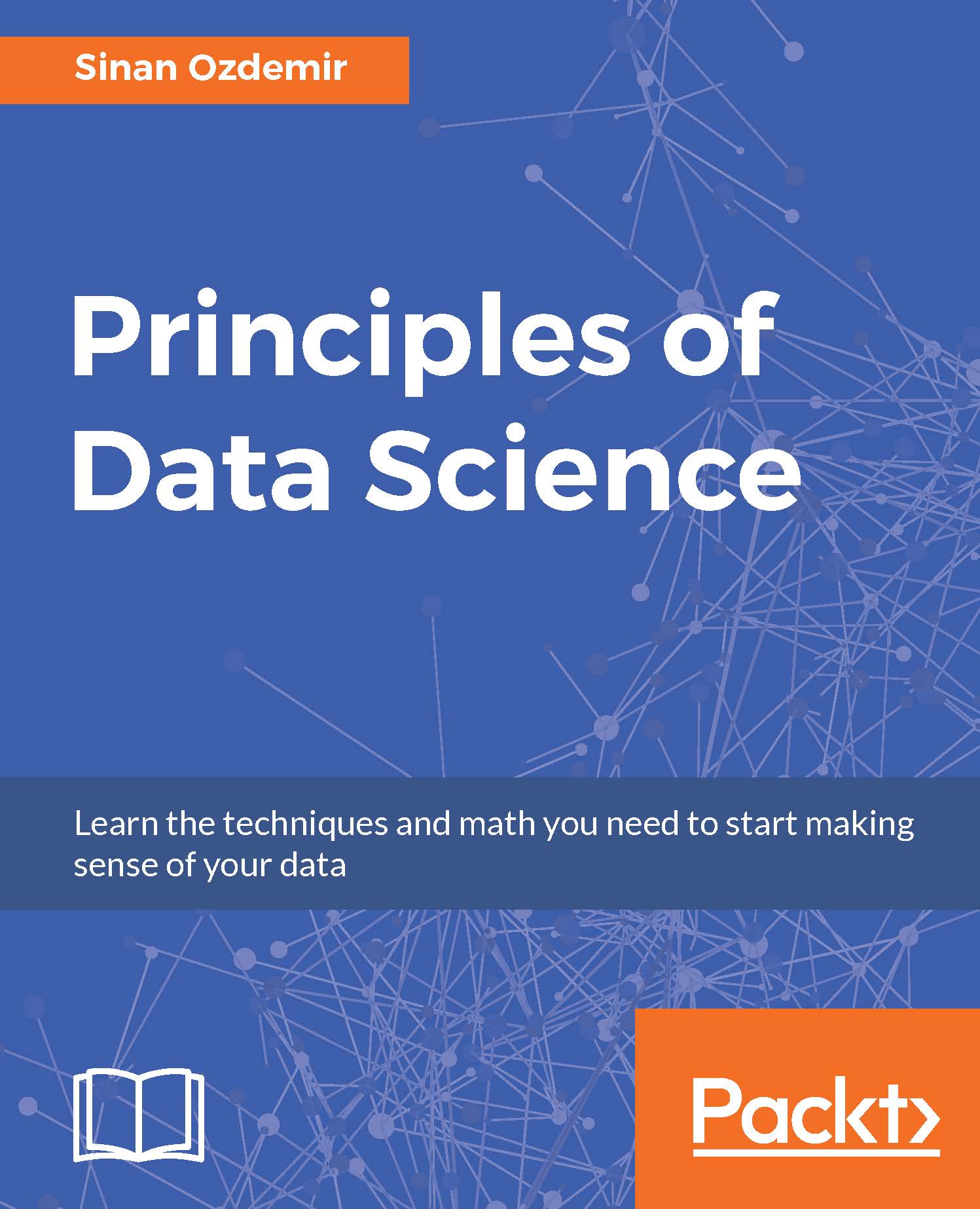
Principles of Data Science

Principles of Data Science

By : Sinan Ozdemir
3.9 (8)
close
close
Principles of Data Science

Principles of Data Science

3.9 (8)
By: Sinan Ozdemir

Overview of this book

Need to turn your skills at programming into effective data science skills? Principles of Data Science is created to help you join the dots between mathematics, programming, and business analysis. With this book, you’ll feel confident about asking—and answering—complex and sophisticated questions of your data to move from abstract and raw statistics to actionable ideas. With a unique approach that bridges the gap between mathematics and computer science, this books takes you through the entire data science pipeline. Beginning with cleaning and preparing data, and effective data mining strategies and techniques, you’ll move on to build a comprehensive picture of how every piece of the data science puzzle fits together. Learn the fundamentals of computational mathematics and statistics, as well as some pseudocode being used today by data scientists and analysts. You’ll get to grips with machine learning, discover the statistical models that help you take control and navigate even the densest datasets, and find out how to create powerful visualizations that communicate what your data means.
Table of Contents (15 chapters)
close
close
14
Index

Summary

In this chapter, we looked at machine learning and its different subcategories. We explored supervised, unsupervised, and reinforcement learning strategies, and looked at situations where each one would come in handy.

Looking into linear regression, we were able to find relationships between predictors and a continuous response variable. Through the train/test split, we were able to help avoid overfitting our machine learning models and get a more generalized prediction. We were able to use metrics, such as the root mean squared error, to evaluate our models as well.

By extending our notion of linear regression into logistic regression, we were able to then find association between the same predictors, but now to categorical responses.

By introducing dummy variables into the mix, we were able to add categorical features to our models and improve our performance even further.

In the next few chapters, we will be taking a much deeper dive into many more machine learning models and, along...

CONTINUE READING
83
Tech Concepts
36
Programming languages
73
Tech Tools
Icon Unlimited access to the largest independent learning library in tech of over 8,000 expert-authored tech books and videos.
Icon Innovative learning tools, including AI book assistants, code context explainers, and text-to-speech.
Icon 50+ new titles added per month and exclusive early access to books as they are being written.
Principles of Data Science
notes
bookmark Notes and Bookmarks search Search in title playlist Add to playlist download Download options font-size Font size

Change the font size

margin-width Margin width

Change margin width

day-mode Day/Sepia/Night Modes

Change background colour

Close icon Search
Country selected

Close icon Your notes and bookmarks

Confirmation

Modal Close icon
claim successful

Buy this book with your credits?

Modal Close icon
Are you sure you want to buy this book with one of your credits?
Close
YES, BUY

Submit Your Feedback

Modal Close icon
Modal Close icon
Modal Close icon