Sign In Start Free Trial
Account

Add to playlist

Create a Playlist

Modal Close icon
You need to login to use this feature.
  • Book Overview & Buying Fast Data Processing with Spark 2
  • Table Of Contents Toc
Fast Data Processing with Spark 2

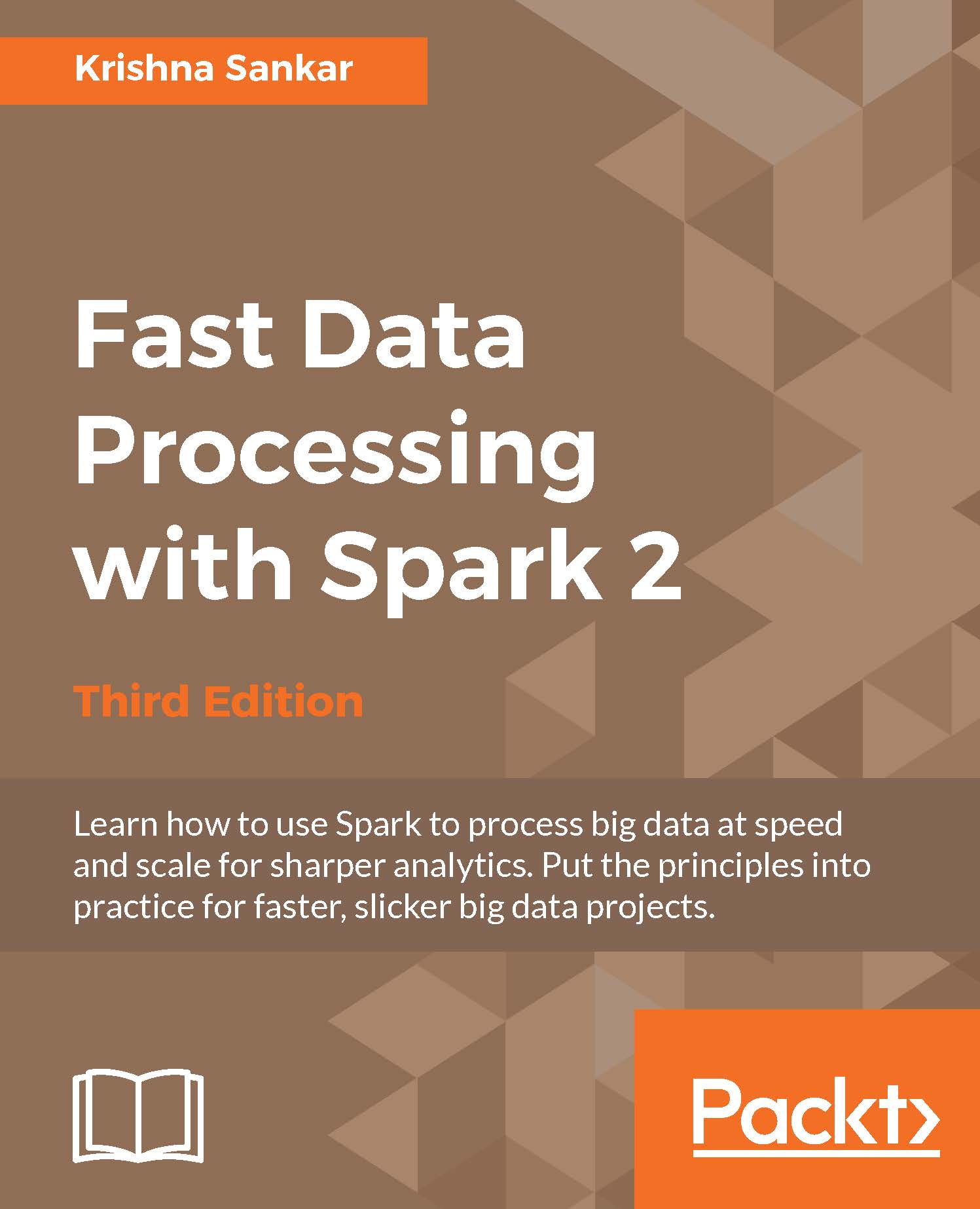
Fast Data Processing with Spark 2 - Third Edition

By : Krishna Sankar , Karau
close
close
Fast Data Processing with Spark 2

Fast Data Processing with Spark 2

By: Krishna Sankar , Karau

Overview of this book

When people want a way to process big data at speed, Spark is invariably the solution. With its ease of development (in comparison to the relative complexity of Hadoop), it’s unsurprising that it’s becoming popular with data analysts and engineers everywhere. Beginning with the fundamentals, we’ll show you how to get set up with Spark with minimum fuss. You’ll then get to grips with some simple APIs before investigating machine learning and graph processing – throughout we’ll make sure you know exactly how to apply your knowledge. You will also learn how to use the Spark shell, how to load data before finding out how to build and run your own Spark applications. Discover how to manipulate your RDD and get stuck into a range of DataFrame APIs. As if that’s not enough, you’ll also learn some useful Machine Learning algorithms with the help of Spark MLlib and integrating Spark with R. We’ll also make sure you’re confident and prepared for graph processing, as you learn more about the GraphX API.
Table of Contents (13 chapters)
close
close

Chapter 1. Installing Spark and Setting Up Your Cluster

This chapter will detail some common methods to set up Spark. Spark on a single machine is excellent for testing or exploring small Datasets, but here you will also learn to use Spark's built-in deployment scripts with a dedicated cluster via Secure Shell (SSH). For Cloud deployments of Spark, this chapter will look at EC2 (both traditional and Elastic Map reduce). Feel free to skip this chapter if you already have your local Spark instance installed and want to get straight to programming. The best way to navigate through installation is to use this chapter as a guide and refer to the Spark installation documentation at http://spark.apache.org/docs/latest/cluster-overview.html.

Regardless of how you are going to deploy Spark, you will want to get the latest version of Spark from https://spark.apache.org/downloads.html (Version 2.0.0 as of this writing). Spark currently releases every 90 days. For coders who want to work with the latest builds, try cloning the code directly from the repository at https://github.com/apache/spark. The building instructions are available at https://spark.apache.org/docs/latest/building-spark.html. Both source code and prebuilt binaries are available at this link. To interact with Hadoop Distributed File System (HDFS), you need to use Spark, which is built against the same version of Hadoop as your cluster. For Version 2.0.0 of Spark, the prebuilt package is built against the available Hadoop Versions 2.3, 2.4, 2.6, and 2.7. If you are up for the challenge, it's recommended that you build against the source as it gives you the flexibility of choosing the HDFS version that you want to support as well as apply patches with. In this chapter, we will do both.

Tip

As you explore the latest version of Spark, an essential task is to read the release notes and especially what has been changed and deprecated. For 2.0.0, the list is slightly long and is available at https://spark.apache.org/releases/spark-release-2-0-0.html#removals-behavior-changes-and-deprecations. For example, the note talks about where the EC2 scripts have moved to and support for Hadoop 2.1 and earlier.

To compile the Spark source, you will need the appropriate version of Scala and the matching JDK. The Spark source tar utility includes the required Scala components. The following discussion is only for information there is no need to install Scala.

The Spark developers have done a good job of managing the dependencies. Refer to the https://spark.apache.org/docs/latest/building-spark.html web page for the latest information on this. The website states that:

"Building Spark using Maven requires Maven 3.3.9 or newer and Java 7+."

Scala gets pulled down as a dependency by Maven (currently Scala 2.11.8). Scala does not need to be installed separately; it is just a bundled dependency.

Just as a note, Spark 2.0.0 by default runs with Scala 2.11.8, but can be compiled to run with Scala 2.10. I have just seen e-mails in the Spark users' group on this.

Tip

This brings up another interesting point about the Spark community. The two essential mailing lists are [email protected] and [email protected]. More details about the Spark community are available at https://spark.apache.org/community.html.

CONTINUE READING
83
Tech Concepts
36
Programming languages
73
Tech Tools
Icon Unlimited access to the largest independent learning library in tech of over 8,000 expert-authored tech books and videos.
Icon Innovative learning tools, including AI book assistants, code context explainers, and text-to-speech.
Icon 50+ new titles added per month and exclusive early access to books as they are being written.
Fast Data Processing with Spark 2
notes
bookmark Notes and Bookmarks search Search in title playlist Add to playlist download Download options font-size Font size

Change the font size

margin-width Margin width

Change margin width

day-mode Day/Sepia/Night Modes

Change background colour

Close icon Search
Country selected

Close icon Your notes and bookmarks

Confirmation

Modal Close icon
claim successful

Buy this book with your credits?

Modal Close icon
Are you sure you want to buy this book with one of your credits?
Close
YES, BUY

Submit Your Feedback

Modal Close icon
Modal Close icon
Modal Close icon