Sign In Start Free Trial
Account

Add to playlist

Create a Playlist

Modal Close icon
You need to login to use this feature.
  • Book Overview & Buying Learning Quantitative Finance with R
  • Table Of Contents Toc
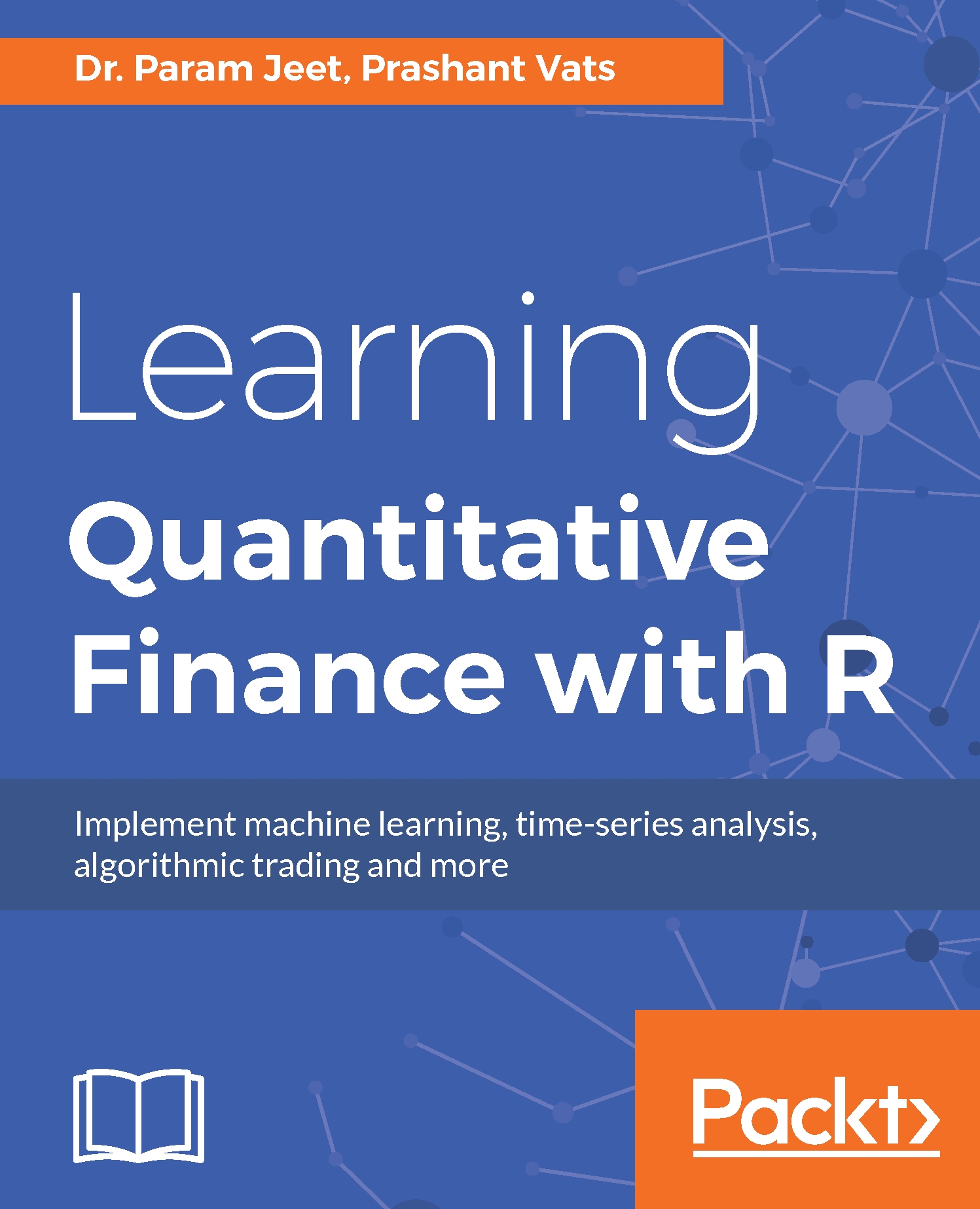
Learning Quantitative Finance with R

Learning Quantitative Finance with R

By : Jeet, PRASHANT VATS
3.7 (3)
close
close
Learning Quantitative Finance with R

Learning Quantitative Finance with R

3.7 (3)
By: Jeet, PRASHANT VATS

Overview of this book

The role of a quantitative analyst is very challenging, yet lucrative, so there is a lot of competition for the role in top-tier organizations and investment banks. This book is your go-to resource if you want to equip yourself with the skills required to tackle any real-world problem in quantitative finance using the popular R programming language. You'll start by getting an understanding of the basics of R and its relevance in the field of quantitative finance. Once you've built this foundation, we'll dive into the practicalities of building financial models in R. This will help you have a fair understanding of the topics as well as their implementation, as the authors have presented some use cases along with examples that are easy to understand and correlate. We'll also look at risk management and optimization techniques for algorithmic trading. Finally, the book will explain some advanced concepts, such as trading using machine learning, optimizations, exotic options, and hedging. By the end of this book, you will have a firm grasp of the techniques required to implement basic quantitative finance models in R.
Table of Contents (10 chapters)
close
close

Probability distributions


Probability distributions determine how the values of random variables are spread. For example, the set of all the possible outcomes of the tossing of a sequence of coins gives rise to binomial distribution. The means of large samples of the data population follow normal distribution, which is the most common and useful distribution.

The features of these distributions are very well known and can be used to extract inferences about the population. We are going to discuss in this chapter some of the most common probability distributions and how to compute them.

Normal distribution

Normal distribution is the most widely used probability distribution in the financial industry. It is a bell-shaped curve and mean, median mode is the same for normal distribution. It is denoted by  where  is the mean and  is the variance of the sample. If the mean is 0 and variance is 1 then the normal distribution is known as standard normal distribution N(1, 0).

Now let us discuss the main...

CONTINUE READING
83
Tech Concepts
36
Programming languages
73
Tech Tools
Icon Unlimited access to the largest independent learning library in tech of over 8,000 expert-authored tech books and videos.
Icon Innovative learning tools, including AI book assistants, code context explainers, and text-to-speech.
Icon 50+ new titles added per month and exclusive early access to books as they are being written.
Learning Quantitative Finance with R
notes
bookmark Notes and Bookmarks search Search in title playlist Add to playlist download Download options font-size Font size

Change the font size

margin-width Margin width

Change margin width

day-mode Day/Sepia/Night Modes

Change background colour

Close icon Search
Country selected

Close icon Your notes and bookmarks

Confirmation

Modal Close icon
claim successful

Buy this book with your credits?

Modal Close icon
Are you sure you want to buy this book with one of your credits?
Close
YES, BUY

Submit Your Feedback

Modal Close icon
Modal Close icon
Modal Close icon