Sign In Start Free Trial
Account

Add to playlist

Create a Playlist

Modal Close icon
You need to login to use this feature.
  • Book Overview & Buying Learning PySpark
  • Table Of Contents Toc
Learning PySpark

Learning PySpark

By : Drabas, Lee
3.9 (194)
close
close
Learning PySpark

Learning PySpark

3.9 (194)
By: Drabas, Lee

Overview of this book

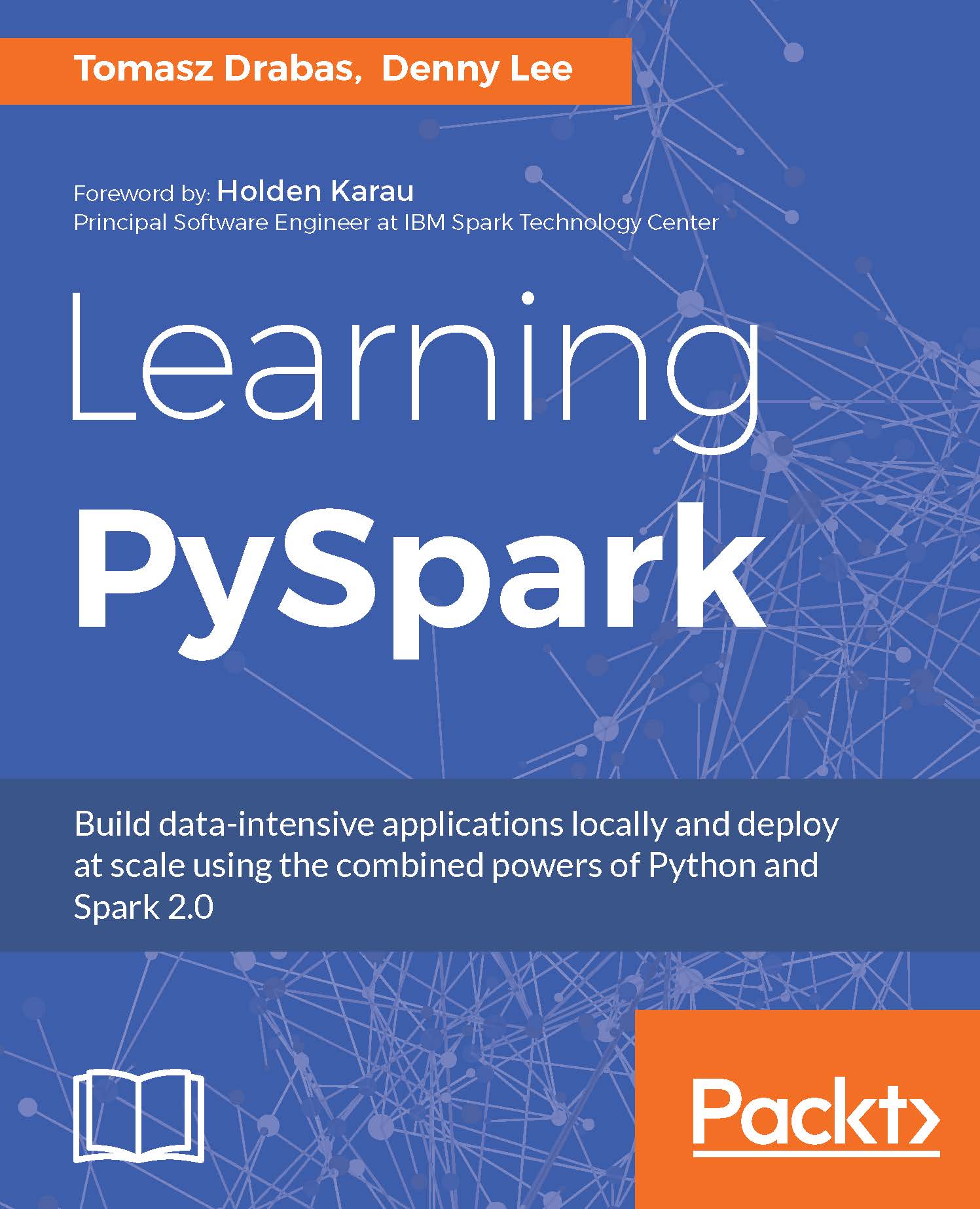
Apache Spark is an open source framework for efficient cluster computing with a strong interface for data parallelism and fault tolerance. This book will show you how to leverage the power of Python and put it to use in the Spark ecosystem. You will start by getting a firm understanding of the Spark 2.0 architecture and how to set up a Python environment for Spark. You will get familiar with the modules available in PySpark. You will learn how to abstract data with RDDs and DataFrames and understand the streaming capabilities of PySpark. Also, you will get a thorough overview of machine learning capabilities of PySpark using ML and MLlib, graph processing using GraphFrames, and polyglot persistence using Blaze. Finally, you will learn how to deploy your applications to the cloud using the spark-submit command. By the end of this book, you will have established a firm understanding of the Spark Python API and how it can be used to build data-intensive applications.
Table of Contents (13 chapters)
close
close
12
Index

Checking for duplicates, missing observations, and outliers


Until you have fully tested the data and proven it worthy of your time, you should neither trust it nor use it. In this section, we will show you how to deal with duplicates, missing observations, and outliers.

Duplicates

Duplicates are observations that appear as distinct rows in your dataset, but which, upon closer inspection, look the same. That is, if you looked at them side by side, all the features in these two (or more) rows would have exactly the same values.

On the other hand, if your data has some form of an ID to distinguish between records (or associate them with certain users, for example), then what might initially appear as a duplicate may not be; sometimes systems fail and produce erroneous IDs. In such a situation, you need to either check whether the same ID is a real duplicate, or you need to come up with a new ID system.

Consider the following example:

df = spark.createDataFrame([
        (1, 144.5, 5.9, 33, 'M')...
Visually different images
CONTINUE READING
83
Tech Concepts
36
Programming languages
73
Tech Tools
Icon Unlimited access to the largest independent learning library in tech of over 8,000 expert-authored tech books and videos.
Icon Innovative learning tools, including AI book assistants, code context explainers, and text-to-speech.
Icon 50+ new titles added per month and exclusive early access to books as they are being written.
Learning PySpark
notes
bookmark Notes and Bookmarks search Search in title playlist Add to playlist download Download options font-size Font size

Change the font size

margin-width Margin width

Change margin width

day-mode Day/Sepia/Night Modes

Change background colour

Close icon Search
Country selected

Close icon Your notes and bookmarks

Confirmation

Modal Close icon
claim successful

Buy this book with your credits?

Modal Close icon
Are you sure you want to buy this book with one of your credits?
Close
YES, BUY

Submit Your Feedback

Modal Close icon
Modal Close icon
Modal Close icon