
Sign In Start Free Trial
Account

Add to playlist

Create a Playlist

Modal Close icon
You need to login to use this feature.
  • Book Overview & Buying Python Data Structures and Algorithms
  • Table Of Contents Toc
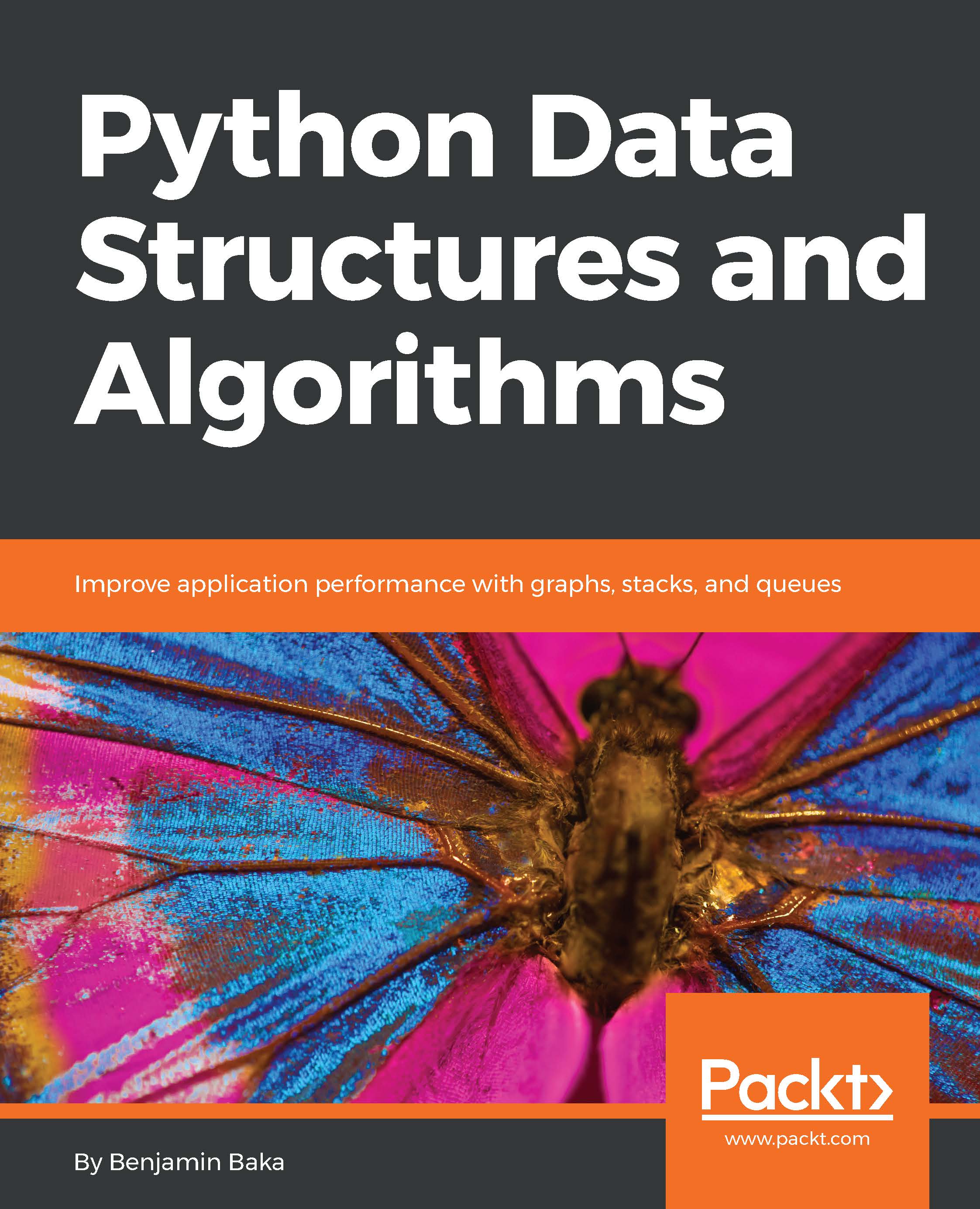
Python Data Structures and Algorithms

Python Data Structures and Algorithms

By : Benjamin Baka
2.7 (11)
close
close
Python Data Structures and Algorithms

Python Data Structures and Algorithms

2.7 (11)
By: Benjamin Baka

Overview of this book

Data structures allow you to organize data in a particular way efficiently. They are critical to any problem, provide a complete solution, and act like reusable code. In this book, you will learn the essential Python data structures and the most common algorithms. With this easy-to-read book, you will be able to understand the power of linked lists, double linked lists, and circular linked lists. You will be able to create complex data structures such as graphs, stacks and queues. We will explore the application of binary searches and binary search trees. You will learn the common techniques and structures used in tasks such as preprocessing, modeling, and transforming data. We will also discuss how to organize your code in a manageable, consistent, and extendable way. The book will explore in detail sorting algorithms such as bubble sort, selection sort, insertion sort, and merge sort. By the end of the book, you will learn how to build components that are easy to understand, debug, and use in different applications.
Table of Contents (14 chapters)
close
close
5
Stacks and Queues
7
Hashing and Symbol Tables

Recursion and backtracking

Recursion is particularly useful for divide and conquer problems; however, it can be difficult to understand exactly what is happening, since each recursive call is itself spinning off other recursive calls. At the core of a recursive function are two types of cases: base cases, which tell the recursion when to terminate, and recursive cases that call the function they are in. A simple problem that naturally lends itself to a recursive solution is calculating factorials. The recursive factorial algorithm defines two cases: the base case when n is zero, and the recursive case when n is greater than zero. A typical implementation is the following:

    def factorial(n):
#test for a base case
if n==0:
return 1
# make a calculation and a recursive call
f= n*factorial(n-1)
print(f)
return(f)
...
CONTINUE READING
83
Tech Concepts
36
Programming languages
73
Tech Tools
Icon Unlimited access to the largest independent learning library in tech of over 8,000 expert-authored tech books and videos.
Icon Innovative learning tools, including AI book assistants, code context explainers, and text-to-speech.
Icon 50+ new titles added per month and exclusive early access to books as they are being written.
Python Data Structures and Algorithms
notes
bookmark Notes and Bookmarks search Search in title playlist Add to playlist download Download options font-size Font size

Change the font size

margin-width Margin width

Change margin width

day-mode Day/Sepia/Night Modes

Change background colour

Close icon Search
Country selected

Close icon Your notes and bookmarks

Confirmation

Modal Close icon
claim successful

Buy this book with your credits?

Modal Close icon
Are you sure you want to buy this book with one of your credits?
Close
YES, BUY

Submit Your Feedback

Modal Close icon
Modal Close icon
Modal Close icon