
Sign In Start Free Trial
Account

Add to playlist

Create a Playlist

Modal Close icon
You need to login to use this feature.
  • Book Overview & Buying Apache Spark 2.x for Java Developers
  • Table Of Contents Toc
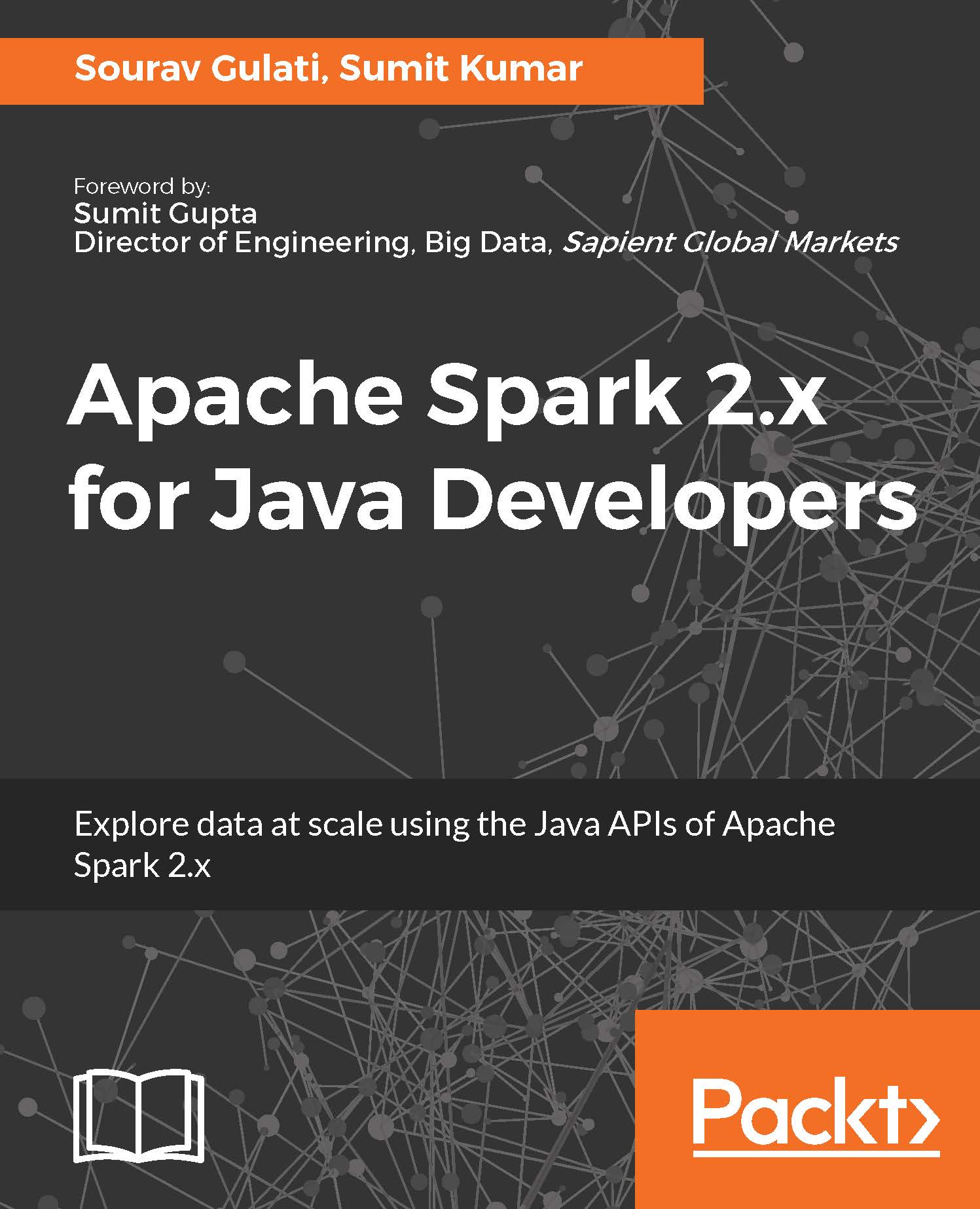
Apache Spark 2.x for Java Developers

Apache Spark 2.x for Java Developers

By : Kumar, Gulati
2 (4)
close
close
Apache Spark 2.x for Java Developers

Apache Spark 2.x for Java Developers

2 (4)
By: Kumar, Gulati

Overview of this book

Apache Spark is the buzzword in the big data industry right now, especially with the increasing need for real-time streaming and data processing. While Spark is built on Scala, the Spark Java API exposes all the Spark features available in the Scala version for Java developers. This book will show you how you can implement various functionalities of the Apache Spark framework in Java, without stepping out of your comfort zone. The book starts with an introduction to the Apache Spark 2.x ecosystem, followed by explaining how to install and configure Spark, and refreshes the Java concepts that will be useful to you when consuming Apache Spark's APIs. You will explore RDD and its associated common Action and Transformation Java APIs, set up a production-like clustered environment, and work with Spark SQL. Moving on, you will perform near-real-time processing with Spark streaming, Machine Learning analytics with Spark MLlib, and graph processing with GraphX, all using various Java packages. By the end of the book, you will have a solid foundation in implementing components in the Spark framework in Java to build fast, real-time applications.
Table of Contents (12 chapters)
close
close

Generics

Generics were introduced in Java 1.5. Generics help the user to create the general purpose code that has abstract type in its definition. That abstract type can be replaced with any concrete type in the implementation.

For example, the list interface or its implementations, such as ArrayList, LinkedList and so on, are defined with generic type. Users can provide the concrete type such as Integer, Long, or String while implementing the list:

List<Integer> list1 =new ArrayList<Integer>(); 
List<String> list2 =new ArrayList<String>(); 

Here, list1 is the list of integers and list2 is the list of strings. With Java 7, the compiler can infer the type. So the preceding code can also be written as follows:

List<Integer> list1 =new ArrayList<>(); 
List<String> list2 =new ArrayList<>(); 

Another huge benefit of generic type is...

CONTINUE READING
83
Tech Concepts
36
Programming languages
73
Tech Tools
Icon Unlimited access to the largest independent learning library in tech of over 8,000 expert-authored tech books and videos.
Icon Innovative learning tools, including AI book assistants, code context explainers, and text-to-speech.
Icon 50+ new titles added per month and exclusive early access to books as they are being written.
Apache Spark 2.x for Java Developers
notes
bookmark Notes and Bookmarks search Search in title playlist Add to playlist download Download options font-size Font size

Change the font size

margin-width Margin width

Change margin width

day-mode Day/Sepia/Night Modes

Change background colour

Close icon Search
Country selected

Close icon Your notes and bookmarks

Confirmation

Modal Close icon
claim successful

Buy this book with your credits?

Modal Close icon
Are you sure you want to buy this book with one of your credits?
Close
YES, BUY

Submit Your Feedback

Modal Close icon
Modal Close icon
Modal Close icon