Sign In Start Free Trial
Account

Add to playlist

Create a Playlist

Modal Close icon
You need to login to use this feature.
  • Book Overview & Buying Apache Spark 2.x Cookbook
  • Table Of Contents Toc
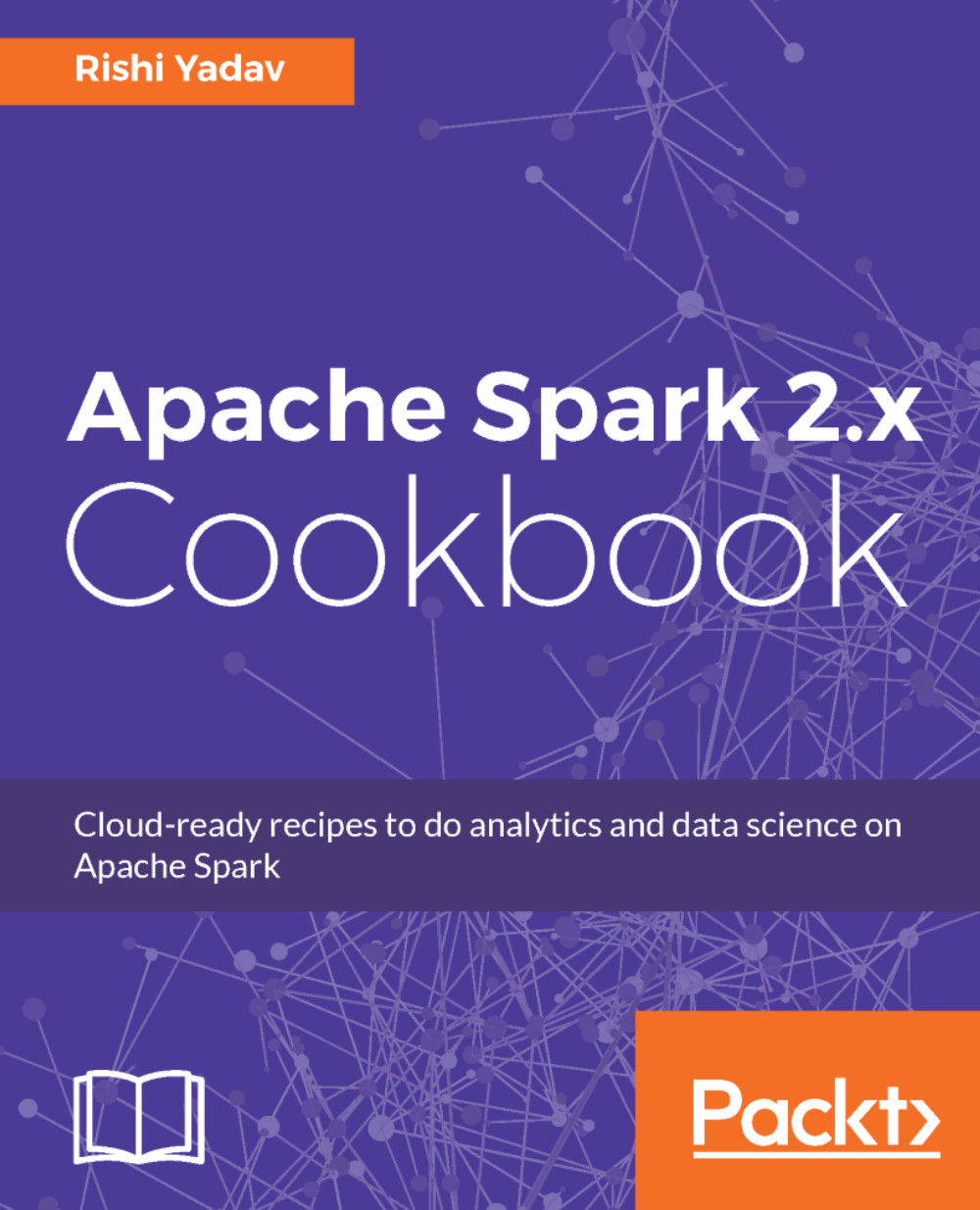
Apache Spark 2.x Cookbook

Apache Spark 2.x Cookbook

By : Yadav
3.3 (3)
close
close
Apache Spark 2.x Cookbook

Apache Spark 2.x Cookbook

3.3 (3)
By: Yadav

Overview of this book

While Apache Spark 1.x gained a lot of traction and adoption in the early years, Spark 2.x delivers notable improvements in the areas of API, schema awareness, Performance, Structured Streaming, and simplifying building blocks to build better, faster, smarter, and more accessible big data applications. This book uncovers all these features in the form of structured recipes to analyze and mature large and complex sets of data. Starting with installing and configuring Apache Spark with various cluster managers, you will learn to set up development environments. Further on, you will be introduced to working with RDDs, DataFrames and Datasets to operate on schema aware data, and real-time streaming with various sources such as Twitter Stream and Apache Kafka. You will also work through recipes on machine learning, including supervised learning, unsupervised learning & recommendation engines in Spark. Last but not least, the final few chapters delve deeper into the concepts of graph processing using GraphX, securing your implementations, cluster optimization, and troubleshooting.
Table of Contents (13 chapters)
close
close

Doing classification using random forest


Sometimes, one decision tree is not enough, so a set of decision trees is used to produce more powerful models. These are called ensemble learning algorithms. Ensemble learning algorithms are not limited to using decision trees as base models.

The most popular ensemble learning algorithm is random forest. In random forest, rather than growing one single tree, K number of trees are grown. Every tree is given a random subset S of training data. To add a twist to it, every tree only uses a subset of features. When it comes to making predictions, a majority vote is done on the trees and that becomes the prediction.

Let me explain this with an example. The goal is to make a prediction for a given person about whether he/she has good credit or bad credit.

To do this, we will provide labeled training data—in this case, a person with features and labels indicating whether he/she has good credit or bad credit. Now we do not want to create feature bias, so we...

CONTINUE READING
83
Tech Concepts
36
Programming languages
73
Tech Tools
Icon Unlimited access to the largest independent learning library in tech of over 8,000 expert-authored tech books and videos.
Icon Innovative learning tools, including AI book assistants, code context explainers, and text-to-speech.
Icon 50+ new titles added per month and exclusive early access to books as they are being written.
Apache Spark 2.x Cookbook
notes
bookmark Notes and Bookmarks search Search in title playlist Add to playlist font-size Font size

Change the font size

margin-width Margin width

Change margin width

day-mode Day/Sepia/Night Modes

Change background colour

Close icon Search
Country selected

Close icon Your notes and bookmarks

Confirmation

Modal Close icon
claim successful

Buy this book with your credits?

Modal Close icon
Are you sure you want to buy this book with one of your credits?
Close
YES, BUY

Submit Your Feedback

Modal Close icon
Modal Close icon
Modal Close icon