Sign In Start Free Trial
Account

Add to playlist

Create a Playlist

Modal Close icon
You need to login to use this feature.
  • Book Overview & Buying Big Data Analytics with Java
  • Table Of Contents Toc
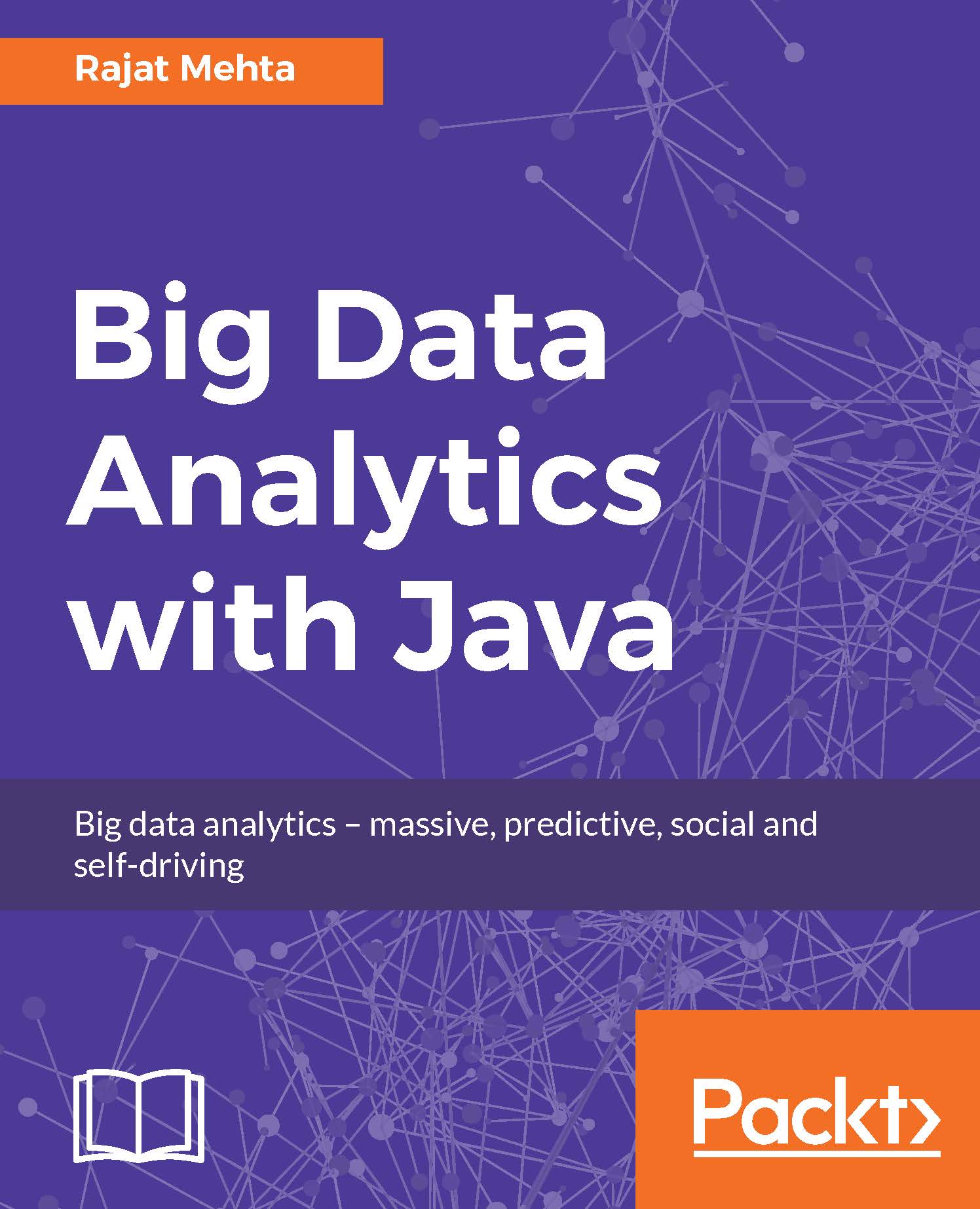
Big Data Analytics with Java

Big Data Analytics with Java

By : RAJAT MEHTA
4.3 (3)
close
close
Big Data Analytics with Java

Big Data Analytics with Java

4.3 (3)
By: RAJAT MEHTA

Overview of this book

This book covers case studies such as sentiment analysis on a tweet dataset, recommendations on a movielens dataset, customer segmentation on an ecommerce dataset, and graph analysis on actual flights dataset. This book is an end-to-end guide to implement analytics on big data with Java. Java is the de facto language for major big data environments, including Hadoop. This book will teach you how to perform analytics on big data with production-friendly Java. This book basically divided into two sections. The first part is an introduction that will help the readers get acquainted with big data environments, whereas the second part will contain a hardcore discussion on all the concepts in analytics on big data. It will take you from data analysis and data visualization to the core concepts and advantages of machine learning, real-life usage of regression and classification using Naïve Bayes, a deep discussion on the concepts of clustering,and a review of simple neural networks on big data using deepLearning4j or plain Java Spark code. This book is a must-have book for Java developers who want to start learning big data analytics and want to use it in the real world.
Table of Contents (15 chapters)
close
close
Lock Free Chapter
1
1. Big Data Analytics with Java
8
8. Ensembling on Big Data
12
12. Real-Time Analytics on Big Data
14
Index

Summary

In this chapter, we learned about recommendation engines. We saw the two types of recommendation engines, that is, content recommenders and collaborative filtering recommenders. We learned how content recommenders can be built on zero to no historical data and are based on the attributes present on the item itself, using which, we figure out the similarity with other items and recommend them. Later, we worked on a collaborative filtering example using the same MovieLens dataset and the Apache Spark alternating least square recommender. We learned that collaborative filtering is based on historical data of users' activity, based on which other similar users are figured out and the products they liked are recommended to the other users.

In the next chapter, we will learn two important algorithms that are part of the unsupervised learning world and they will help us form clusters or groups in unlabeled data. We will also see how these algorithms help us segment the important customers...

CONTINUE READING
83
Tech Concepts
36
Programming languages
73
Tech Tools
Icon Unlimited access to the largest independent learning library in tech of over 8,000 expert-authored tech books and videos.
Icon Innovative learning tools, including AI book assistants, code context explainers, and text-to-speech.
Icon 50+ new titles added per month and exclusive early access to books as they are being written.
Big Data Analytics with Java
notes
bookmark Notes and Bookmarks search Search in title playlist Add to playlist download Download options font-size Font size

Change the font size

margin-width Margin width

Change margin width

day-mode Day/Sepia/Night Modes

Change background colour

Close icon Search
Country selected

Close icon Your notes and bookmarks

Confirmation

Modal Close icon
claim successful

Buy this book with your credits?

Modal Close icon
Are you sure you want to buy this book with one of your credits?
Close
YES, BUY

Submit Your Feedback

Modal Close icon
Modal Close icon
Modal Close icon