
Sign In Start Free Trial
Account

Add to playlist

Create a Playlist

Modal Close icon
You need to login to use this feature.
  • Book Overview & Buying Practical Time Series Analysis
  • Table Of Contents Toc
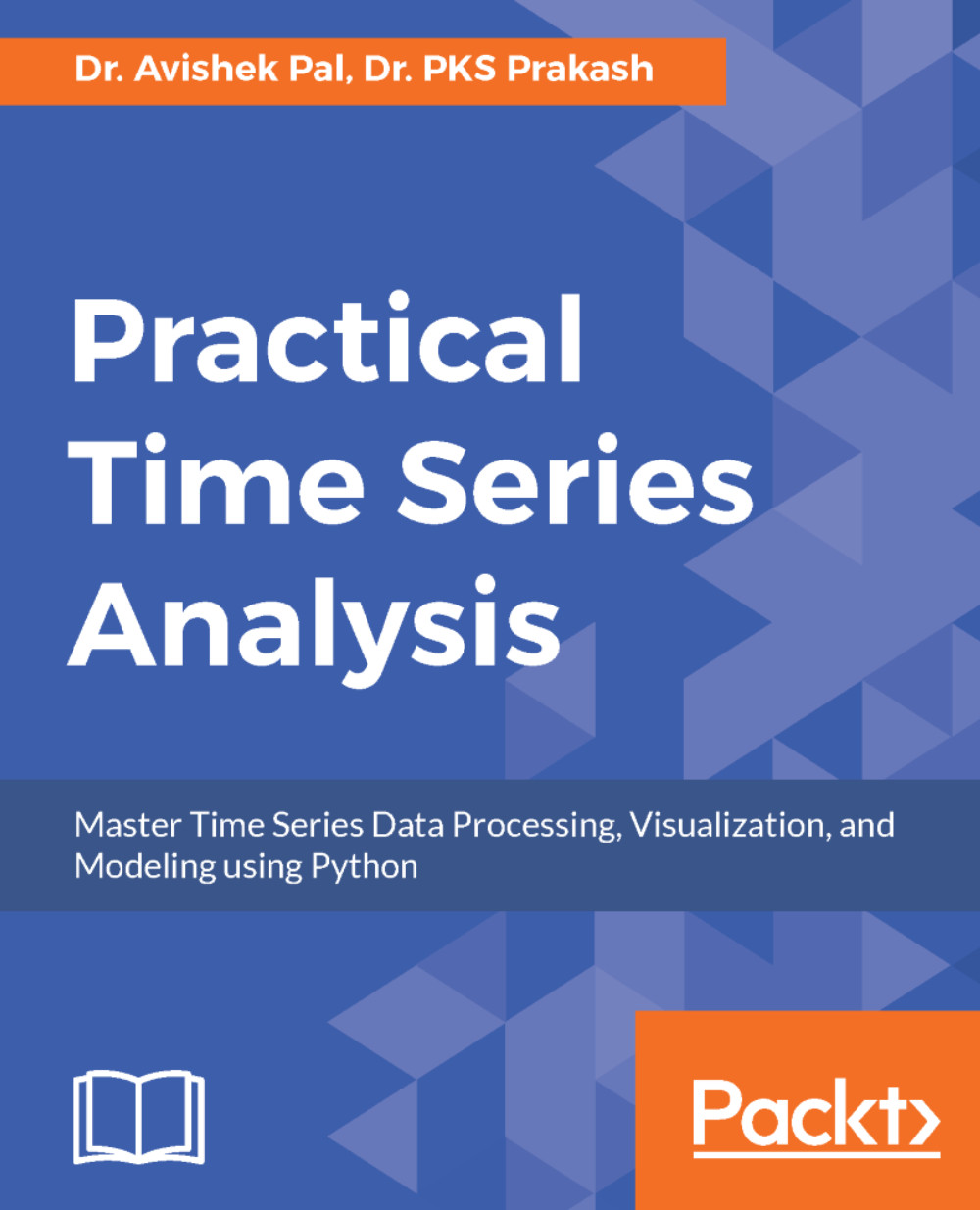
Practical Time Series Analysis

Practical Time Series Analysis

By : Avishek Pal, PKS Prakash
1.4 (5)
close
close
Practical Time Series Analysis

Practical Time Series Analysis

1.4 (5)
By: Avishek Pal, PKS Prakash

Overview of this book

Time Series Analysis allows us to analyze data which is generated over a period of time and has sequential interdependencies between the observations. This book describes special mathematical tricks and techniques which are geared towards exploring the internal structures of time series data and generating powerful descriptive and predictive insights. Also, the book is full of real-life examples of time series and their analyses using cutting-edge solutions developed in Python. The book starts with descriptive analysis to create insightful visualizations of internal structures such as trend, seasonality, and autocorrelation. Next, the statistical methods of dealing with autocorrelation and non-stationary time series are described. This is followed by exponential smoothing to produce meaningful insights from noisy time series data. At this point, we shift focus towards predictive analysis and introduce autoregressive models such as ARMA and ARIMA for time series forecasting. Later, powerful deep learning methods are presented, to develop accurate forecasting models for complex time series, and under the availability of little domain knowledge. All the topics are illustrated with real-life problem scenarios and their solutions by best-practice implementations in Python. The book concludes with the Appendix, with a brief discussion of programming and solving data science problems using Python.
Table of Contents (7 chapters)
close
close

Summary

In this chapter, we covered auto-regressive models such as a MA model to capture serial correlation using error relationship. On similar lines, AR models were covered, which set up the forecasting using the lags as dependent observations. The AR models are good to capture trend information. The ARMA-based approach was also illustrated, which integrates AR and MA models to capture any time-based trends and catastrophic events leading to a lot of error that will take time to correct such as an economy meltdown. All these models assume stationarity; in scenarios where stationarity is not present, a differencing-based model such as ARIMA is proposed, which performs differencing in time series datasets to remove any trend-related components. The forecasting approaches were illustrated with examples using Python's tsa module.

The current chapter focuses on using statistical...

CONTINUE READING
83
Tech Concepts
36
Programming languages
73
Tech Tools
Icon Unlimited access to the largest independent learning library in tech of over 8,000 expert-authored tech books and videos.
Icon Innovative learning tools, including AI book assistants, code context explainers, and text-to-speech.
Icon 50+ new titles added per month and exclusive early access to books as they are being written.
Practical Time Series Analysis
notes
bookmark Notes and Bookmarks search Search in title playlist Add to playlist download Download options font-size Font size

Change the font size

margin-width Margin width

Change margin width

day-mode Day/Sepia/Night Modes

Change background colour

Close icon Search
Country selected

Close icon Your notes and bookmarks

Confirmation

Modal Close icon
claim successful

Buy this book with your credits?

Modal Close icon
Are you sure you want to buy this book with one of your credits?
Close
YES, BUY

Submit Your Feedback

Modal Close icon
Modal Close icon
Modal Close icon