Sign In Start Free Trial
Account

Add to playlist

Create a Playlist

Modal Close icon
You need to login to use this feature.
  • Book Overview & Buying Deep Learning for Computer Vision
  • Table Of Contents Toc
Deep Learning for Computer Vision

Deep Learning for Computer Vision

By : Rajalingappaa Shanmugamani
3.2 (22)
close
close
Deep Learning for Computer Vision

Deep Learning for Computer Vision

3.2 (22)
By: Rajalingappaa Shanmugamani

Overview of this book

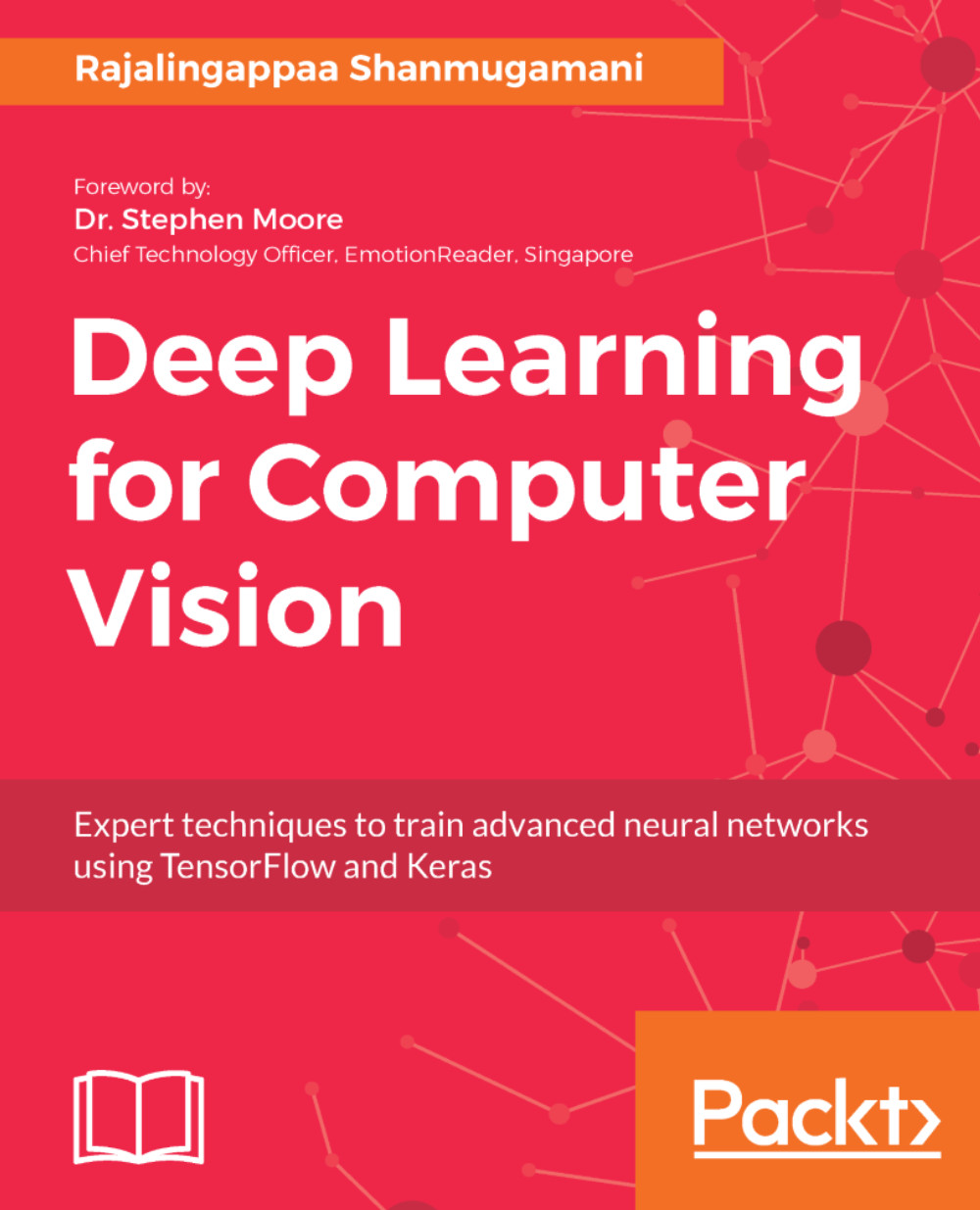
Deep learning has shown its power in several application areas of Artificial Intelligence, especially in Computer Vision. Computer Vision is the science of understanding and manipulating images, and finds enormous applications in the areas of robotics, automation, and so on. This book will also show you, with practical examples, how to develop Computer Vision applications by leveraging the power of deep learning. In this book, you will learn different techniques related to object classification, object detection, image segmentation, captioning, image generation, face analysis, and more. You will also explore their applications using popular Python libraries such as TensorFlow and Keras. This book will help you master state-of-the-art, deep learning algorithms and their implementation.
Table of Contents (12 chapters)
close
close

Algorithms for semantic segmentation


There are several deep learning-based algorithms that were proposed to solve image segmentation tasks. A sliding window approach can be applied at a pixel level for segmentation. A sliding window approach takes an image and breaks the image into smaller crops. Every crop of the image is classified for a label. This approach is expensive and inefficient because it doesn't reuse the shared features between the overlapping patches. In the following sections, we will discuss a few algorithms that can overcome this problem.

The Fully Convolutional Network

The Fully Convolutional Network (FCN) introduced the idea of an end-to-end convolutional network. Any standard CNN architecture can be used for FCN by removing the fully connected layers, and the implementation of the same was shown in Chapter 4, Object Detection. The fully connected layers are replaced by a convolution layer. The depth is higher in the final layers and the size is smaller. Hence, 1D convolution...

CONTINUE READING
83
Tech Concepts
36
Programming languages
73
Tech Tools
Icon Unlimited access to the largest independent learning library in tech of over 8,000 expert-authored tech books and videos.
Icon Innovative learning tools, including AI book assistants, code context explainers, and text-to-speech.
Icon 50+ new titles added per month and exclusive early access to books as they are being written.
Deep Learning for Computer Vision
notes
bookmark Notes and Bookmarks search Search in title playlist Add to playlist download Download options font-size Font size

Change the font size

margin-width Margin width

Change margin width

day-mode Day/Sepia/Night Modes

Change background colour

Close icon Search
Country selected

Close icon Your notes and bookmarks

Confirmation

Modal Close icon
claim successful

Buy this book with your credits?

Modal Close icon
Are you sure you want to buy this book with one of your credits?
Close
YES, BUY

Submit Your Feedback

Modal Close icon
Modal Close icon
Modal Close icon