Sign In Start Free Trial
Account

Add to playlist

Create a Playlist

Modal Close icon
You need to login to use this feature.
  • Book Overview & Buying Learning Apache Apex
  • Table Of Contents Toc
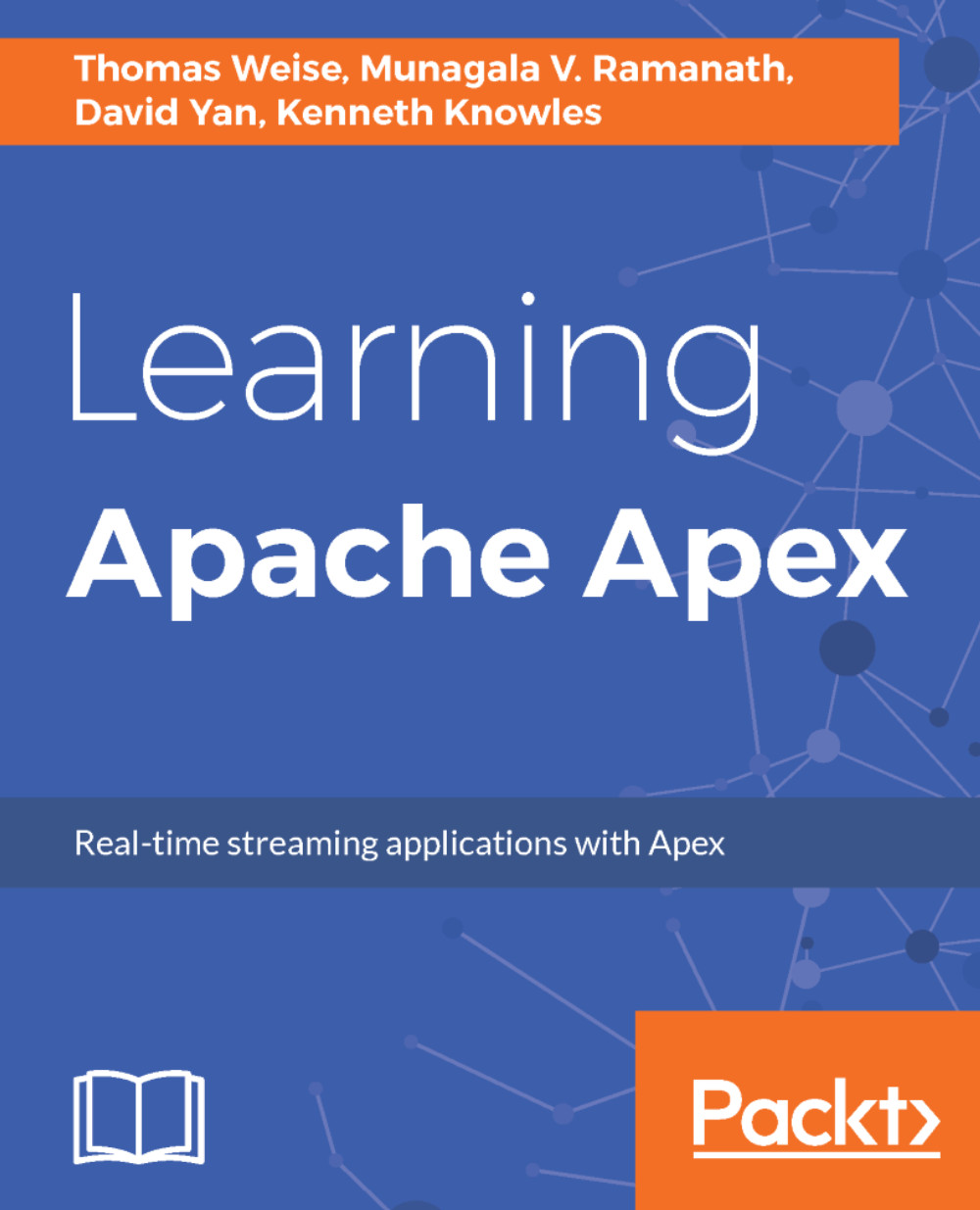
Learning Apache Apex

Learning Apache Apex

By : Gundabattula, Thomas Weise, Munagala V. Ramanath, David Yan, Kenneth Knowles
5 (1)
close
close
Learning Apache Apex

Learning Apache Apex

5 (1)
By: Gundabattula, Thomas Weise, Munagala V. Ramanath, David Yan, Kenneth Knowles

Overview of this book

Apache Apex is a next-generation stream processing framework designed to operate on data at large scale, with minimum latency, maximum reliability, and strict correctness guarantees. Half of the book consists of Apex applications, showing you key aspects of data processing pipelines such as connectors for sources and sinks, and common data transformations. The other half of the book is evenly split into explaining the Apex framework, and tuning, testing, and scaling Apex applications. Much of our economic world depends on growing streams of data, such as social media feeds, financial records, data from mobile devices, sensors and machines (the Internet of Things - IoT). The projects in the book show how to process such streams to gain valuable, timely, and actionable insights. Traditional use cases, such as ETL, that currently consume a significant chunk of data engineering resources are also covered. The final chapter shows you future possibilities emerging in the streaming space, and how Apache Apex can contribute to it.
Table of Contents (11 chapters)
close
close

Elasticity


As described in the preceding section, the number of desired partitions of each operator that is likely to be a bottleneck can be specified as part of the application configuration and the platform will ensure that the desired partitions are created at application start time. However, this is not possible when the volume of data flows can fluctuate unpredictably since we cannot forecast the number of required partitions.

The platform has the required elasticity to support such scenarios via dynamic scaling: the application writer can implement the Partitioner interface along with the related StatsListener interface, either directly in the operator or in a separate object that is set on the operator as an attribute. These interfaces allow the operator to periodically examine current metrics such as throughput, latency, or even custom metrics, and, based on those values, create new partitions or remove existing partitions, or both. All the resource allocation and deallocation is...

CONTINUE READING
83
Tech Concepts
36
Programming languages
73
Tech Tools
Icon Unlimited access to the largest independent learning library in tech of over 8,000 expert-authored tech books and videos.
Icon Innovative learning tools, including AI book assistants, code context explainers, and text-to-speech.
Icon 50+ new titles added per month and exclusive early access to books as they are being written.
Learning Apache Apex
notes
bookmark Notes and Bookmarks search Search in title playlist Add to playlist font-size Font size

Change the font size

margin-width Margin width

Change margin width

day-mode Day/Sepia/Night Modes

Change background colour

Close icon Search
Country selected

Close icon Your notes and bookmarks

Confirmation

Modal Close icon
claim successful

Buy this book with your credits?

Modal Close icon
Are you sure you want to buy this book with one of your credits?
Close
YES, BUY

Submit Your Feedback

Modal Close icon
Modal Close icon
Modal Close icon