Sign In Start Free Trial
Account

Add to playlist

Create a Playlist

Modal Close icon
You need to login to use this feature.
  • Book Overview & Buying Artificial Intelligence for Big Data
  • Table Of Contents Toc
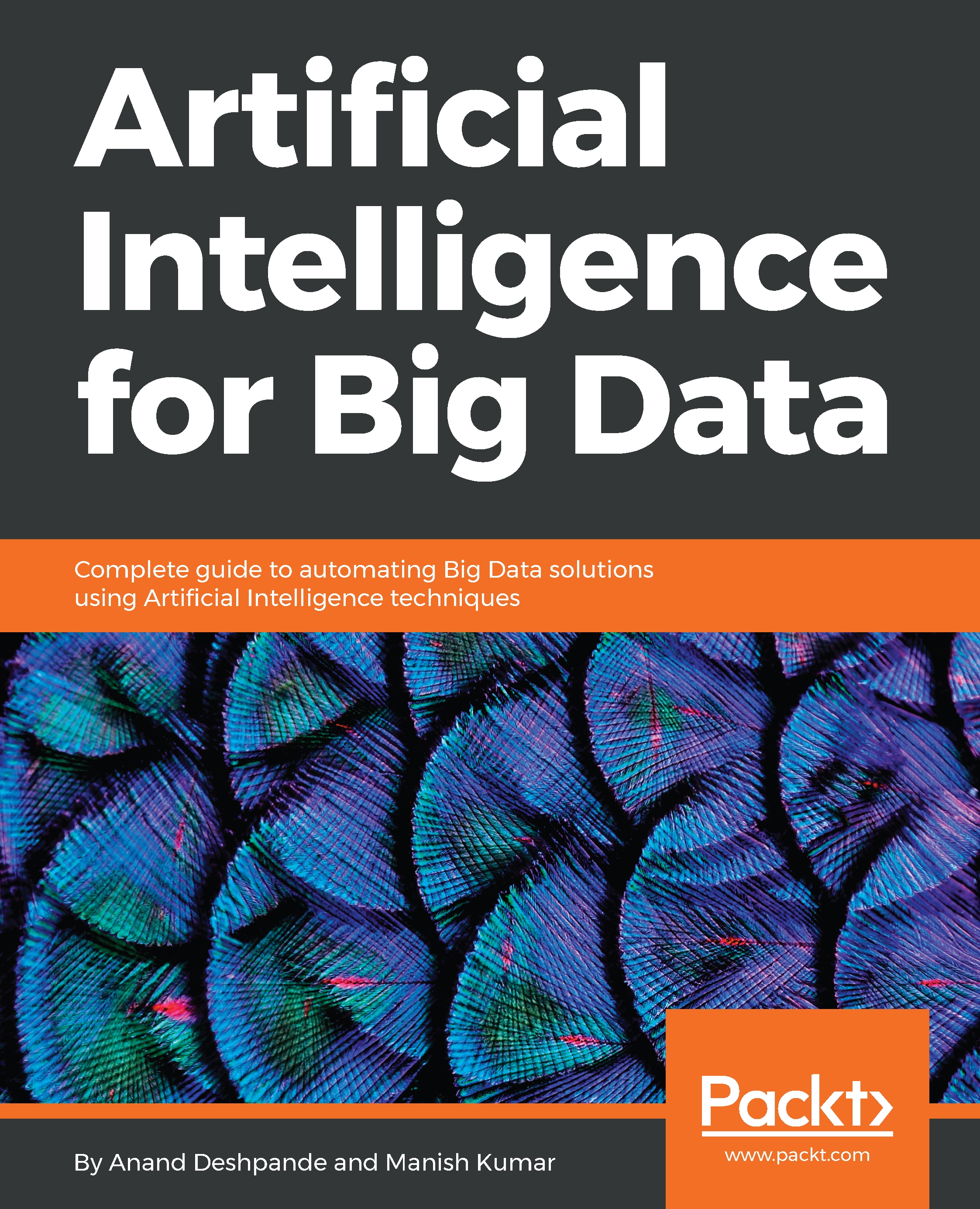
Artificial Intelligence for Big Data

Artificial Intelligence for Big Data

By : Deshpande, Kumar
5 (2)
close
close
Artificial Intelligence for Big Data

Artificial Intelligence for Big Data

5 (2)
By: Deshpande, Kumar

Overview of this book

In this age of big data, companies have larger amount of consumer data than ever before, far more than what the current technologies can ever hope to keep up with. However, Artificial Intelligence closes the gap by moving past human limitations in order to analyze data. With the help of Artificial Intelligence for big data, you will learn to use Machine Learning algorithms such as k-means, SVM, RBF, and regression to perform advanced data analysis. You will understand the current status of Machine and Deep Learning techniques to work on Genetic and Neuro-Fuzzy algorithms. In addition, you will explore how to develop Artificial Intelligence algorithms to learn from data, why they are necessary, and how they can help solve real-world problems. By the end of this book, you'll have learned how to implement various Artificial Intelligence algorithms for your big data systems and integrate them into your product offerings such as reinforcement learning, natural language processing, image recognition, genetic algorithms, and fuzzy logic systems.
Table of Contents (14 chapters)
close
close

Deep learning basics and the building blocks


In the previous chapters, we established the fact that the machine learning algorithms generalize the input data into a hypothesis that fits the data so that the output, based on the new values, can be predicted accurately by the model. The accuracy of the model is a function of the amount of the input data along with variation in the values of the independent variables. The more data and variety, the more computation power we require to generate and execute the models. The distributed computing frameworks (Hadoop, Spark, and so on) work very well with the large volumes of data with variety. The same principles apply to ANNs.

The more input data we have along with variations, the more accurate the models can be generated, which requires more storage and computation power. Since the computation power and storage is available with the development of the big data analytics platforms (in-premise as well as on the cloud), it is possible to experiment...

CONTINUE READING
83
Tech Concepts
36
Programming languages
73
Tech Tools
Icon Unlimited access to the largest independent learning library in tech of over 8,000 expert-authored tech books and videos.
Icon Innovative learning tools, including AI book assistants, code context explainers, and text-to-speech.
Icon 50+ new titles added per month and exclusive early access to books as they are being written.
Artificial Intelligence for Big Data
notes
bookmark Notes and Bookmarks search Search in title playlist Add to playlist download Download options font-size Font size

Change the font size

margin-width Margin width

Change margin width

day-mode Day/Sepia/Night Modes

Change background colour

Close icon Search
Country selected

Close icon Your notes and bookmarks

Confirmation

Modal Close icon
claim successful

Buy this book with your credits?

Modal Close icon
Are you sure you want to buy this book with one of your credits?
Close
YES, BUY

Submit Your Feedback

Modal Close icon
Modal Close icon
Modal Close icon