
Sign In Start Free Trial
Account

Add to playlist

Create a Playlist

Modal Close icon
You need to login to use this feature.
  • Book Overview & Buying Building Machine Learning Systems with Python
  • Table Of Contents Toc
Building Machine Learning Systems with Python

Building Machine Learning Systems with Python - Third Edition

By : Pedro Coelho, Willi Richert , Brucher
1.7 (3)
close
close
Building Machine Learning Systems with Python

Building Machine Learning Systems with Python

1.7 (3)
By: Pedro Coelho, Willi Richert , Brucher

Overview of this book

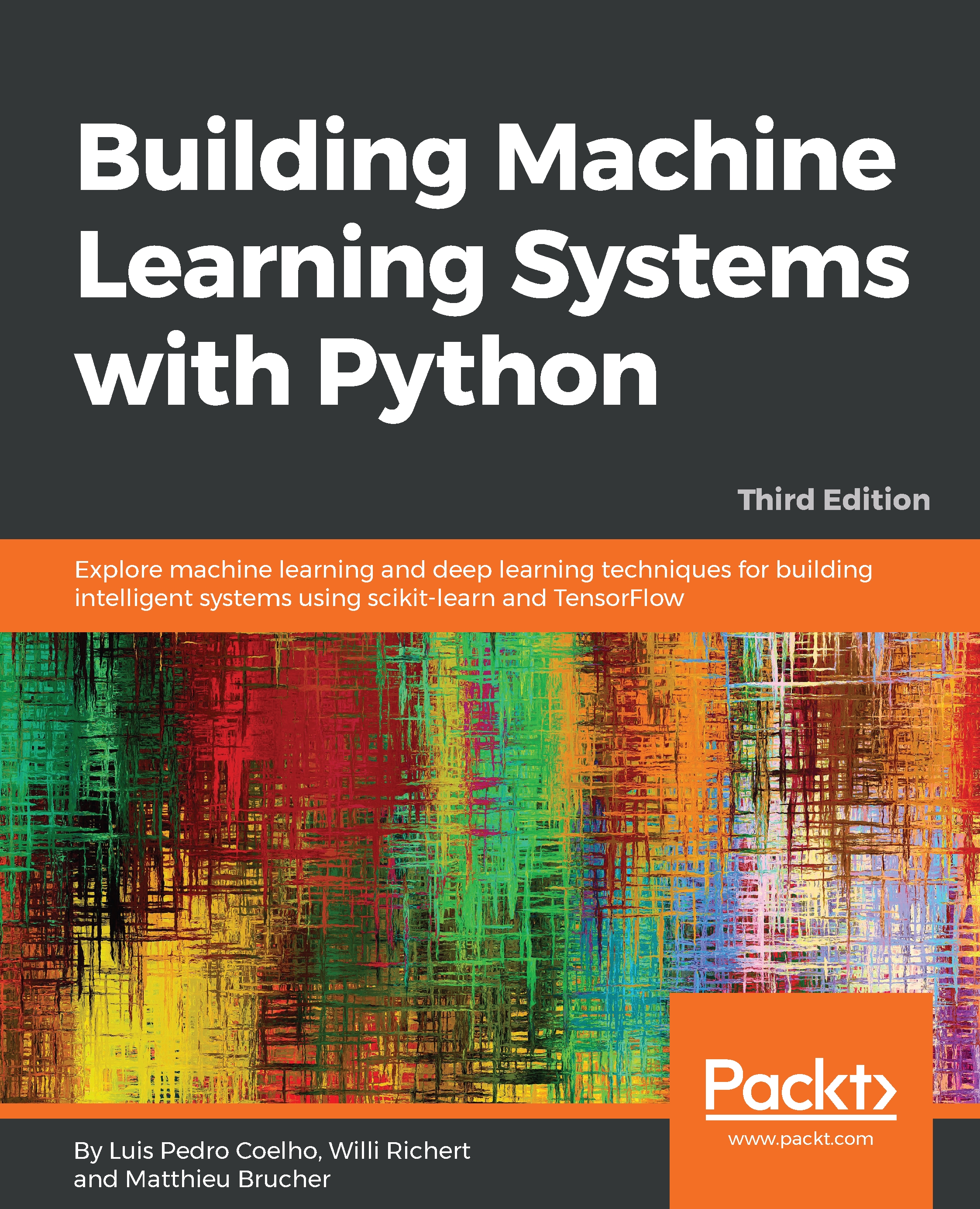
Machine learning enables systems to make predictions based on historical data. Python is one of the most popular languages used to develop machine learning applications, thanks to its extensive library support. This updated third edition of Building Machine Learning Systems with Python helps you get up to speed with the latest trends in artificial intelligence (AI). With this guide’s hands-on approach, you’ll learn to build state-of-the-art machine learning models from scratch. Complete with ready-to-implement code and real-world examples, the book starts by introducing the Python ecosystem for machine learning. You’ll then learn best practices for preparing data for analysis and later gain insights into implementing supervised and unsupervised machine learning techniques such as classification, regression and clustering. As you progress, you’ll understand how to use Python’s scikit-learn and TensorFlow libraries to build production-ready and end-to-end machine learning system models, and then fine-tune them for high performance. By the end of this book, you’ll have the skills you need to confidently train and deploy enterprise-grade machine learning models in Python.
Table of Contents (17 chapters)
close
close
Lock Free Chapter
1
Getting Started with Python Machine Learning

Bigger Data

It's not easy to say what big data is. We will adopt an operational definition: when data is so large that it becomes cumbersome to work with, we refer to it as big data. In some cases, this might mean petabytes of data or trillions of transactions: data that will not fit into a single hard drive. In other cases, it may be one hundred times smaller, but still difficult to work with.

Why has data itself become an issue? While computers keep getting faster and gaining more memory, the size of the data has grown as well. In fact, data has grown faster than computational speed and few algorithms scale linearly with the size of the input data taken together; this means that data has grown faster than our ability to process it.

We will first build on some of the experience of the previous chapters and work with what we can call medium data setting (not quite big data...

CONTINUE READING
83
Tech Concepts
36
Programming languages
73
Tech Tools
Icon Unlimited access to the largest independent learning library in tech of over 8,000 expert-authored tech books and videos.
Icon Innovative learning tools, including AI book assistants, code context explainers, and text-to-speech.
Icon 50+ new titles added per month and exclusive early access to books as they are being written.
Building Machine Learning Systems with Python
notes
bookmark Notes and Bookmarks search Search in title playlist Add to playlist font-size Font size

Change the font size

margin-width Margin width

Change margin width

day-mode Day/Sepia/Night Modes

Change background colour

Close icon Search
Country selected

Close icon Your notes and bookmarks

Confirmation

Modal Close icon
claim successful

Buy this book with your credits?

Modal Close icon
Are you sure you want to buy this book with one of your credits?
Close
YES, BUY

Submit Your Feedback

Modal Close icon
Modal Close icon
Modal Close icon