
Sign In Start Free Trial
Account

Add to playlist

Create a Playlist

Modal Close icon
You need to login to use this feature.
  • Book Overview & Buying Regression Analysis with R
  • Table Of Contents Toc
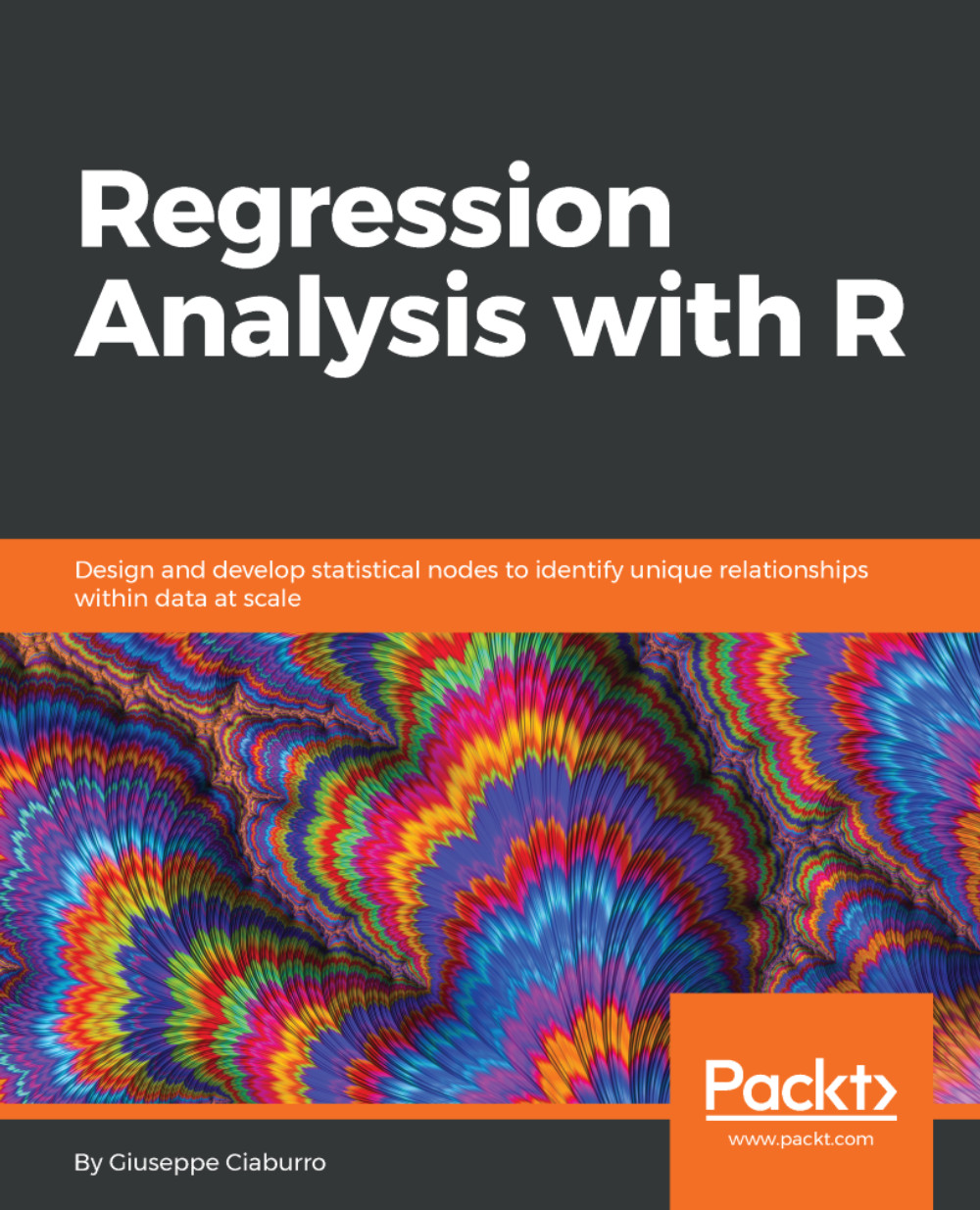
Regression Analysis with R

Regression Analysis with R

By : Giuseppe Ciaburro, Pierre Paquay, Manoj Kumar, Shaikh Salamatullah
4.7 (3)
close
close
Regression Analysis with R

Regression Analysis with R

4.7 (3)
By: Giuseppe Ciaburro, Pierre Paquay, Manoj Kumar, Shaikh Salamatullah

Overview of this book

Regression analysis is a statistical process which enables prediction of relationships between variables. The predictions are based on the casual effect of one variable upon another. Regression techniques for modeling and analyzing are employed on large set of data in order to reveal hidden relationship among the variables. This book will give you a rundown explaining what regression analysis is, explaining you the process from scratch. The first few chapters give an understanding of what the different types of learning are – supervised and unsupervised, how these learnings differ from each other. We then move to covering the supervised learning in details covering the various aspects of regression analysis. The outline of chapters are arranged in a way that gives a feel of all the steps covered in a data science process – loading the training dataset, handling missing values, EDA on the dataset, transformations and feature engineering, model building, assessing the model fitting and performance, and finally making predictions on unseen datasets. Each chapter starts with explaining the theoretical concepts and once the reader gets comfortable with the theory, we move to the practical examples to support the understanding. The practical examples are illustrated using R code including the different packages in R such as R Stats, Caret and so on. Each chapter is a mix of theory and practical examples. By the end of this book you will know all the concepts and pain-points related to regression analysis, and you will be able to implement your learning in your projects.
Table of Contents (11 chapters)
close
close

Summary

In this chapter, we introduced classifications through logistic regression techniques. We have first described a logistic model and then we have provided some intuitions underneath the math formulation.  We learned how to define a classification problem and how to apply logistic regression to solve this type of problem. We introduced the simple logistic regression model, where the dichotomous response depends on only one explanatory variable.

Then, we generalized the logistic model to the case of more than one independent variable in the multiple logistic regression. Central arguments in dealing with multiple logistic models have been the estimate of the coefficients in the model and the tests for their significance. This has followed the same lines as the univariate model. In multiple regression, the coefficients are called partial because they express the specific...

CONTINUE READING
83
Tech Concepts
36
Programming languages
73
Tech Tools
Icon Unlimited access to the largest independent learning library in tech of over 8,000 expert-authored tech books and videos.
Icon Innovative learning tools, including AI book assistants, code context explainers, and text-to-speech.
Icon 50+ new titles added per month and exclusive early access to books as they are being written.
Regression Analysis with R
notes
bookmark Notes and Bookmarks search Search in title playlist Add to playlist download Download options font-size Font size

Change the font size

margin-width Margin width

Change margin width

day-mode Day/Sepia/Night Modes

Change background colour

Close icon Search
Country selected

Close icon Your notes and bookmarks

Confirmation

Modal Close icon
claim successful

Buy this book with your credits?

Modal Close icon
Are you sure you want to buy this book with one of your credits?
Close
YES, BUY

Submit Your Feedback

Modal Close icon
Modal Close icon
Modal Close icon