Sign In Start Free Trial
Account

Add to playlist

Create a Playlist

Modal Close icon
You need to login to use this feature.
  • Book Overview & Buying Deep Reinforcement Learning Hands-On
  • Table Of Contents Toc
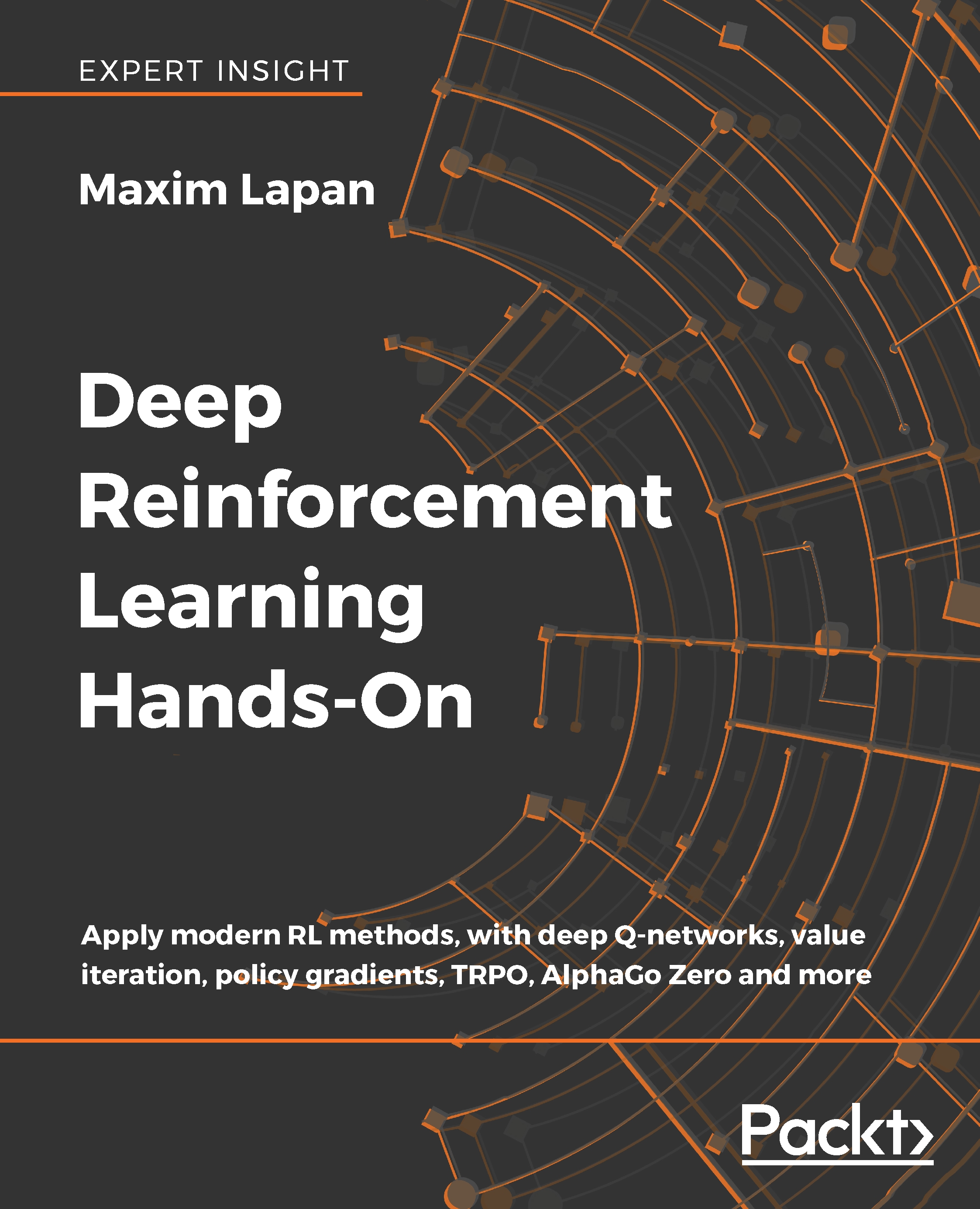
Deep Reinforcement Learning Hands-On

Deep Reinforcement Learning Hands-On

By : Maxim Lapan, Oleg Vasilev, Martijn van Otterlo, Mikhail Yurushkin, Basem O. F. Alijla
4.3 (34)
close
close
Deep Reinforcement Learning Hands-On

Deep Reinforcement Learning Hands-On

4.3 (34)
By: Maxim Lapan, Oleg Vasilev, Martijn van Otterlo, Mikhail Yurushkin, Basem O. F. Alijla

Overview of this book

Deep Reinforcement Learning Hands-On is a comprehensive guide to the very latest DL tools and their limitations. You will evaluate methods including Cross-entropy and policy gradients, before applying them to real-world environments. Take on both the Atari set of virtual games and family favorites such as Connect4. The book provides an introduction to the basics of RL, giving you the know-how to code intelligent learning agents to take on a formidable array of practical tasks. Discover how to implement Q-learning on 'grid world' environments, teach your agent to buy and trade stocks, and find out how natural language models are driving the boom in chatbots.
Table of Contents (21 chapters)
close
close
20
Index

Taxonomy of RL methods


The cross-entropy method falls into the model-free and policy-based category of methods. These notions are new, so let's spend some time exploring them. All methods in RL can be classified into various aspects:

  • Model-free or model-based

  • Value-based or policy-based

  • On-policy or off-policy

There are other ways that you can taxonomize RL methods, but for now we're interested in the preceding three. Let's define them, as your problem specifics can influence your decision on a particular method.

The term model-free means that the method doesn't build a model of the environment or reward; it just directly connects observations to actions (or values that are related to actions). In other words, the agent takes current observations and does some computations on them, and the result is the action that it should take. In contrast, model-based methods try to predict what the next observation and/or reward will be. Based on this prediction, the agent is trying to choose the best possible...

CONTINUE READING
83
Tech Concepts
36
Programming languages
73
Tech Tools
Icon Unlimited access to the largest independent learning library in tech of over 8,000 expert-authored tech books and videos.
Icon Innovative learning tools, including AI book assistants, code context explainers, and text-to-speech.
Icon 50+ new titles added per month and exclusive early access to books as they are being written.
Deep Reinforcement Learning Hands-On
notes
bookmark Notes and Bookmarks search Search in title playlist Add to playlist download Download options font-size Font size

Change the font size

margin-width Margin width

Change margin width

day-mode Day/Sepia/Night Modes

Change background colour

Close icon Search
Country selected

Close icon Your notes and bookmarks

Confirmation

Modal Close icon
claim successful

Buy this book with your credits?

Modal Close icon
Are you sure you want to buy this book with one of your credits?
Close
YES, BUY

Submit Your Feedback

Modal Close icon
Modal Close icon
Modal Close icon