
Sign In Start Free Trial
Account

Add to playlist

Create a Playlist

Modal Close icon
You need to login to use this feature.
  • Book Overview & Buying Hands-On Artificial Intelligence for IoT
  • Table Of Contents Toc
Hands-On Artificial Intelligence for IoT

Hands-On Artificial Intelligence for IoT - Second Edition

By : Dr. Amita Kapoor, Hector Duran Lopez-Velarde
5 (4)
close
close
Hands-On Artificial Intelligence for IoT

Hands-On Artificial Intelligence for IoT

5 (4)
By: Dr. Amita Kapoor, Hector Duran Lopez-Velarde

Overview of this book

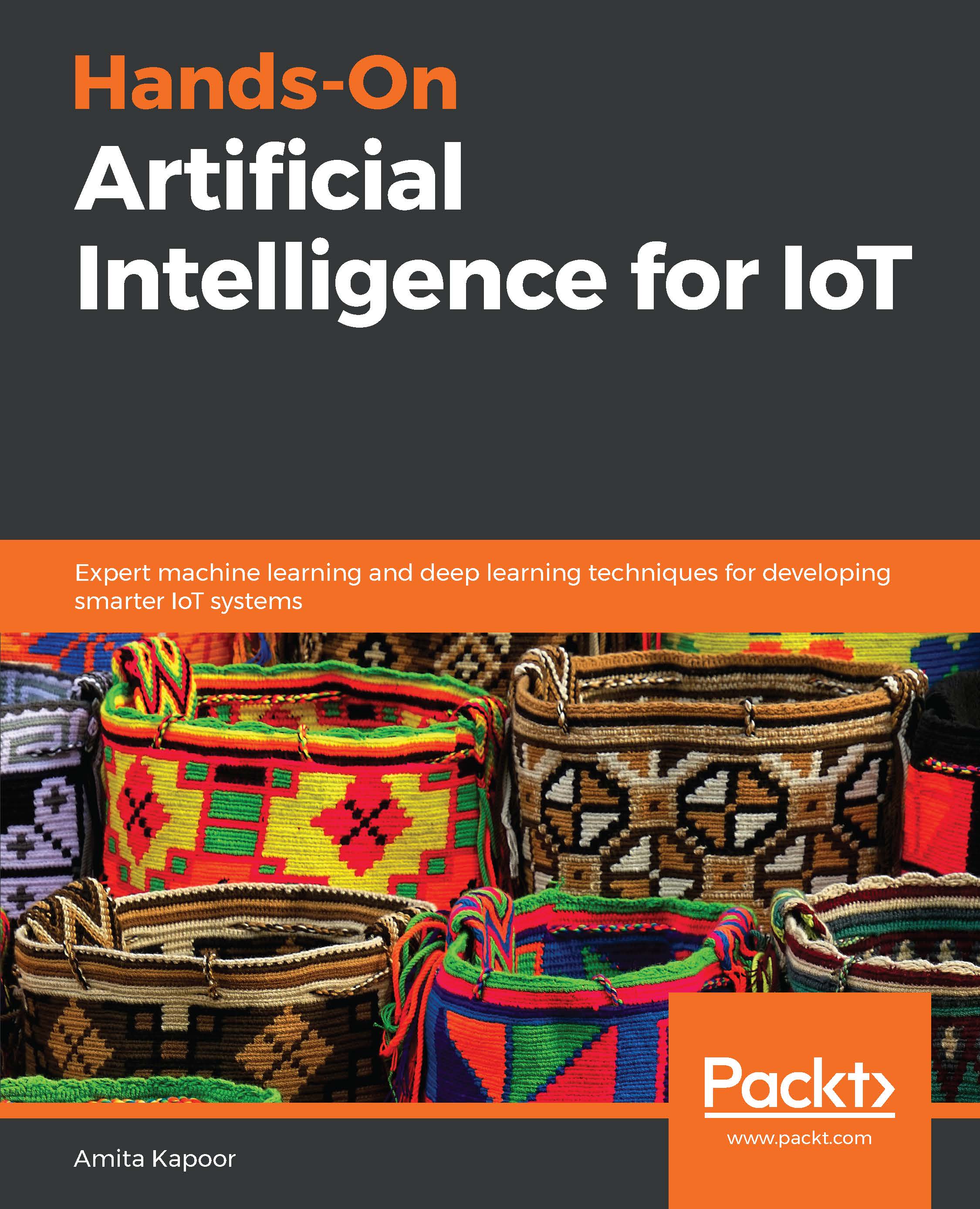
There are many applications that use data science and analytics to gain insights from terabytes of data. These apps, however, do not address the challenge of continually discovering patterns for IoT data. In Hands-On Artificial Intelligence for IoT, we cover various aspects of artificial intelligence (AI) and its implementation to make your IoT solutions smarter. This book starts by covering the process of gathering and preprocessing IoT data gathered from distributed sources. You will learn different AI techniques such as machine learning, deep learning, reinforcement learning, and natural language processing to build smart IoT systems. You will also leverage the power of AI to handle real-time data coming from wearable devices. As you progress through the book, techniques for building models that work with different kinds of data generated and consumed by IoT devices such as time series, images, and audio will be covered. Useful case studies on four major application areas of IoT solutions are a key focal point of this book. In the concluding chapters, you will leverage the power of widely used Python libraries, TensorFlow and Keras, to build different kinds of smart AI models. By the end of this book, you will be able to build smart AI-powered IoT apps with confidence.
Table of Contents (14 chapters)
close
close

Coding genetic algorithms using Distributed Evolutionary Algorithms in Python

Now that we understand how genetic algorithms work, let's try solving some problems with them. They have been used to solve NP-hard problems such as the traveling salesman problem. To make the task of generating a population, performing the crossover, and performing mutation operations easy, we will make use of Distributed Evolutionary Algorithms in Python (DEAP). It supports multiprocessing and we can use it for other evolutionary algorithms as well. You can download DEAP directly from PyPi using this:

pip install deap

It is compatible with Python 3.

To learn more about DEAP, you can refer to its GitHub repository (https://github.com/DEAP/deap) and its user's guide (http://deap.readthedocs.io/en/master/).

...
Visually different images
CONTINUE READING
83
Tech Concepts
36
Programming languages
73
Tech Tools
Icon Unlimited access to the largest independent learning library in tech of over 8,000 expert-authored tech books and videos.
Icon Innovative learning tools, including AI book assistants, code context explainers, and text-to-speech.
Icon 50+ new titles added per month and exclusive early access to books as they are being written.
Hands-On Artificial Intelligence for IoT
notes
bookmark Notes and Bookmarks search Search in title playlist Add to playlist download Download options font-size Font size

Change the font size

margin-width Margin width

Change margin width

day-mode Day/Sepia/Night Modes

Change background colour

Close icon Search
Country selected

Close icon Your notes and bookmarks

Confirmation

Modal Close icon
claim successful

Buy this book with your credits?

Modal Close icon
Are you sure you want to buy this book with one of your credits?
Close
YES, BUY

Submit Your Feedback

Modal Close icon
Modal Close icon
Modal Close icon