
Sign In Start Free Trial
Account

Add to playlist

Create a Playlist

Modal Close icon
You need to login to use this feature.
  • Book Overview & Buying Python Reinforcement Learning Projects
  • Table Of Contents Toc
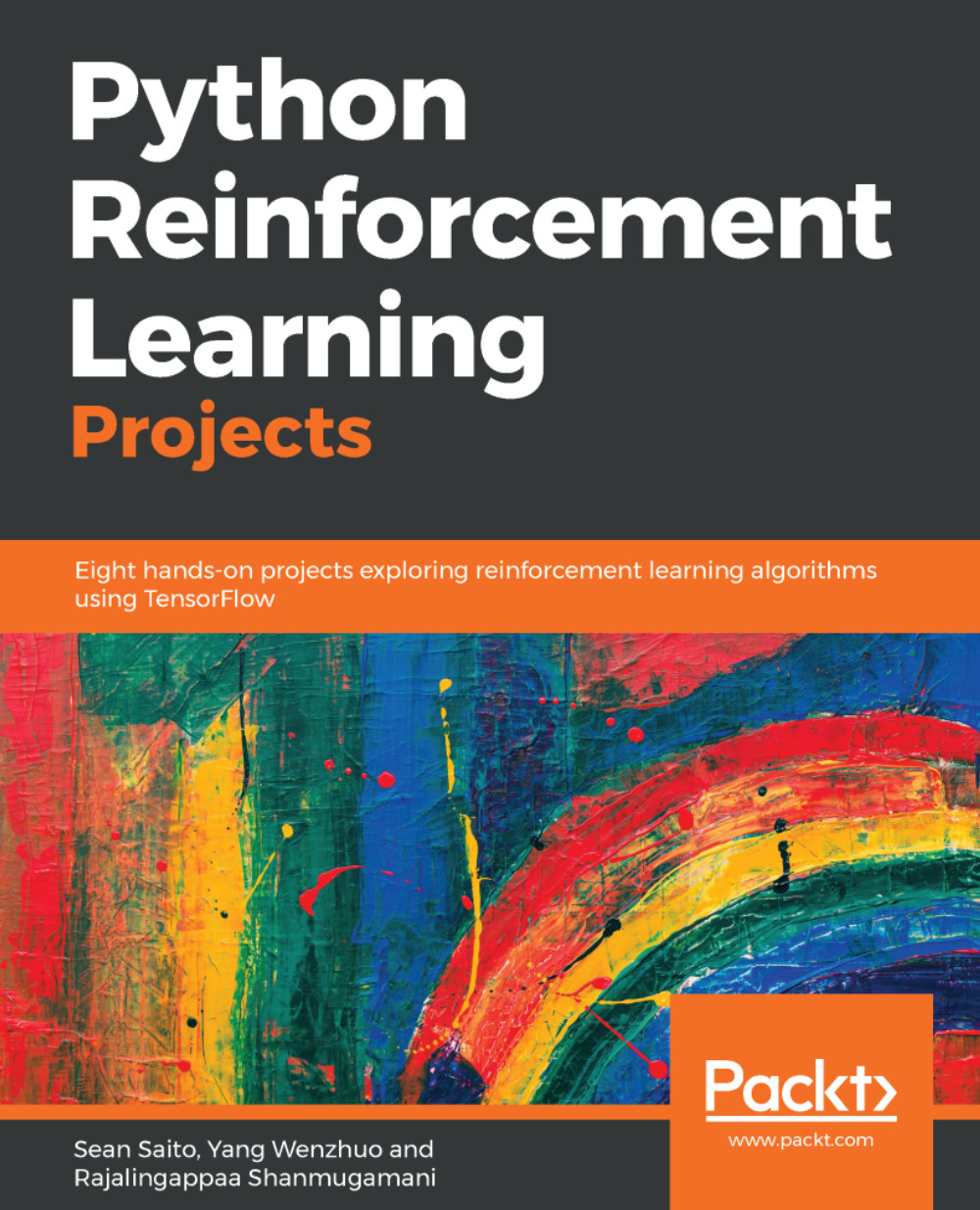
Python Reinforcement Learning Projects

Python Reinforcement Learning Projects

By : Sean Saito, Yang Wenzhuo , Rajalingappaa Shanmugamani
5 (1)
close
close
Python Reinforcement Learning Projects

Python Reinforcement Learning Projects

5 (1)
By: Sean Saito, Yang Wenzhuo , Rajalingappaa Shanmugamani

Overview of this book

Reinforcement learning is one of the most exciting and rapidly growing fields in machine learning. This is due to the many novel algorithms developed and incredible results published in recent years. In this book, you will learn about the core concepts of RL including Q-learning, policy gradients, Monte Carlo processes, and several deep reinforcement learning algorithms. As you make your way through the book, you'll work on projects with datasets of various modalities including image, text, and video. You will gain experience in several domains, including gaming, image processing, and physical simulations. You'll explore technologies such as TensorFlow and OpenAI Gym to implement deep learning reinforcement learning algorithms that also predict stock prices, generate natural language, and even build other neural networks. By the end of this book, you will have hands-on experience with eight reinforcement learning projects, each addressing different topics and/or algorithms. We hope these practical exercises will provide you with better intuition and insight about the field of reinforcement learning and how to apply its algorithms to various problems in real life.
Table of Contents (12 chapters)
close
close

Experiments

The full implementation of the deep Q-learning algorithm can be downloaded from GitHub (link xxx). To train our AI player for Breakout, run the following command under the src folder:

python train.py -g Breakout -d gpu

There are two arguments in train.py. One is -g or --game, indicating the name of the game one wants to test. The other one is -d or --device, which specifies the device (CPU or GPU) one wants to use to train the Q-network.

For Atari games, even with a high-end GPU, it will take 4-7 days to make our AI player achieve human-level performance. In order to test the algorithm quickly, a special game called demo is implemented as a lightweight benchmark. Run the demo via the following:

python train.py -g demo -d cpu

The demo game is based on the GridWorld game on the website at https://cs.stanford.edu/people/karpathy/convnetjs/demo/rldemo.html:

In this game...

CONTINUE READING
83
Tech Concepts
36
Programming languages
73
Tech Tools
Icon Unlimited access to the largest independent learning library in tech of over 8,000 expert-authored tech books and videos.
Icon Innovative learning tools, including AI book assistants, code context explainers, and text-to-speech.
Icon 50+ new titles added per month and exclusive early access to books as they are being written.
Python Reinforcement Learning Projects
notes
bookmark Notes and Bookmarks search Search in title playlist Add to playlist download Download options font-size Font size

Change the font size

margin-width Margin width

Change margin width

day-mode Day/Sepia/Night Modes

Change background colour

Close icon Search
Country selected

Close icon Your notes and bookmarks

Confirmation

Modal Close icon
claim successful

Buy this book with your credits?

Modal Close icon
Are you sure you want to buy this book with one of your credits?
Close
YES, BUY

Submit Your Feedback

Modal Close icon
Modal Close icon
Modal Close icon