
Sign In Start Free Trial
Account

Add to playlist

Create a Playlist

Modal Close icon
You need to login to use this feature.
  • Book Overview & Buying Go Machine Learning Projects
  • Table Of Contents Toc
Go Machine Learning Projects

Go Machine Learning Projects

By : Xuanyi Chew
5 (1)
close
close
Go Machine Learning Projects

Go Machine Learning Projects

5 (1)
By: Xuanyi Chew

Overview of this book

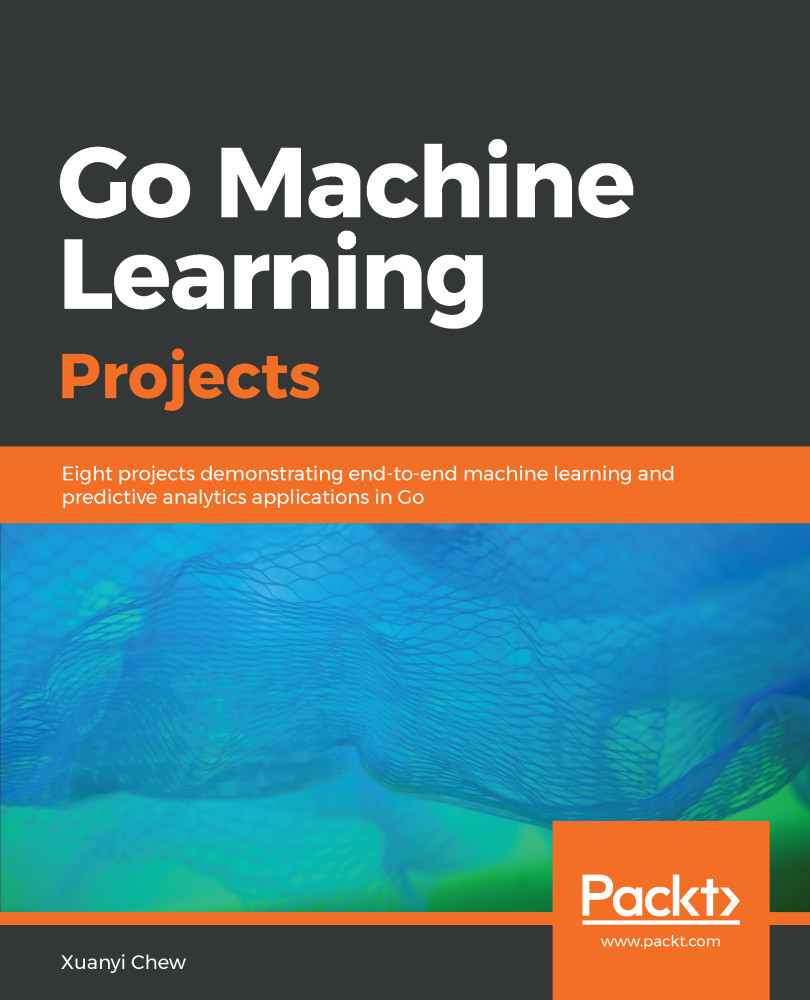
Go is the perfect language for machine learning; it helps to clearly describe complex algorithms, and also helps developers to understand how to run efficient optimized code. This book will teach you how to implement machine learning in Go to make programs that are easy to deploy and code that is not only easy to understand and debug, but also to have its performance measured. The book begins by guiding you through setting up your machine learning environment with Go libraries and capabilities. You will then plunge into regression analysis of a real-life house pricing dataset and build a classification model in Go to classify emails as spam or ham. Using Gonum, Gorgonia, and STL, you will explore time series analysis along with decomposition and clean up your personal Twitter timeline by clustering tweets. In addition to this, you will learn how to recognize handwriting using neural networks and convolutional neural networks. Lastly, you'll learn how to choose the most appropriate machine learning algorithms to use for your projects with the help of a facial detection project. By the end of this book, you will have developed a solid machine learning mindset, a strong hold on the powerful Go toolkit, and a sound understanding of the practical implementations of machine learning algorithms in real-world projects.
Table of Contents (12 chapters)
close
close

Clustering

The purpose of this project is to clean up the amount of tweets that I have to read. If there is a reading budget of 100 tweets, I don't want to be reading 50 tweets on the same topic; they may well represent different viewpoints, but in general for skimming purposes, are not relevant to my interests. Clustering provides a good solution to this problem.

First, if the tweets are clustered, the 50 tweets on the same topic will be grouped in the same cluster. This allows me to dig in deeper if I wish. Otherwise, I can just skip those tweets and move on.

In this project, we wish to use K-means. To do so, we'll use Marcin Praski's clusters library. To install it, simply run go get -u github.com/mpraski/clusters. It's a good library, and it comes built in with multiple clustering algorithms. I introduced K-means before, but we're also going to be...

CONTINUE READING
83
Tech Concepts
36
Programming languages
73
Tech Tools
Icon Unlimited access to the largest independent learning library in tech of over 8,000 expert-authored tech books and videos.
Icon Innovative learning tools, including AI book assistants, code context explainers, and text-to-speech.
Icon 50+ new titles added per month and exclusive early access to books as they are being written.
Go Machine Learning Projects
notes
bookmark Notes and Bookmarks search Search in title playlist Add to playlist download Download options font-size Font size

Change the font size

margin-width Margin width

Change margin width

day-mode Day/Sepia/Night Modes

Change background colour

Close icon Search
Country selected

Close icon Your notes and bookmarks

Confirmation

Modal Close icon
claim successful

Buy this book with your credits?

Modal Close icon
Are you sure you want to buy this book with one of your credits?
Close
YES, BUY

Submit Your Feedback

Modal Close icon
Modal Close icon
Modal Close icon