
Sign In Start Free Trial
Account

Add to playlist

Create a Playlist

Modal Close icon
You need to login to use this feature.
  • Book Overview & Buying Hands-On Convolutional Neural Networks with TensorFlow
  • Table Of Contents Toc
Hands-On Convolutional Neural Networks with TensorFlow

Hands-On Convolutional Neural Networks with TensorFlow

By : Araujo, Zafar, Tzanidou, Burton, Patel
4 (3)
close
close
Hands-On Convolutional Neural Networks with TensorFlow

Hands-On Convolutional Neural Networks with TensorFlow

4 (3)
By: Araujo, Zafar, Tzanidou, Burton, Patel

Overview of this book

Convolutional Neural Networks (CNN) are one of the most popular architectures used in computer vision apps. This book is an introduction to CNNs through solving real-world problems in deep learning while teaching you their implementation in popular Python library - TensorFlow. By the end of the book, you will be training CNNs in no time! We start with an overview of popular machine learning and deep learning models, and then get you set up with a TensorFlow development environment. This environment is the basis for implementing and training deep learning models in later chapters. Then, you will use Convolutional Neural Networks to work on problems such as image classification, object detection, and semantic segmentation. After that, you will use transfer learning to see how these models can solve other deep learning problems. You will also get a taste of implementing generative models such as autoencoders and generative adversarial networks. Later on, you will see useful tips on machine learning best practices and troubleshooting. Finally, you will learn how to apply your models on large datasets of millions of images.
Table of Contents (12 chapters)
close
close

Why generative models

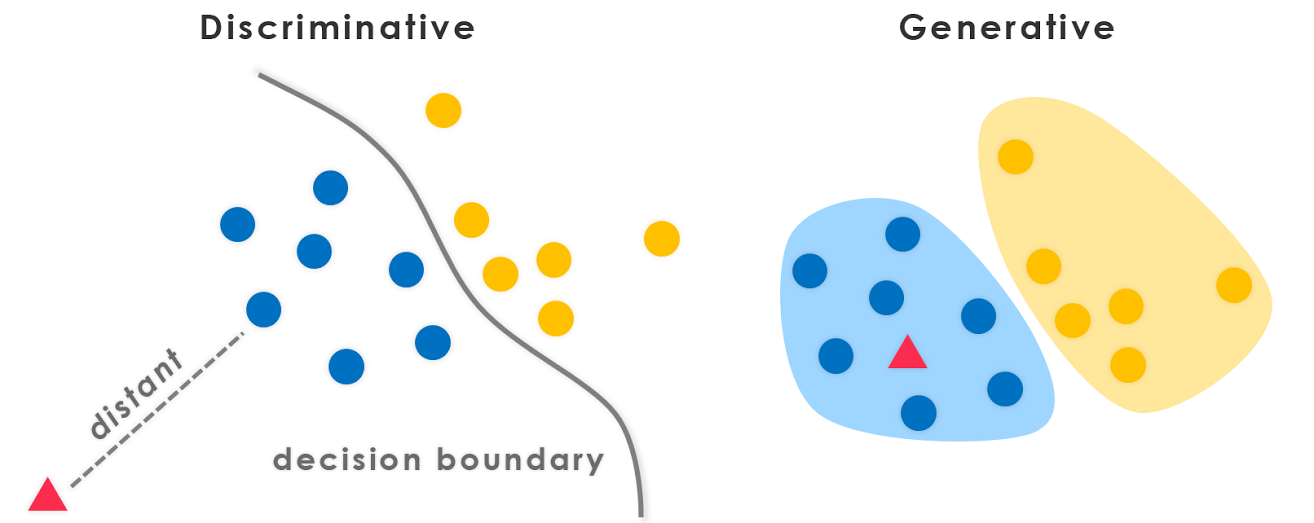
In the following illustration, we can see the main difference between generative models and discriminative models. With discriminative models, we generally try to find ways of separating or "discriminating" between different classes in our data. However, with generative models, we try to find out the probability distribution of our data. In the illustration, the distributions are represented by the large blue and yellow blobs that contain smaller circles. If we learn this distribution from our data, we will be able to sample or "generate" new data points that should belong to it like the red triangle.
Trying to capture the probability distribution of a dataset has the following use cases:

  • Pretrain a model with unlabeled data
  • Augment your dataset (in theory, if you capture the probability distribution of your data, you can generate...
CONTINUE READING
83
Tech Concepts
36
Programming languages
73
Tech Tools
Icon Unlimited access to the largest independent learning library in tech of over 8,000 expert-authored tech books and videos.
Icon Innovative learning tools, including AI book assistants, code context explainers, and text-to-speech.
Icon 50+ new titles added per month and exclusive early access to books as they are being written.
Hands-On Convolutional Neural Networks with TensorFlow
notes
bookmark Notes and Bookmarks search Search in title playlist Add to playlist download Download options font-size Font size

Change the font size

margin-width Margin width

Change margin width

day-mode Day/Sepia/Night Modes

Change background colour

Close icon Search
Country selected

Close icon Your notes and bookmarks

Confirmation

Modal Close icon
claim successful

Buy this book with your credits?

Modal Close icon
Are you sure you want to buy this book with one of your credits?
Close
YES, BUY

Submit Your Feedback

Modal Close icon
Modal Close icon
Modal Close icon