
Sign In Start Free Trial
Account

Add to playlist

Create a Playlist

Modal Close icon
You need to login to use this feature.
  • Book Overview & Buying Hands-On Data Analysis with NumPy and pandas
  • Table Of Contents Toc
  • Feedback & Rating feedback
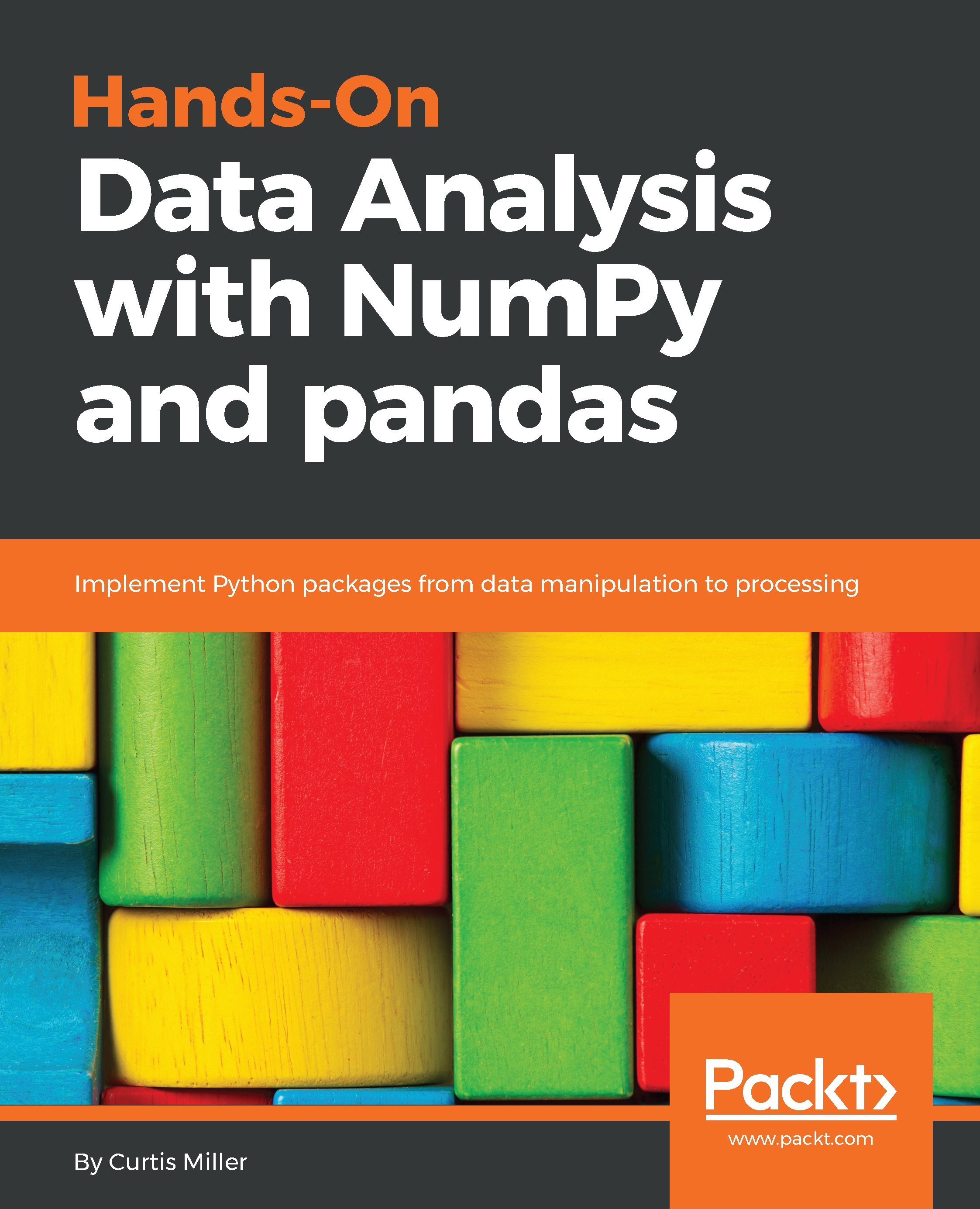
Hands-On Data Analysis with NumPy and pandas

Hands-On Data Analysis with NumPy and pandas

By : Miller
2.9 (7)
close
close
Hands-On Data Analysis with NumPy and pandas

Hands-On Data Analysis with NumPy and pandas

2.9 (7)
By: Miller

Overview of this book

Python, a multi-paradigm programming language, has become the language of choice for data scientists for visualization, data analysis, and machine learning. Hands-On Data Analysis with NumPy and Pandas starts by guiding you in setting up the right environment for data analysis with Python, along with helping you install the correct Python distribution. In addition to this, you will work with the Jupyter notebook and set up a database. Once you have covered Jupyter, you will dig deep into Python’s NumPy package, a powerful extension with advanced mathematical functions. You will then move on to creating NumPy arrays and employing different array methods and functions. You will explore Python’s pandas extension which will help you get to grips with data mining and learn to subset your data. Last but not the least you will grasp how to manage your datasets by sorting and ranking them. By the end of this book, you will have learned to index and group your data for sophisticated data analysis and manipulation.
Table of Contents (8 chapters)
close
close

NumPy arrays

Let's now talk about NumPy arrays, which are called ndarray. These are not the arrays you may encounter in C or C++. A better analog is matrices in MATLAB or R; that is, they behave like a mathematical object resembling a mathematical vector, matrix, or tensor. While they can store non-mathematical information such as strings, they exist mainly to manage and facilitate operations with data that is numeric in nature. ndarray are assigned a particular data type or dtype upon creation, and all current and future data in the array must be of that dtype. They also have more than one-dimension, referred to as axes.

A one-dimensional ndarray is a line of data; this would be a vector. A two-dimensional ndarray would be a square of data, effectively a matrix. A three-dimensional ndarray would be key book data, like a tensor. Any number of dimensions is permitted...

Visually different images
CONTINUE READING
83
Tech Concepts
36
Programming languages
73
Tech Tools
Icon Unlimited access to the largest independent learning library in tech of over 8,000 expert-authored tech books and videos.
Icon Innovative learning tools, including AI book assistants, code context explainers, and text-to-speech.
Icon 50+ new titles added per month and exclusive early access to books as they are being written.
Hands-On Data Analysis with NumPy and pandas
notes
bookmark Notes and Bookmarks search Search in title playlist Add to playlist download Download options font-size Font size

Change the font size

margin-width Margin width

Change margin width

day-mode Day/Sepia/Night Modes

Change background colour

Close icon Search
Country selected

Close icon Your notes and bookmarks

Confirmation

Modal Close icon
claim successful

Buy this book with your credits?

Modal Close icon
Are you sure you want to buy this book with one of your credits?
Close
YES, BUY

Submit Your Feedback

Modal Close icon
Modal Close icon
Modal Close icon