Sign In Start Free Trial
Account

Add to playlist

Create a Playlist

Modal Close icon
You need to login to use this feature.
  • Book Overview & Buying Beginning Data Science with Python and Jupyter
  • Table Of Contents Toc
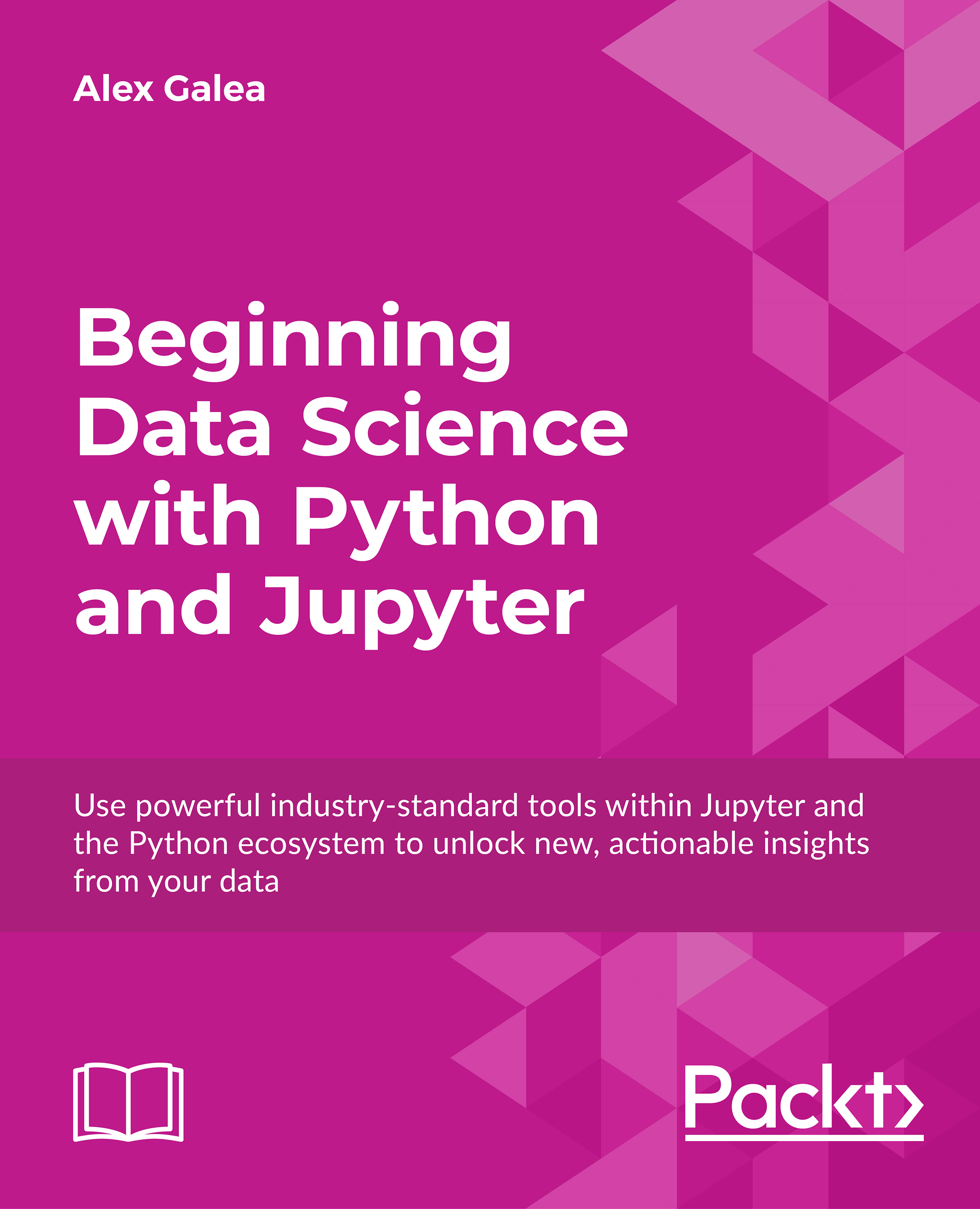
Beginning Data Science with Python and Jupyter

Beginning Data Science with Python and Jupyter

By : Galea
4 (5)
close
close
Beginning Data Science with Python and Jupyter

Beginning Data Science with Python and Jupyter

4 (5)
By: Galea

Overview of this book

Get to grips with the skills you need for entry-level data science in this hands-on Python and Jupyter course. You'll learn about some of the most commonly used libraries that are part of the Anaconda distribution, and then explore machine learning models with real datasets to give you the skills and exposure you need for the real world. We'll finish up by showing you how easy it can be to scrape and gather your own data from the open web, so that you can apply your new skills in an actionable context.
Table of Contents (5 chapters)
close
close

What This Book Covers

Lesson 1, Jupyter Fundamentals, covers the fundamentals of data analysis in Jupyter. We will start with usage instructions and features of Jupyter such as magic functions and tab completion. We will then transition to data science specific material. We will run an exploratory analysis in a live Jupyter Notebook. We will use visual assists such as scatter plots, histograms, and violin plots to deepen our understanding of the data. We will also perform simple predictive modeling.

Lesson 2, Data Cleaning and Advanced Machine Learning, shows how predictive models can be trained in Jupyter Notebooks. We will talk about how to plan a machine learning strategy. This lesson also explains the machine learning terminology such as supervised learning, unsupervised learning, classification, and regression. We will discuss methods for preprocessing data using scikit-learn and pandas.

Lesson 3, Web Scraping and Interactive Visualizations, explains how to scrap web page tables and then use interactive visualizations to study the data. We will start by looking at how HTTP requests work, focusing on GET requests and their response status codes. Then, we will go into the Jupyter Notebook and make HTTP requests with Python using the Requests library. We will see how Jupyter can be used to render HTML in the notebook, along with actual web pages that can be interacted with. After making requests, we will see how Beautiful Soup can be used to parse text from the HTML, and used this library to scrape tabular data.

CONTINUE READING
83
Tech Concepts
36
Programming languages
73
Tech Tools
Icon Unlimited access to the largest independent learning library in tech of over 8,000 expert-authored tech books and videos.
Icon Innovative learning tools, including AI book assistants, code context explainers, and text-to-speech.
Icon 50+ new titles added per month and exclusive early access to books as they are being written.
Beginning Data Science with Python and Jupyter
notes
bookmark Notes and Bookmarks search Search in title playlist Add to playlist font-size Font size

Change the font size

margin-width Margin width

Change margin width

day-mode Day/Sepia/Night Modes

Change background colour

Close icon Search
Country selected

Close icon Your notes and bookmarks

Confirmation

Modal Close icon
claim successful

Buy this book with your credits?

Modal Close icon
Are you sure you want to buy this book with one of your credits?
Close
YES, BUY

Submit Your Feedback

Modal Close icon
Modal Close icon
Modal Close icon