
Sign In Start Free Trial
Account

Add to playlist

Create a Playlist

Modal Close icon
You need to login to use this feature.
  • Book Overview & Buying TensorFlow Reinforcement Learning Quick Start Guide
  • Table Of Contents Toc
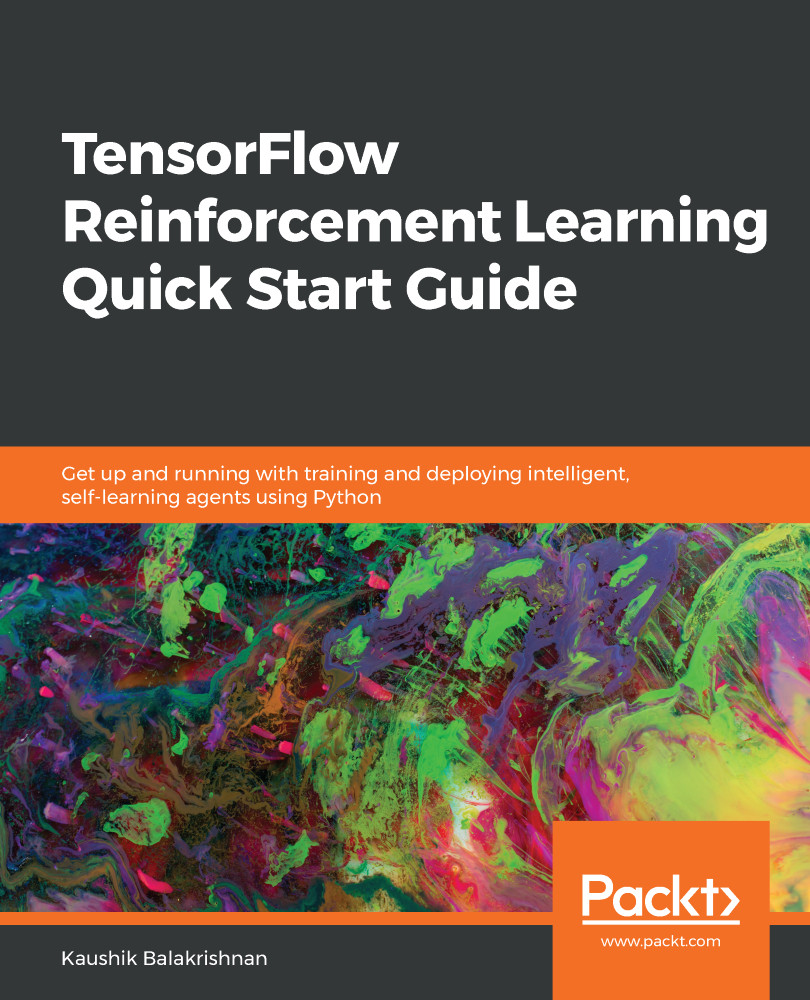
TensorFlow Reinforcement Learning Quick Start Guide

TensorFlow Reinforcement Learning Quick Start Guide

By : Balakrishnan
5 (2)
close
close
TensorFlow Reinforcement Learning Quick Start Guide

TensorFlow Reinforcement Learning Quick Start Guide

5 (2)
By: Balakrishnan

Overview of this book

Advances in reinforcement learning algorithms have made it possible to use them for optimal control in several different industrial applications. With this book, you will apply Reinforcement Learning to a range of problems, from computer games to autonomous driving. The book starts by introducing you to essential Reinforcement Learning concepts such as agents, environments, rewards, and advantage functions. You will also master the distinctions between on-policy and off-policy algorithms, as well as model-free and model-based algorithms. You will also learn about several Reinforcement Learning algorithms, such as SARSA, Deep Q-Networks (DQN), Deep Deterministic Policy Gradients (DDPG), Asynchronous Advantage Actor-Critic (A3C), Trust Region Policy Optimization (TRPO), and Proximal Policy Optimization (PPO). The book will also show you how to code these algorithms in TensorFlow and Python and apply them to solve computer games from OpenAI Gym. Finally, you will also learn how to train a car to drive autonomously in the Torcs racing car simulator. By the end of the book, you will be able to design, build, train, and evaluate feed-forward neural networks and convolutional neural networks. You will also have mastered coding state-of-the-art algorithms and also training agents for various control problems.
Table of Contents (11 chapters)
close
close

Deep Deterministic Policy Gradient

In earlier chapters, you saw the use of reinforcement learning (RL) to solve discrete action problems, such as those that arise in Atari games. We will now build on this to tackle continuous, real-valued action problems. Continuous control problems are copious—for example, the motor torque of a robotic arm; the steering, acceleration, and braking of an autonomous car; the wheeled robotic motion on terrain; and the roll, pitch, and yaw controls of a drone. For these problems, we train neural networks in an RL setting to output real-valued actions.

Many continuous control algorithms involve two neural networks—one referred to as the actor (policy-based), and the other as the critic (value-based)—and therefore, this family of algorithms is referred to as Actor-Critic algorithms. The role of the actor is to learn a good policy...

Visually different images
CONTINUE READING
83
Tech Concepts
36
Programming languages
73
Tech Tools
Icon Unlimited access to the largest independent learning library in tech of over 8,000 expert-authored tech books and videos.
Icon Innovative learning tools, including AI book assistants, code context explainers, and text-to-speech.
Icon 50+ new titles added per month and exclusive early access to books as they are being written.
TensorFlow Reinforcement Learning Quick Start Guide
notes
bookmark Notes and Bookmarks search Search in title playlist Add to playlist download Download options font-size Font size

Change the font size

margin-width Margin width

Change margin width

day-mode Day/Sepia/Night Modes

Change background colour

Close icon Search
Country selected

Close icon Your notes and bookmarks

Confirmation

Modal Close icon
claim successful

Buy this book with your credits?

Modal Close icon
Are you sure you want to buy this book with one of your credits?
Close
YES, BUY

Submit Your Feedback

Modal Close icon
Modal Close icon
Modal Close icon