Sign In Start Free Trial
Account

Add to playlist

Create a Playlist

Modal Close icon
You need to login to use this feature.
  • Book Overview & Buying Machine Learning for Healthcare Analytics Projects
  • Table Of Contents Toc
Machine Learning for Healthcare Analytics Projects

Machine Learning for Healthcare Analytics Projects

3.3 (4)
close
close
Machine Learning for Healthcare Analytics Projects

Machine Learning for Healthcare Analytics Projects

3.3 (4)

Overview of this book

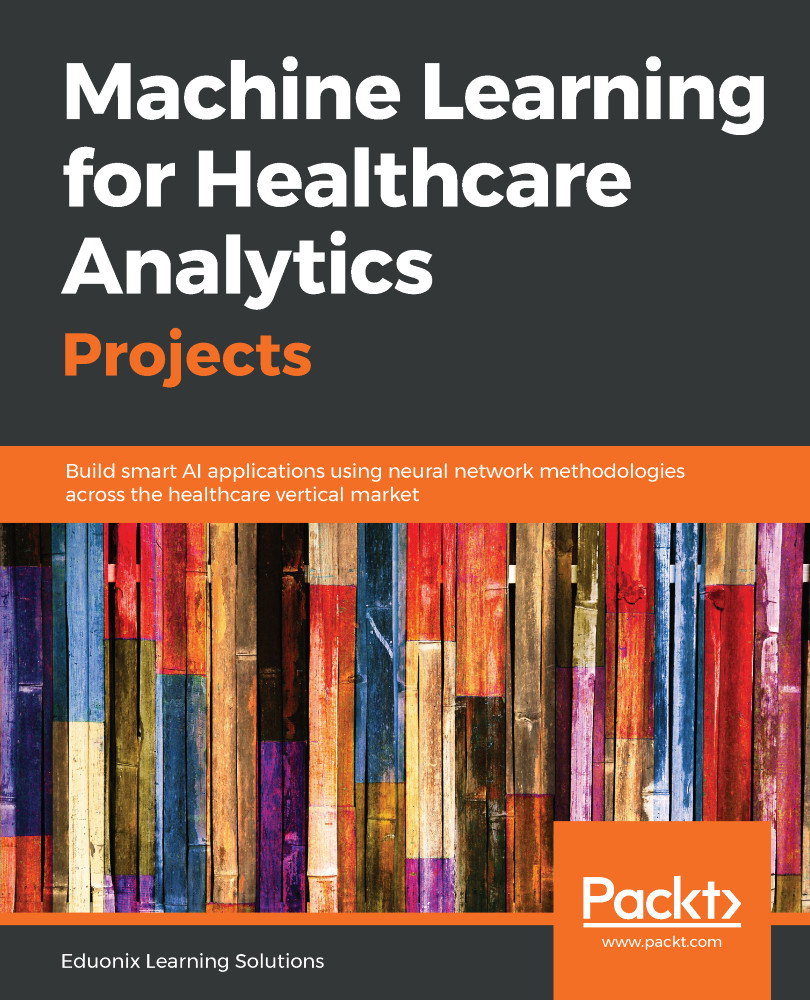
Machine Learning (ML) has changed the way organizations and individuals use data to improve the efficiency of a system. ML algorithms allow strategists to deal with a variety of structured, unstructured, and semi-structured data. Machine Learning for Healthcare Analytics Projects is packed with new approaches and methodologies for creating powerful solutions for healthcare analytics. This book will teach you how to implement key machine learning algorithms and walk you through their use cases by employing a range of libraries from the Python ecosystem. You will build five end-to-end projects to evaluate the efficiency of Artificial Intelligence (AI) applications for carrying out simple-to-complex healthcare analytics tasks. With each project, you will gain new insights, which will then help you handle healthcare data efficiently. As you make your way through the book, you will use ML to detect cancer in a set of patients using support vector machines (SVMs) and k-Nearest neighbors (KNN) models. In the final chapters, you will create a deep neural network in Keras to predict the onset of diabetes in a huge dataset of patients. You will also learn how to predict heart diseases using neural networks. By the end of this book, you will have learned how to address long-standing challenges, provide specialized solutions for how to deal with them, and carry out a range of cognitive tasks in the healthcare domain.

Table of Contents (7 chapters)
close
close

DNA Classification

In this chapter, we will explore the world of bioinformatics. We will use Markov models, k-nearest neighbors algorithms, support vector machines, and other common classifiers, to classify short E. coli DNA sequences. For this project, will use a dataset from the UCI machine learning repository that has 106 DNA sequences, with 57 sequential nucleotides each. You will learn how to import data from the UCI repository, convert text input to numerical data, build and train classification algorithms, and compare and contrast classification machine learning algorithms.

We will cover the following topics:

  • Classifying DNA sequences
  • Data preprocessing
CONTINUE READING
83
Tech Concepts
36
Programming languages
73
Tech Tools
Icon Unlimited access to the largest independent learning library in tech of over 8,000 expert-authored tech books and videos.
Icon Innovative learning tools, including AI book assistants, code context explainers, and text-to-speech.
Icon 50+ new titles added per month and exclusive early access to books as they are being written.
Machine Learning for Healthcare Analytics Projects
notes
bookmark Notes and Bookmarks search Search in title playlist Add to playlist download Download options font-size Font size

Change the font size

margin-width Margin width

Change margin width

day-mode Day/Sepia/Night Modes

Change background colour

Close icon Search
Country selected

Close icon Your notes and bookmarks

Confirmation

Modal Close icon
claim successful

Buy this book with your credits?

Modal Close icon
Are you sure you want to buy this book with one of your credits?
Close
YES, BUY

Submit Your Feedback

Modal Close icon
Modal Close icon
Modal Close icon